







Question: Answer the followwing questions b-e based on data collected in the table please. Table 2: Mass and spring data Mass (g) Amplitude (cm) 10 cycles
Answer the followwing questions b-e based on data collected in the table please.
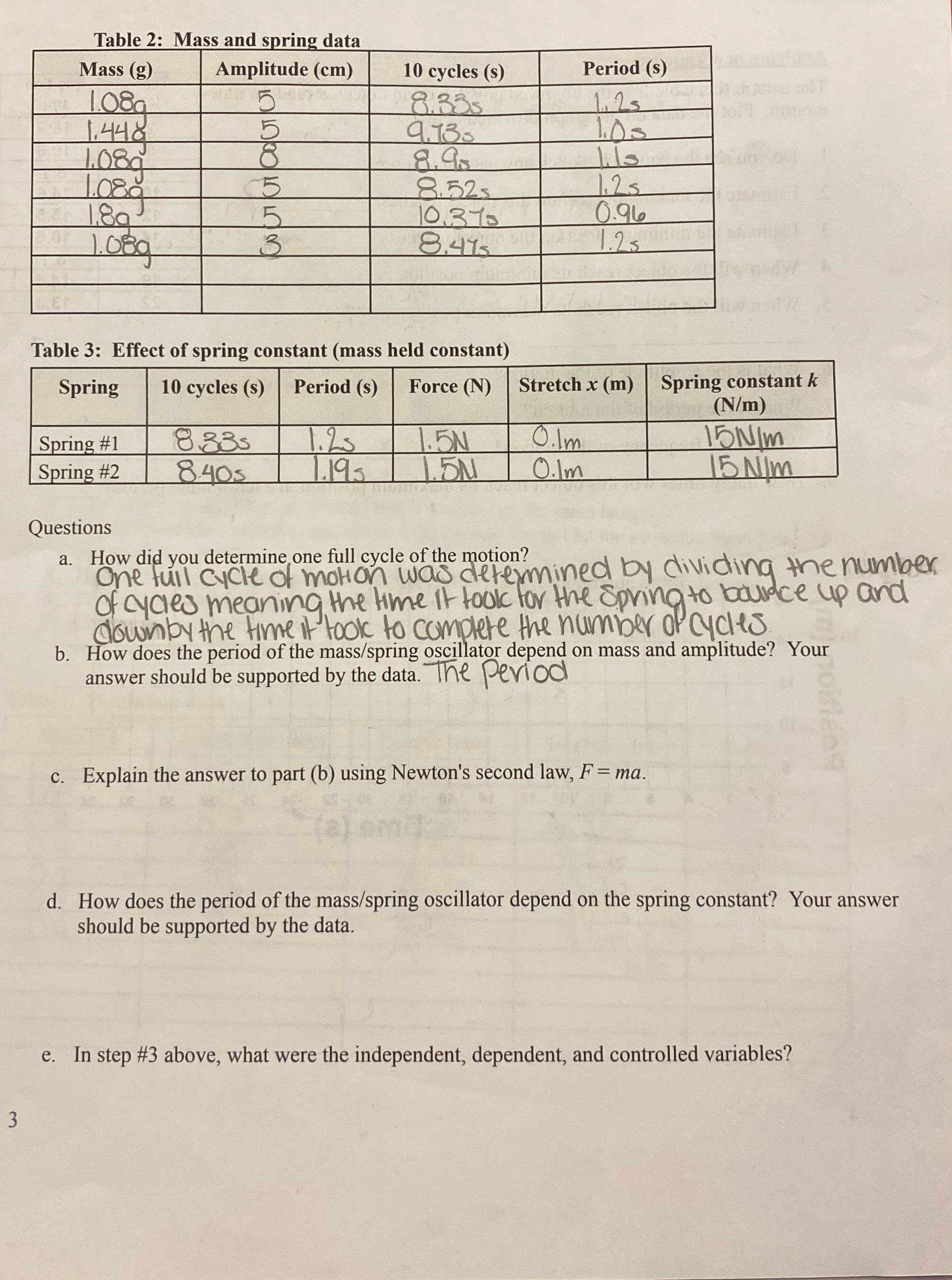
Table 2: Mass and spring data Mass (g) Amplitude (cm) 10 cycles (s) Period (s) 1.08a 8.83s 1. 2s 1. 448 9.13s 1.0s 108a 8.9 LOSa 8.52s 1.25 6.96 1.089 3 8.475 1.25 Table 3: Effect of spring constant (mass held constant) Spring 10 cycles (s) Period (s) Force (N) Stretch x (m) Spring constant k N/m) Spring #1 8.83s 1.25 1.5N 0. Im 15N/m Spring #2 8.40s 1.19s L5M 0.Im 15 NIm Questions a. How did you determine one full cycle of the motion? One full cycle of motion was determined by dividing the number of cycles meaning the time It took for the Spring to bounce up and downby the time it took to complete the number of cycles. b. How does the period of the mass/spring oscillator depend on mass and amplitude? Your answer should be supported by the data. The Period c. Explain the answer to part (b) using Newton's second law, F = ma. d. How does the period of the mass/spring oscillator depend on the spring constant? Your answer should be supported by the data. e. In step #3 above, what were the independent, dependent, and controlled variables? 3
Step by Step Solution
There are 3 Steps involved in it

Get step-by-step solutions from verified subject matter experts
 Study Help