





Question: Answer the highlighted questions for each illustration. Provide computations to substantiate your answer. 8. Pricing decisions and other profit factor Pricing decisions refer to the

Answer the highlighted questions for each illustration. Provide computations to substantiate your answer.
Answer the highlighted questions for each
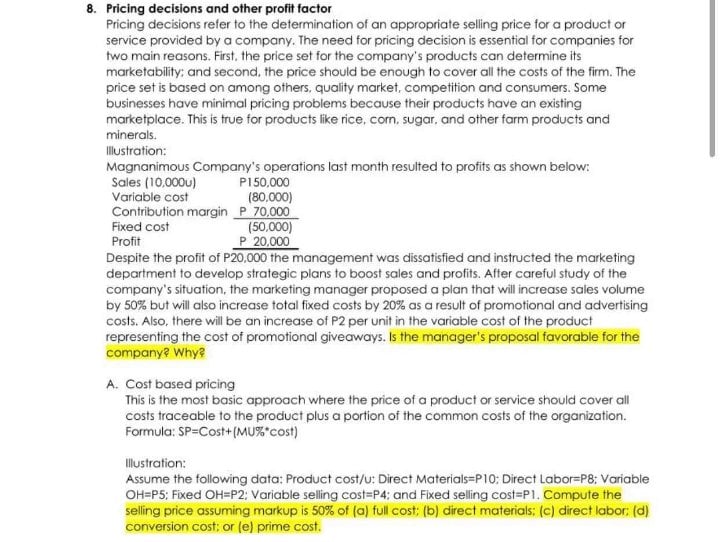
8. Pricing decisions and other profit factor Pricing decisions refer to the determination of an appropriate selling price for a product or service provided by a company. The need for pricing decision is essential for companies for two main reasons. First, the price set for the company's products can determine its marketability: and second, the price should be enough to cover all the costs of the firm. The price set is based on among others, quality market, competition and consumers. Some businesses have minimal pricing problems because their products have an existing marketplace. This is true for products like rice, com, sugar, and other farm products and minerals. Illustration: Magnanimous Company's operations last month resulted to profits as shown below: Sales (10,000u) P150,000 Variable cost (80,000) Contribution margin P 70,000 Fixed cost (50,000) Profit P 20,000 Despite the profit of P20,000 the management was dissatisfied and instructed the marketing department to develop strategic plans to boost sales and profits. After careful study of the company's situation, the marketing manager proposed a plan that will increase sales volume by 50% but will also increase total fixed costs by 20% as a result of promotional and advertising costs. Also, there will be an increase of P2 per unit in the variable cost of the product representing the cost of promotional giveaways. Is the manager's proposal favorable for the company? Why? A. Cost based pricing This is the most basic approach where the price of a product or service should cover all costs traceable to the product plus a portion of the common costs of the organization. Formula: SP=Cost+(MU%*cost) Illustration: Assume the following data: Product cost/u: Direct Materials=P10: Direct Labor=P8: Variable OH=P5; Fixed OH=P2; Variable selling cost=P4: and Fixed selling cost=P1. Compute the selling price assuming markup is 50% of (a) full cost; (b) direct materials; (c) direct labor, (d) conversion cost; or (e] prime cost

Step by Step Solution

There are 3 Steps involved in it

1 Expert Approved Answer
Step: 1 Unlock blur-text-image

Question Has Been Solved by an Expert!

Get step-by-step solutions from verified subject matter experts

Step: 2 Unlock
Step: 3 Unlock

Students Have Also Explored These Related Accounting Questions!