







Question: answer the marked spot in the second image correctly please A firm's short-run revenue is given by R=10ee2 where e is the level of effort
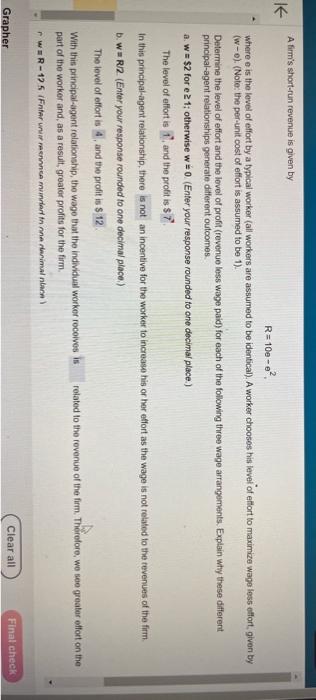
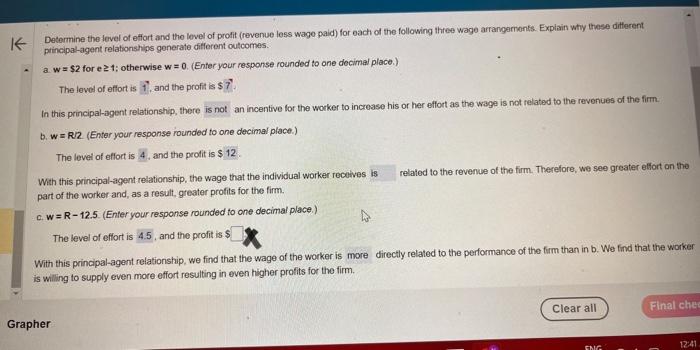
A firm's short-run revenue is given by R=10ee2 where e is the level of effort by a bypical worker (all workers are assumed to be identical). A worker chooses his level of elfort to maximize wage less elfort given by (we) ). (Note: the per-unit cost of effort is assumed to be 1). Determine the level of effort and the lovel of profit (revenue less wage paid) for each of the following three wage arrangerrents. Explain why these different principal-agent relationships generate different outoomes. a. w=$2 for e1 1; otherwise w=0. (Enter your response rounded to one decimal place.) The level of effort is 1, and the probit is 37 . In this principat-agent relationship, there an incentive for the worker to increase his or her effort as the wage is not related to the revenues of the firm. b. w=R/2. (Enter your response rounded to one decimal place,) The level of effort is 4 , and the profit is $12. With this principal-agent relationship, the wage that the individual worker rocoives related to the rovenue of the firm. Therelore, we see greatar elfort on the part of the worker and, as a result, greater profits for the firm. f. w a R125 ifinter unuer reeninnce maprlart tn nne rlarimal ntach ) Determine the level of effort and the lovel of profit (revenue less wage paid) for each of the following three wage arrangarrents. Expiain why these ditterent principal-agent relahionships generate different outcomes. a. w=$2 for e1; otherwise w=0. (Enter your response rounded to one decimal place.) The level of effort is 1, and the profit is $7. In this principal-agent relationship, there an incentive for the worker to increase his or her effort as the wage is not related to the revenues of the firm. b. w=R/2 (Enter your response rounded to ane decimal place.) The level of effort is 4 , and the protit is $ With this principal-agent relationship, the wage that the individual worker receives related to the reverue of the firm. Therefore, we see greater effort on thi part of the worker and, as a result, greater profits for the firm. c. w=R12.5. (Enter your response rounded to one decimal place.) The level of effort is and the profit is S With this principal-agent relationship, we find that the wage of the worker is more directly related to the performance of the firm than in b. We find that the work is willing to supply even more effort resulting in even higher profits for the firm. A firm's short-run revenue is given by R=10ee2 where e is the level of effort by a bypical worker (all workers are assumed to be identical). A worker chooses his level of elfort to maximize wage less elfort given by (we) ). (Note: the per-unit cost of effort is assumed to be 1). Determine the level of effort and the lovel of profit (revenue less wage paid) for each of the following three wage arrangerrents. Explain why these different principal-agent relationships generate different outoomes. a. w=$2 for e1 1; otherwise w=0. (Enter your response rounded to one decimal place.) The level of effort is 1, and the probit is 37 . In this principat-agent relationship, there an incentive for the worker to increase his or her effort as the wage is not related to the revenues of the firm. b. w=R/2. (Enter your response rounded to one decimal place,) The level of effort is 4 , and the profit is $12. With this principal-agent relationship, the wage that the individual worker rocoives related to the rovenue of the firm. Therelore, we see greatar elfort on the part of the worker and, as a result, greater profits for the firm. f. w a R125 ifinter unuer reeninnce maprlart tn nne rlarimal ntach ) Determine the level of effort and the lovel of profit (revenue less wage paid) for each of the following three wage arrangarrents. Expiain why these ditterent principal-agent relahionships generate different outcomes. a. w=$2 for e1; otherwise w=0. (Enter your response rounded to one decimal place.) The level of effort is 1, and the profit is $7. In this principal-agent relationship, there an incentive for the worker to increase his or her effort as the wage is not related to the revenues of the firm. b. w=R/2 (Enter your response rounded to ane decimal place.) The level of effort is 4 , and the protit is $ With this principal-agent relationship, the wage that the individual worker receives related to the reverue of the firm. Therefore, we see greater effort on thi part of the worker and, as a result, greater profits for the firm. c. w=R12.5. (Enter your response rounded to one decimal place.) The level of effort is and the profit is S With this principal-agent relationship, we find that the wage of the worker is more directly related to the performance of the firm than in b. We find that the work is willing to supply even more effort resulting in even higher profits for the firm
Step by Step Solution
There are 3 Steps involved in it

Get step-by-step solutions from verified subject matter experts
 Study Help