







Question: Answer the multiple choice. Please. Question 1 True or false: If an array is already sorted, Linear Search / Sequential Search is more efficient than
Answer the multiple choice. Please.
Question 1
True or false: If an array is already sorted, Linear Search / Sequential Search is more efficient than Binary Search.
Question 1 options:
| True | |
| False |
Question 2
True or False: elements in an array need to be sorted for Linear Search to work.
Question 2 options:
| True | |
| False |
Question 3
Which of the following are false?
Question 3 options:
| Binary search works with a randomly ordered array. | |
| Binary search works with any data type which can be ordered from least to greatest. (or greatest to least) | |
| Binary search eliminates half the remain elements each move. | |
| Binary search is faster than linear search most of the time |
Question 4
We are searching for an int key in a sorted int array that has n elements. Under what circumstances will Linear Search / Sequential Search be more efficient than Binary Search?
Question 4 options:
| key is the last element in the array | |
| key is in the middle of the array | |
| n is very large | |
| key is the first element in the array |
Question 5
What is the largest number of comparisons needed to perform a binary search on an array with 42 elements?
Question 5 options:
| 5 | |
| 6 | |
| 42 | |
| 4 | |
| 2 |
Question 6
What is the largest number of comparisons needed to perform a linear search on an array with 42 elements?
Question 6 options:
| 1 | |
| 42 | |
| 5 | |
| 4 | |
| 6 |
Question 7
True or false: Bubble sort is a recursive sort.
Question 7 options:
| True | |
| False |
Question 8
True or false: merge sort is a recursive sort.
Question 8 options:
| True | |
| False |
Question 9
What sort is pictured here?
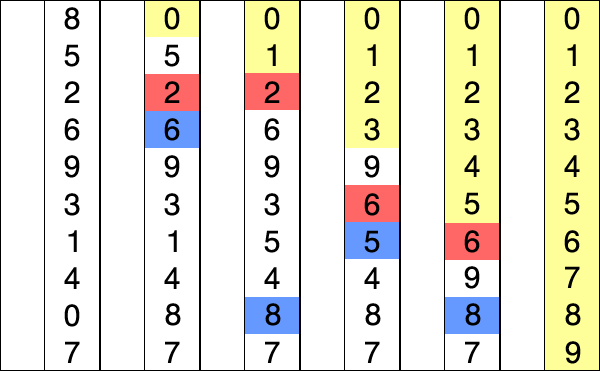
Question 9 options:
| bubble sort | |
| selection sort | |
| insertion sort | |
| merge sort | |
| none of the above |
Question 10
What sort is pictured here?

Question 10 options:
| bubble sort | |
| selection sort | |
| insertion sort | |
| merge sort | |
| none of the above |
Question 11
What sort is pictured here?

Question 11 options:
| bubble sort | |
| selection sort | |
| insertion sort | |
| merge sort | |
| none of the above |
Question 12
True or false: the base case in recursive functions is optional.
Question 12 options:
| True | |
| False |
Save
Question 13
True or false: there can only be one base case in any recursive function.
Question 13 options:
| True | |
| False |
Question 14
Consider the following recursive function:
public int mystery2(int n) { if(n == 0) { return mystery2(10); } else { return 2 * mystery(n - 1); } }How many times will the function mystery be called if we call mystery(5) (be sure to include the first call mystery(5))
Question 14 options:
| 4 | |
| 5 | |
| 6 | |
| 7 | |
| The recursion will go on forever because there is no base case |
Question 15
Consider the following recursive function:
public int mystery2(int n) { if(n == 0) { return 2; } else { return 2 * mystery(n - 1); } }How many times will the function mystery be called if we call mystery(5) (be sure to include the first call mystery(5))
Question 15 options:
| 4 | |
| 5 | |
| 6 | |
| 7 | |
| The recursion will go on forever because there is no base case. |
OP WOON
Step by Step Solution
There are 3 Steps involved in it

Get step-by-step solutions from verified subject matter experts
 Study Help