


Question: answer the question at the bottom Bae NAME Fault: is a discontinuity in a rock, in which there has been observable displacement. There are two

answer the question at the bottom
answer the question at the bottom Bae NAME Fault:
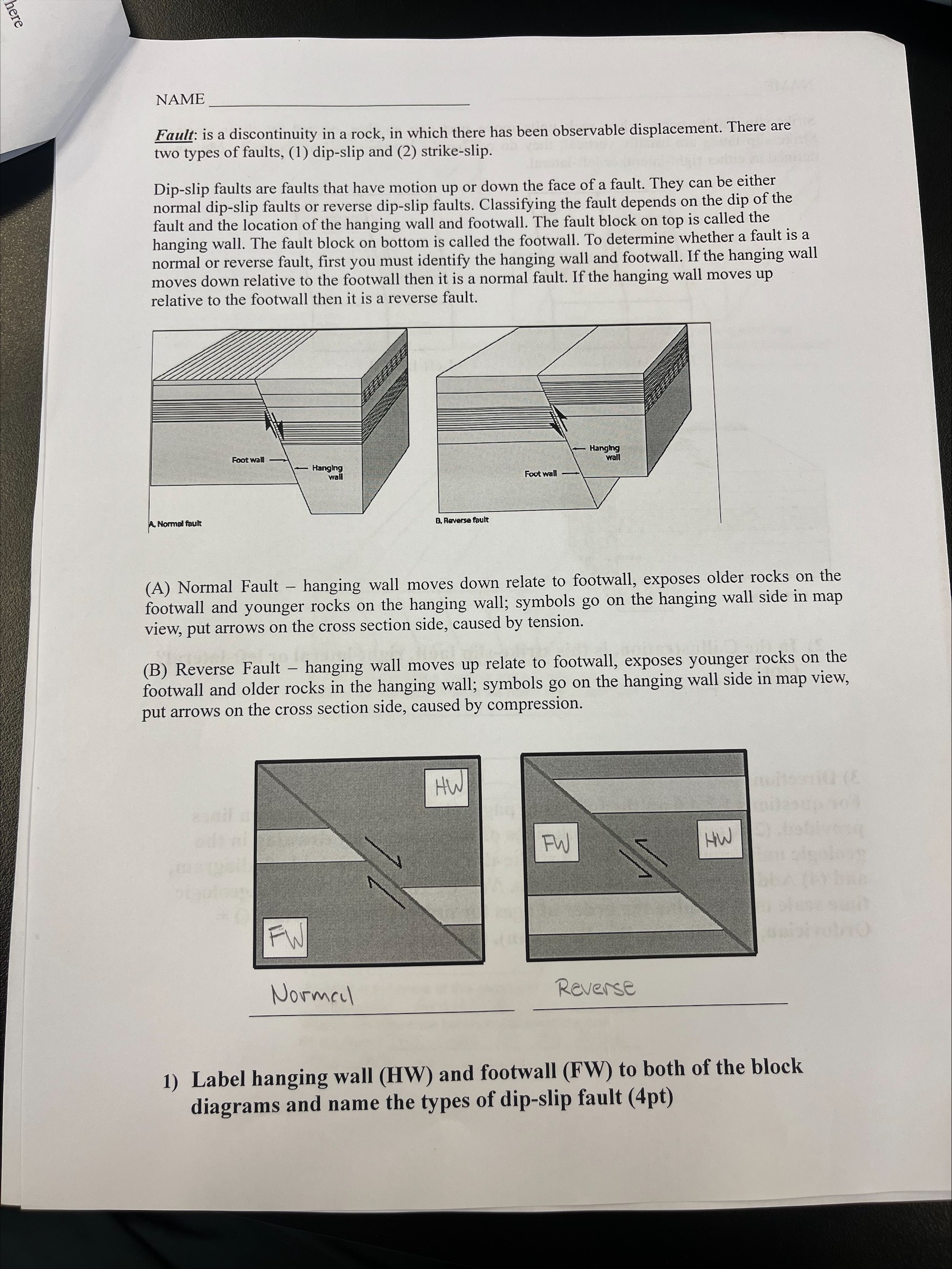
Bae NAME Fault: is a discontinuity in a rock, in which there has been observable displacement. There are two types of faults, (1) dip-slip and (2) strike-slip. Dip-slip faults are faults that have motion up or down the face of a fault. They can be either normal dip-slip faults or reverse dip-slip faults. Classifying the fault depends on the dip of the fault and the location of the hanging wall and footwall. The fault block on top is called the hanging wall. The fault block on bottom is called the footwall. To determine whether a fault is a normal or reverse fault, first you must identify the hanging wall and footwall. If the hanging wall moves down relative to the footwall then it is a normal fault. If the hanging wall moves up relative to the footwall then it is a reverse fault. (A) Normal Fault hanging wall moves down relate to footwall, exposes older rocks on the footwall and younger rocks on the hanging wall; symbols go on the hanging wall side in map view, put arrows on the cross section side, caused by tension. hanging wall moves up relate to footwall, exposes younger rocks on the (B) Reverse Fault e hanging wall; symbols go on the hanging wall side in map view, footwall and older rocks in th put arrows on the cross section side, caused by compression. Normer\\ Reverse 1) Label hanging wall (HW) and footwall (FW) to both of the block diagrams and name the types of dip-slip fault (4pt)

Step by Step Solution

There are 3 Steps involved in it

1 Expert Approved Answer
Step: 1 Unlock blur-text-image

Question Has Been Solved by an Expert!

Get step-by-step solutions from verified subject matter experts

Step: 2 Unlock
Step: 3 Unlock

Students Have Also Explored These Related Accounting Questions!