







Question: Answer the question based on the SCOTTS MIRACLE GRO CASE STUDY. Pleae share the excel formulas COMPANY SUPPLIED DATA Scotts total company sales and profit
Answer the question based on the SCOTTS MIRACLE GRO CASE STUDY. Pleae share the excel formulas 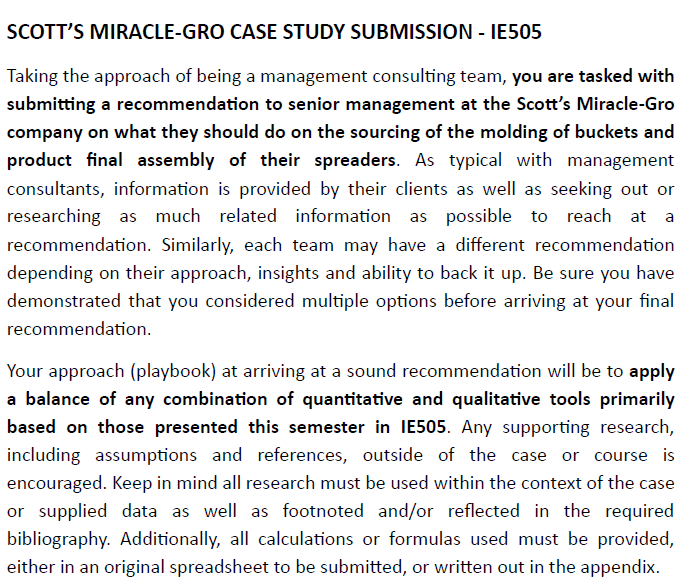
COMPANY SUPPLIED DATA
Scotts total company sales and profit ~$3 billion sales ~$1 billion gross profit 3 million spreaders per year Scotts customer = Home Depot, Wal Mart, Ace, etc. Cost to Scotts customers: ~$20 each Gross margin: ~25%, ~$5/spreader
~$60 million revenue/year ~$15 million profit/year
During mid selling season, assume 30,000 spreaders per day demanded (4x average daily demand) Impact of loss in sales 1% of sales loss = $150,000/year 5% sales loss = $750,000/year 5% price drop (to Scotts) = $3 million/year Note, any present value analysis you may elect to do should be at a 15% discount rate over a 10 year period.
What do Scotts customers, current or future, value. Value drivers for current customers Sell for high price Obtain for low price Ability to match supply (on shelf) and demand Consistently meet/exceed consumer expectations Responsive customer service Value from complementary offerings Value from competitive offerings Protect confidential information Social/environmental performance
The main cost drivers of the Temecula plant (see Exhibit 4) were raw materials, labor, electricity and overhead(including building lease). Scotts used a discountrate of 15 per cent. Scotts spent capitalto make the improvements in Temecula that it wouldnot need to spend (directly) if it used a contractmanufacturer. Thishad historically run about $500,000 per year. Given that contractmanufacturers had lowerlabor costs and less incentiveto invest in capital improvements, it was estimatedthat they would only spend about $300,000 per year in capital
Outsourcing to China Scotts had considerable experience sourcing components for its spreaders and had frequently considered the possibility of outsourcing the complete spreader manufacture and assembly to China. In fact, Scotts currently sourced the most complex components of the spreaders related to the rotor assembly from China. The molding of spreader buckets, the only non-assembly process occurring at Temecula, was a fairly simple process for companies with experience in injection molding, with the exception of the in- mold labeling processes. Since the only product-specific component of the plastic injection molding process was the mold, the common practice when outsourcing was for the customer to own the molds and the supplier to own the injection moldingmachines and plant. Thus, customers might move the mold from one supplier to another, but only if the suppliers used a compatible injection molding machine. As the injection moldingtechnology necessary for the hopperswas fairly mature,all major suppliers tended to use similar technology.
The one exception to this rule involved the use of the in-mold labeling technology. If Scotts were to outsource spreader manufacture and assembly, it might need to either provide the contract manufacturer with the equipmentand know-how to perform in-moldlabeling or removethis feature from its spreaders. Moreover, if Scotts were to provide the necessary in-mold training and equipment, it was unlikely that achosen contract manufacturer would be able to use the molds currently in use at Temecula. New molds used for injection molding averaged about $40,000 and lasted approximately five years. There were currently 10 distinct molds used in Temecula in the injection molding for the in-mold technology; it would be safelyassumed that the average remaininglife was half of the total model life.
The relevant labor cost in China was currently at $0.91 per hour and was expected to increase by 40 per cent over the next 10 years, according to the Chinese Labor Ministry.4 This estimate might be low, as wages increased almost 10 per cent in 2005 alone, up as high as 40 per cent in some companies.5 The Chinese workers had somewhat lower productivity than U.S. workers, in general. Electricity in China was subsidized and was currently at 0.5 yuan per kilo-watt hour (approximately $0.065 per kilo-watt hour). Increases in the cost of coal, the main fuel used by China for power generation, suggested that electricity prices in China would rise by 20 per cent over the next decade. This estimate, too, might be low given the increasing pressure on the Chinese to improve their environmental record and recent trends in fuel costs. The lease for space to do this work in China was assumed to be about $200,000. These costs could be compared to the Temecula cost drivers given in Exhibit 4. If Scotts entire annual production volume of approximately three million spreaders was transferred to China, the annual freight costs were expected to be $8 million in 2005 and expected to rise by three per cent annually. These costs might be partially offset by some savings off the approximately $1 million in shipping of components currently sourced from China.
Sourcing from Chinaalso meant that the lead time of Scotts supplychain would increase.Scotts estimated that it would have to hold an additional eight weeks of safety stock at a current annual cost of $460,000 tooffset this lead time differential.6 Any contract manufacturer would have management and oversight costsand earn a margin.The overheadcosts (which includedall salaried labor, maintenance, facility, etc.) were about 50 per cent of direct labor costs. The contract manufacturer would take a profit margin above costs; eightper cent was a reasonable estimate for this. And, of course, there would be transition costs search,contracting, Temecula shutdown, etc. On-going, Scotts would have some costs (management time, travel) for managing the suppliers. Because spreaders were considered an agricultural product, Scotts would not have to pay duties and taxes when importing them. There was some (low) risk that this might change in the future. Finally, Scotts management anticipated that outsourcing would involve some additional general and administrative costs within its own organization. Scotts usually set up structured regular communication plans with its suppliers. Scotts had regular scheduled meetings and sent production plans (mostly in the form of purchase orders,POs) at regularintervals and avoidedmaking changes to the POs, except in some extreme cases (sudden input/process/demand variation). Scotts also regularly qualified its suppliers and conducted weekly conference calls. These steps were taken to ensure that the supplier met Scotts quality standards and used approved inputs and production processes. Despite these checks, Scotts occasionally faced issues with suppliers. The time required for transportation of spreaders from China to the United States and the batch natureof most supplier operations meant that any problems might not be detected untilafter a batch reached the United Statesand entire batchesmight have to be rejectedor reworked.
Bawcombe feared that in todays meeting the corporate folks would push to outsource from China. Bawcombe was concerned about handing production over to anothercompany and was prepared if needed to argue for another option. The alternative to outsourcing that Bawcombe was considering was the settingup of a Scotts production plant in China, i.e., to offshore spreader production. Setting up a plant in China would cost about $8 million and would take up to a year. Despite the high initial cost, this option offered the possible cost benefits associated with manufacturing in China, while allowing Scotts to continue to maintain directcontrol over its products and process.
One of Bawcombes major concerns with either outsourcing or offshoring from China was uncertainty regarding the Chinese governments policy with respect to the yuan. Historically, the Chinese government had pegged the yuan to the U.S. dollar. This policy allowed only limited float in its price. The policy was controversial and a source of considerable inter-government talks. In 2007, the yuan-U.S. dollar exchange rate was 7.65 yuan/$. The market expectation was that the yuan would appreciate by about 20 per cent in the next five years,7 although there was considerable uncertainty with the estimate. This appreciation would directly affect the cost of any product manufactured in China.If China were to allow the yuan to trade more freely, this appreciation wouldlikely be magnified.
Taking the approach of being a management consulting team, you are tasked with submitting a recommendation to senior management at the Scott's Miracle-Gro company on what they should do on the sourcing of the molding of buckets and product final assembly of their spreaders. As typical with management consultants, information is provided by their clients as well as seeking out or researching as much related information as possible to reach at a recommendation. Similarly, each team may have a different recommendation depending on their approach, insights and ability to back it up. Be sure you have demonstrated that you considered multiple options before arriving at your final recommendation. Your approach (playbook) at arriving at a sound recommendation will be to apply a balance of any combination of quantitative and qualitative tools primarily based on those presented this semester in IE505. Any supporting research, including assumptions and references, outside of the case or course is encouraged. Keep in mind all research must be used within the context of the case or supplied data as well as footnoted and/or reflected in the required bibliography. Additionally, all calculations or formulas used must be provided, either in an original spreadsheet to be submitted, or written out in the appendix
Step by Step Solution
There are 3 Steps involved in it

Get step-by-step solutions from verified subject matter experts
 Study Help