







Question: Answer the question below: 1.) From time to time, Congress has raised the minimum wage. Some people suggested that a government subsidy could help employers
Answer the question below:
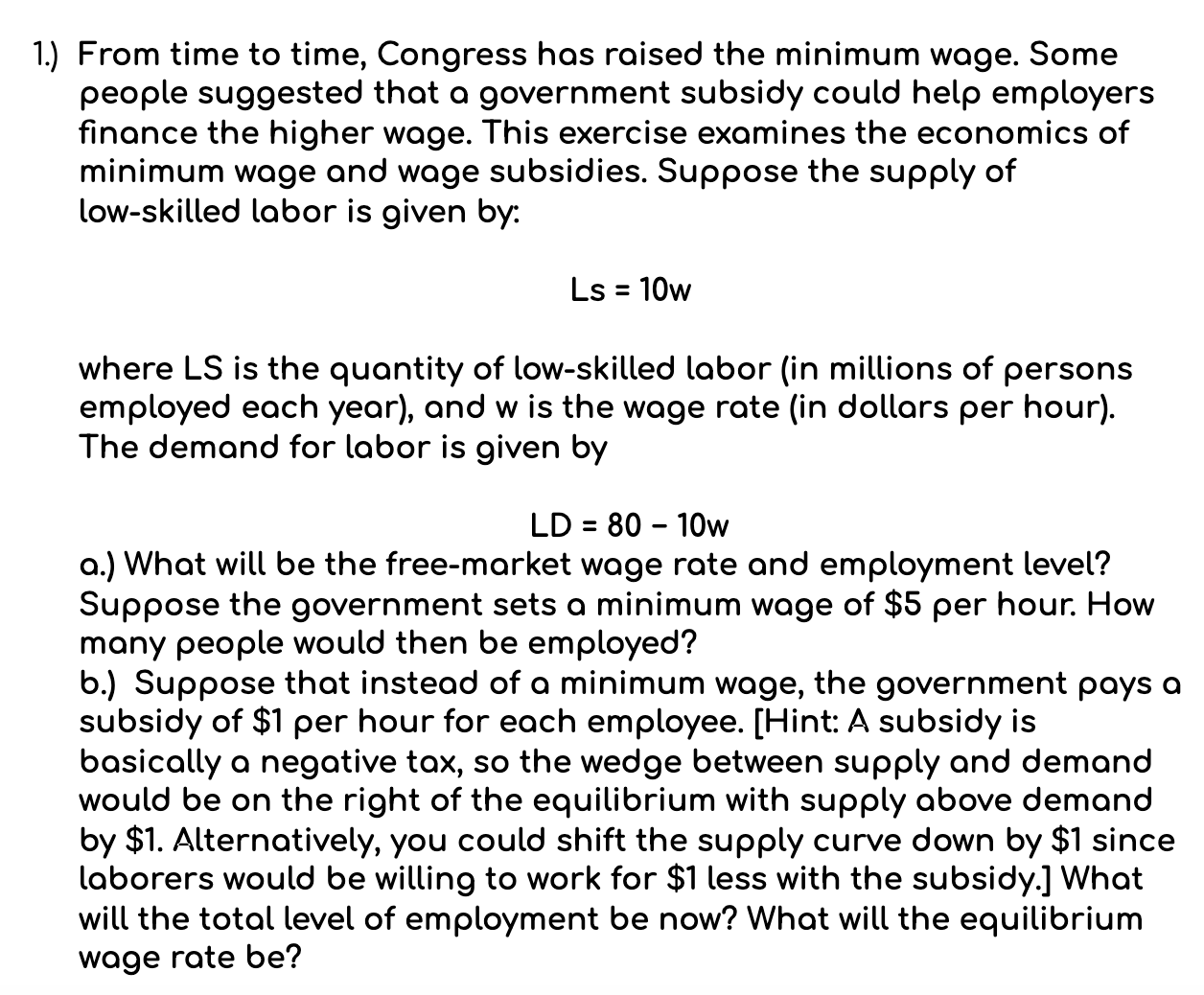
1.) From time to time, Congress has raised the minimum wage. Some people suggested that a government subsidy could help employers finance the higher wage. This exercise examines the economics of minimum wage and wage subsidies. Suppose the supply of low-skilled labor is given by: Ls = 10w where LS is the quantity of low-skilled labor (in millions of persons employed each year), and w is the wage rate (in dollars per hour). The demand for labor is given by LD = 80 - 10w a.) What will be the free-market wage rate and employment level? Suppose the government sets a minimum wage of $5 per hour. How many people would then be employed? b.) Suppose that instead of a minimum wage, the government pays a subsidy of $1 per hour for each employee. [Hint: A subsidy is basically a negative tax, so the wedge between supply and demand would be on the right of the equilibrium with supply above demand by $1. Alternatively, you could shift the supply curve down by $1 since laborers would be willing to work for $1 less with the subsidy.] What will the total level of employment be now? What will the equilibrium wage rate be
Step by Step Solution
There are 3 Steps involved in it

Get step-by-step solutions from verified subject matter experts
 Study Help