







Question: answer the question Case 9.3 Market entry in monopoly Cooper, Garvin and Kagel (1997b) performed an interesting and revealing study of market entry in a
answer the question
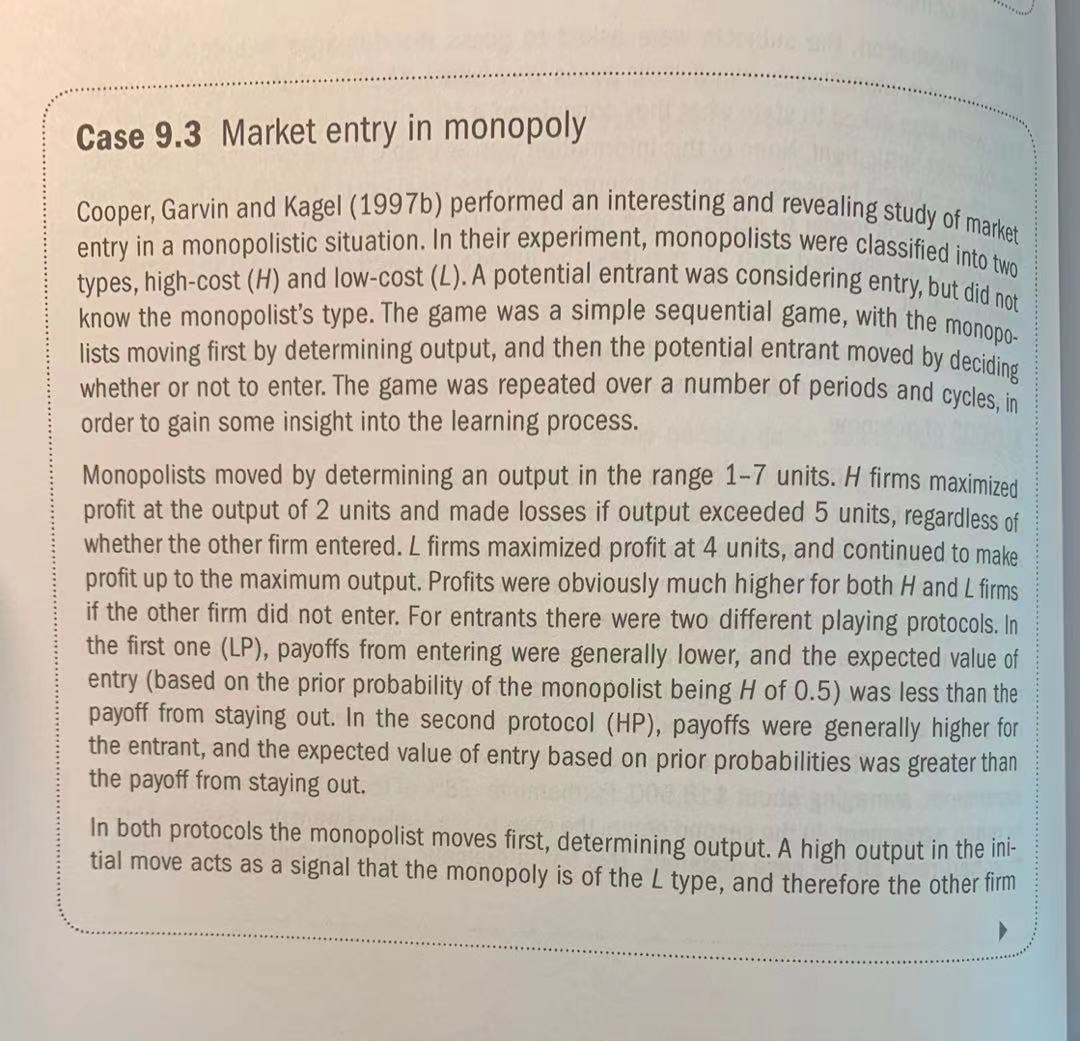
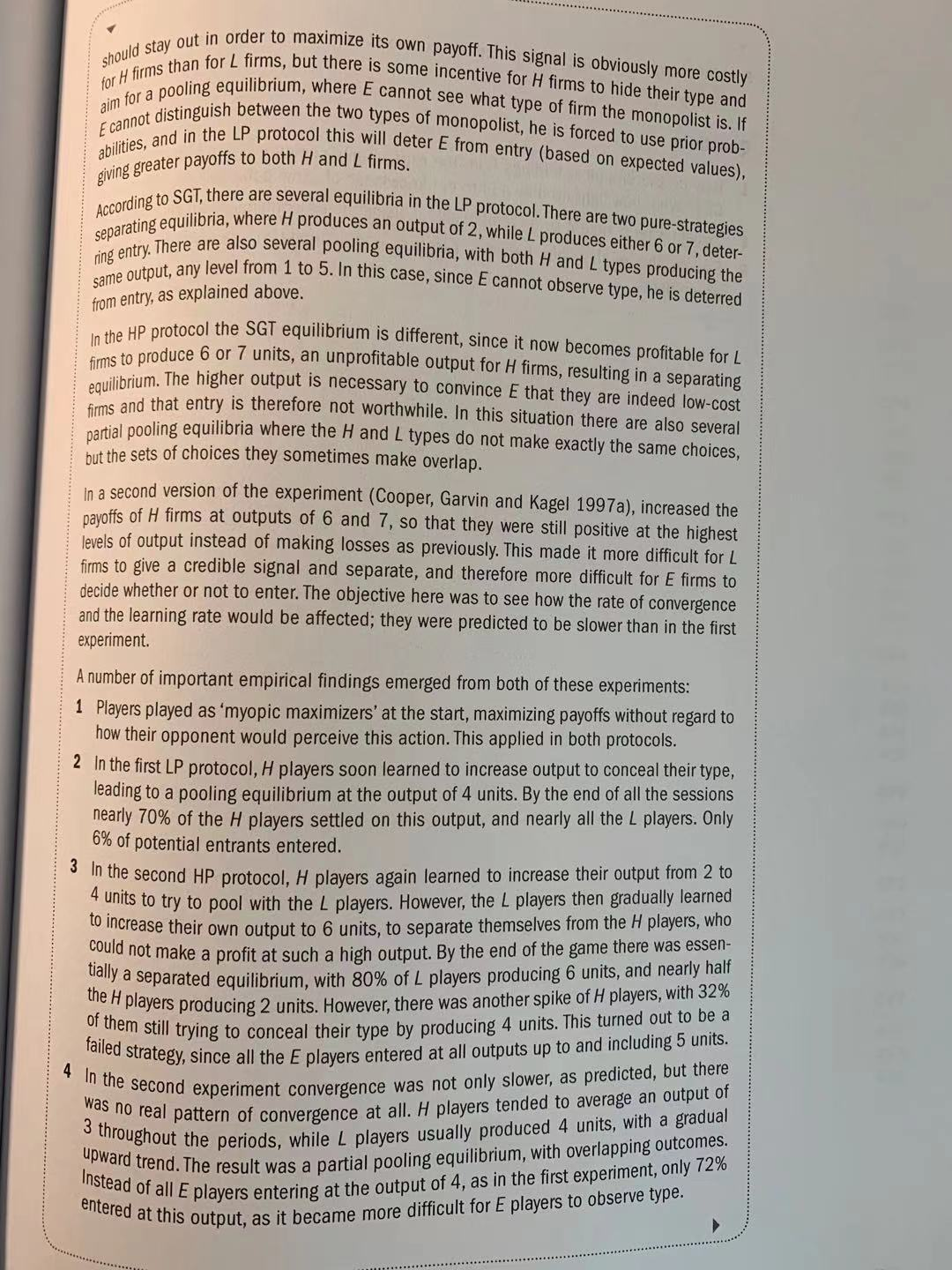
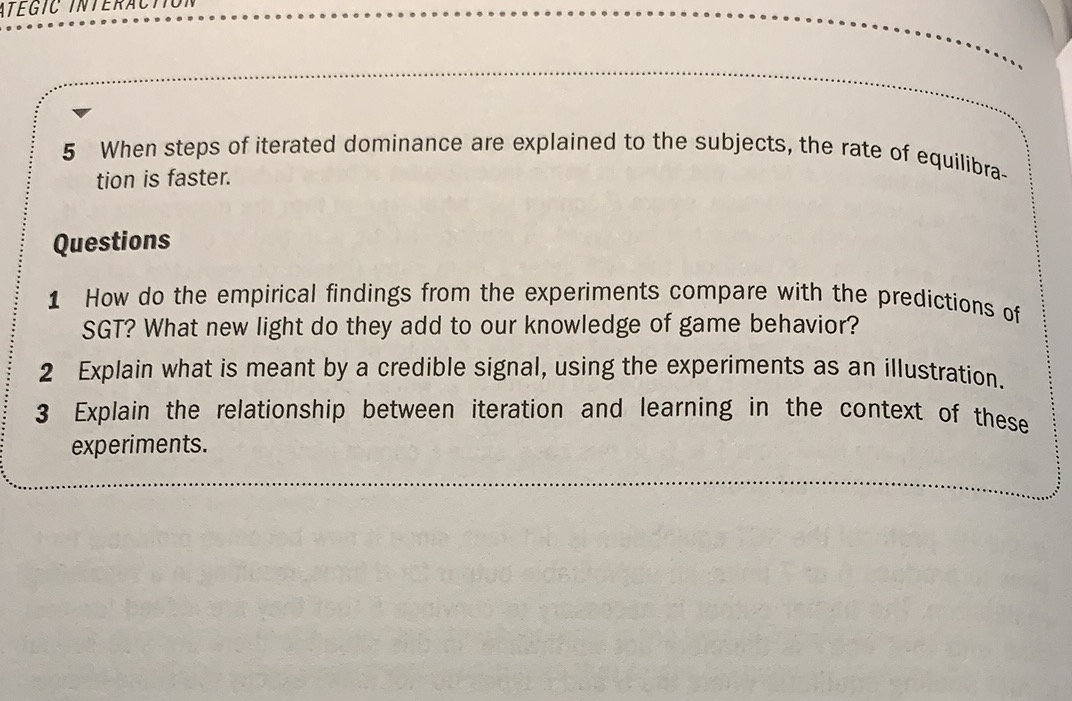
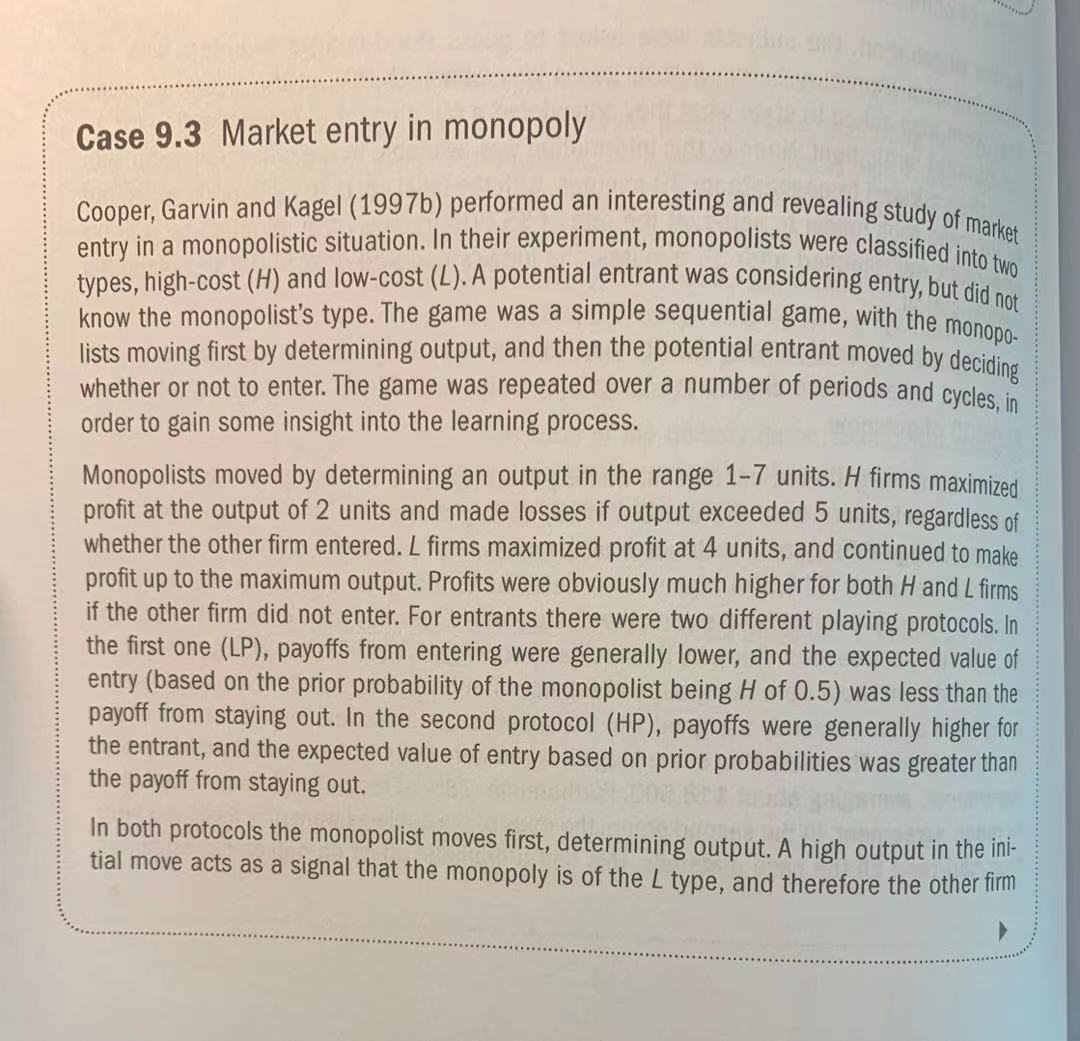
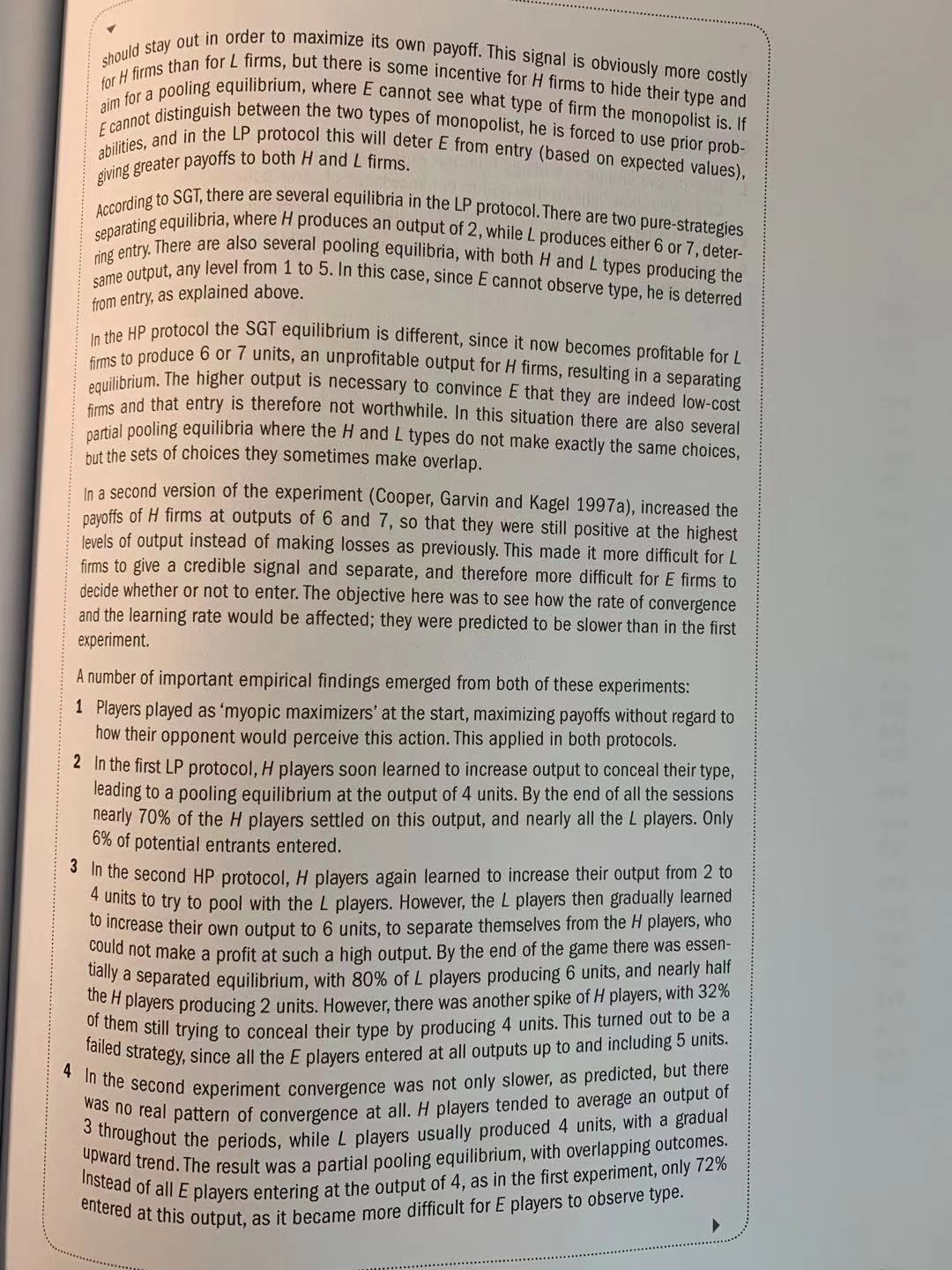
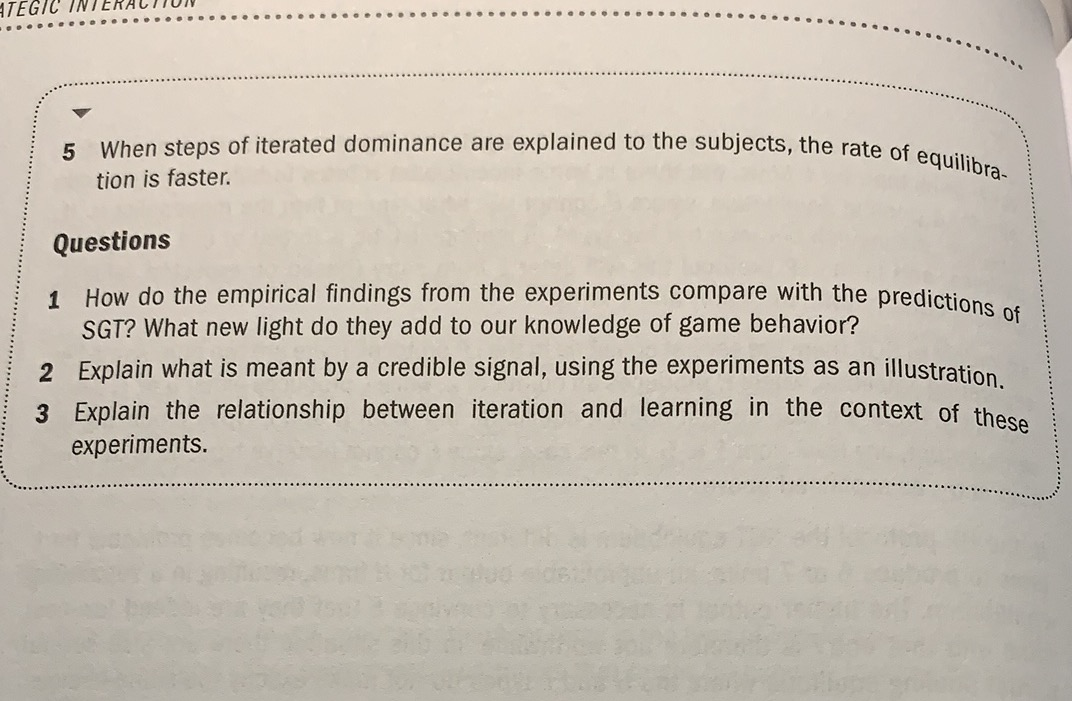
Case 9.3 Market entry in monopoly Cooper, Garvin and Kagel (1997b) performed an interesting and revealing study of market entry in a monopolistic situation. In their experiment, monopolists were classified into two types, high-cost (H) and low-cost (L). A potential entrant was considering entry, but did not know the monopolist's type. The game was a simple sequential game, with the monopo- lists moving first by determining output, and then the potential entrant moved by deciding whether or not to enter. The game was repeated over a number of periods and cycles, in order to gain some insight into the learning process. Monopolists moved by determining an output in the range 1-7 units. H firms maximized profit at the output of 2 units and made losses if output exceeded 5 units, regardless of whether the other firm entered. L firms maximized profit at 4 units, and continued to make profit up to the maximum output. Profits were obviously much higher for both H and L firms if the other firm did not enter. For entrants there were two different playing protocols. In the first one (LP), payoffs from entering were generally lower, and the expected value of entry (based on the prior probability of the monopolist being H of 0.5) was less than the payoff from staying out. In the second protocol (HP), payoffs were generally higher for the entrant, and the expected value of entry based on prior probabilities was greater than the payoff from staying out. In both protocols the monopolist moves first, determining output. A high output in the ini- tial move acts as a signal that the monopoly is of the L type, and therefore the other firmshould stay out in order to maximize its own payoff. This signal is obviously more costly for H firms than for L firms, but there is some incentive for H firms to hide their type and im for a pooling equilibrium, where E cannot see what type of firm the monopolist is. IT cannot distinguish between the two types of monopolist, he is forced to use prior prob- abilities, and in the LP protocol this will deter E from entry (based on expected values), giving greater payoffs to both H and L firms. According to SGT, there are several equilibria in the LP protocol. There are two pure-strategies separating equilibria, where H produces an output of 2, while L produces either 6 or 7, deter- ring entry. There are also several pooling equilibria, with both H and L types producing the same output, any level from 1 to 5. In this case, since E cannot observe type, he is deterred from entry, as explained above. In the HP protocol the SGT equilibrium is different, since it now becomes profitable for L firms to produce 6 or 7 units, an unprofitable output for H firms, resulting in a separating equilibrium. The higher output is necessary to convince E that they are indeed low-cost firms and that entry is therefore not worthwhile. In this situation there are also several partial pooling equilibria where the H and L types do not make exactly the same choices, but the sets of choices they sometimes make overlap. In a second version of the experiment (Cooper, Garvin and Kagel 1997a), increased the payoffs of H firms at outputs of 6 and 7, so that they were still positive at the highest levels of output instead of making losses as previously. This made it more difficult for L firms to give a credible signal and separate, and therefore more difficult for E firms to decide whether or not to enter. The objective here was to see how the rate of convergence and the learning rate would be affected; they were predicted to be slower than in the first experiment. A number of important empirical findings emerged from both of these experiments: 1 Players played as 'myopic maximizers' at the start, maximizing payoffs without regard to how their opponent would perceive this action. This applied in both protocols. 2 In the first LP protocol, H players soon learned to increase output to conceal their type, leading to a pooling equilibrium at the output of 4 units. By the end of all the sessions nearly 70% of the H players settled on this output, and nearly all the L players. Only 6% of potential entrants entered. 3 In the second HP protocol, H players again learned to increase their output from 2 to 4 units to try to pool with the L players. However, the L players then gradually learned to increase their own output to 6 units, to separate themselves from the H players, who could not make a profit at such a high output. By the end of the game there was essen- tially a separated equilibrium, with 80% of L players producing 6 units, and nearly half the H players producing 2 units. However, there was another spike of H players, with 32% of them still trying to conceal their type by producing 4 units. This turned out to be a failed strategy, since all the E players entered at all outputs up to and including 5 units. * In the second experiment convergence was not only slower, as predicted, but there was no real pattern of convergence at all. H players tended to average an output of 3 throughout the periods, while L players usually produced 4 units, with a gradual upward trend. The result was a partial pooling equilibrium, with overlapping outcomes. Instead of all E players entering at the output of 4, as in the first experiment, only 72% entered at this output, as it became more difficult for E players to observe type.ITEGIC INTERACT ............... 5 When steps of iterated dominance are explained to the subjects, the rate of equilibra- tion is faster. Questions 1 How do the empirical findings from the experiments compare with the predictions of SGT? What new light do they add to our knowledge of game behavior? 2 Explain what is meant by a credible signal, using the experiments as an illustration, 3 Explain the relationship between iteration and learning in the context of these experiments
Step by Step Solution
There are 3 Steps involved in it

Get step-by-step solutions from verified subject matter experts
 Study Help