





Question: Answer the question Drift and Selection: Input OD View Fie & Help Print X Close Population Size ( N) = 8 WM = 1 Initial

Answer the question
Answer the question Drift and Selection: Input OD
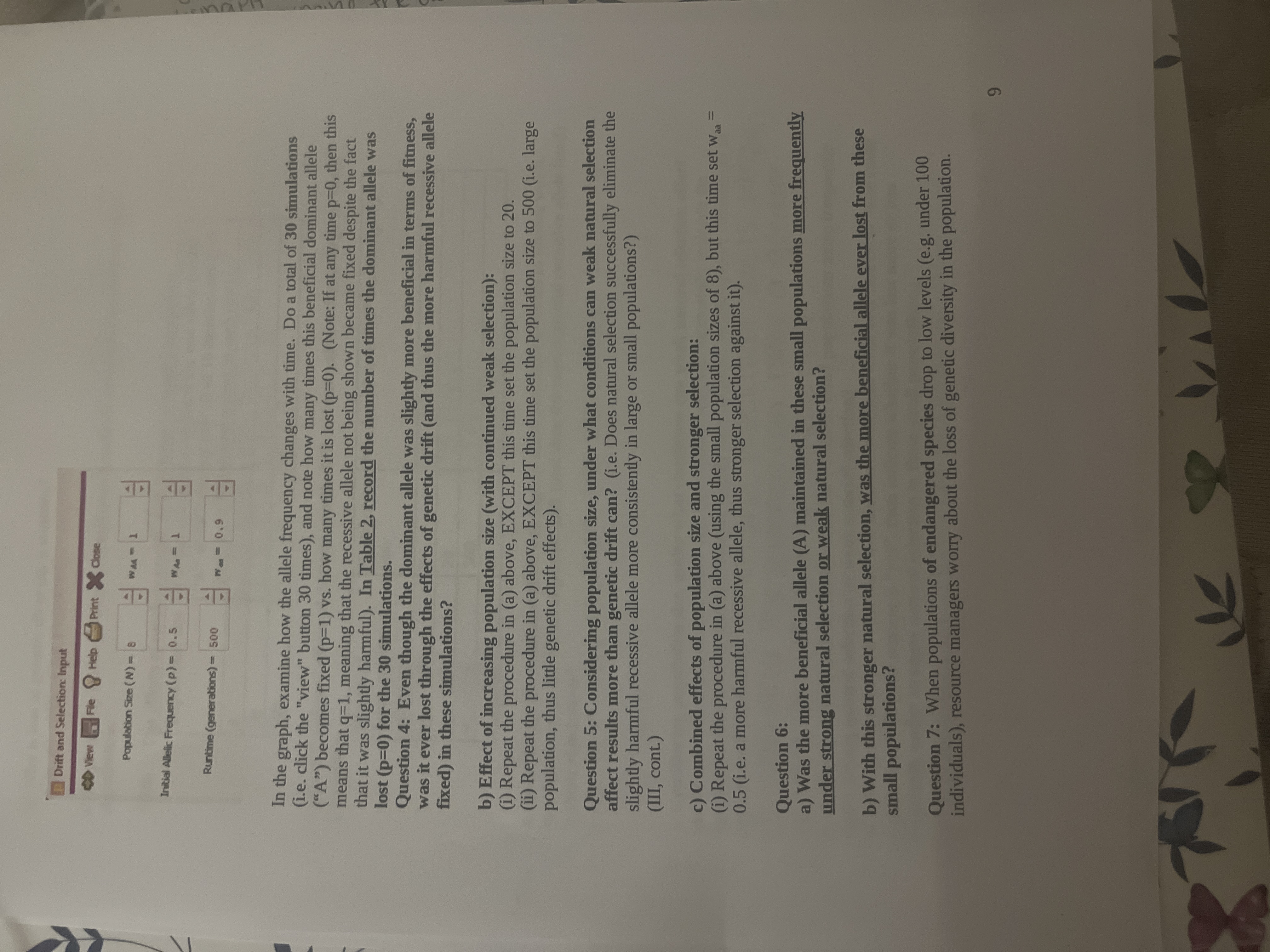
Drift and Selection: Input OD View Fie & Help Print X Close Population Size ( N) = 8 WM = 1 Initial Allelic Frequency (p) = 0.5 Runtime (generations) = 500 Was = 0.9 In the graph, examine how the allele frequency changes with time. Do a total of 30 simulations (i.e. click the "view" button 30 times), and note how many times this beneficial dominant allele ("A") becomes fixed (p=1) vs. how many times it is lost (p=0). (Note: If at any time p=0, then this means that q=1, meaning that the recessive allele not being shown became fixed despite the fact that it was slightly harmful). In Table 2, record the number of times the dominant allele was lost (p=0) for the 30 simulations. Question 4: Even though the dominant allele was slightly more beneficial in terms of fitness, was it ever lost through the effects of genetic drift (and thus the more harmful recessive allele fixed) in these simulations? b) Effect of increasing population size (with continued weak selection): (i) Repeat the procedure in (a) above, EXCEPT this time set the population size to 20. (ii) Repeat the procedure in (a) above, EXCEPT this time set the population size to 500 (i.e. large population, thus little genetic drift effects). Question 5: Considering population size, under what conditions can weak natural selection affect results more than genetic drift can? (i.e. Does natural selection successfully eliminate the slightly harmful recessive allele more consistently in large or small populations?) (III, cont) c) Combined effects of population size and stronger selection: (i) Repeat the procedure in (a) above (using the small population sizes of 8), but this time set Waa = 0.5 (i.e. a more harmful recessive allele, thus stronger selection against it). Question 6: a) Was the more beneficial allele (A) maintained in these small populations more frequently under strong natural selection or weak natural selection? b) With this stronger natural selection, was the more beneficial allele ever lost from these small populations? Question 7: When populations of endangered species drop to low levels (e.g. under 100 individuals), resource managers worry about the loss of genetic diversity in the population. 9

Step by Step Solution

There are 3 Steps involved in it

1 Expert Approved Answer
Step: 1 Unlock blur-text-image

Question Has Been Solved by an Expert!

Get step-by-step solutions from verified subject matter experts

Step: 2 Unlock
Step: 3 Unlock

Students Have Also Explored These Related Business Writing Questions!