







Question: Answer the question given at the end Reflective Learning Journal The Reflective Learning Reflective Journal is a brief account of what went on at each
Answer the question given at the end
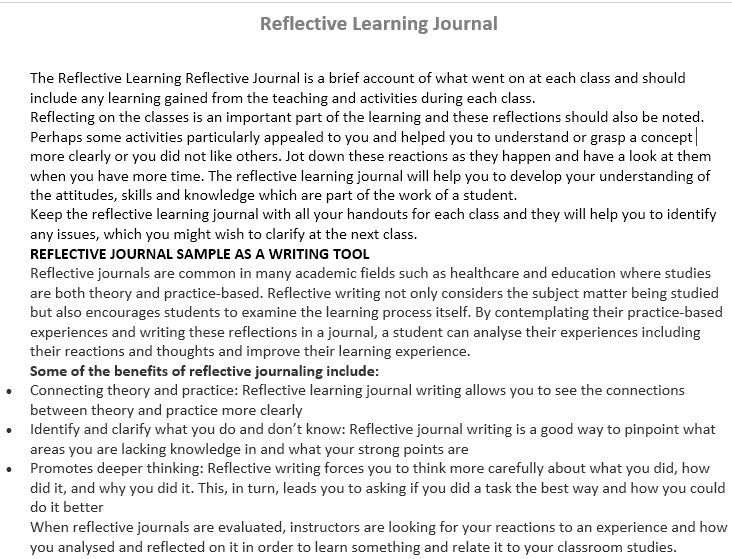
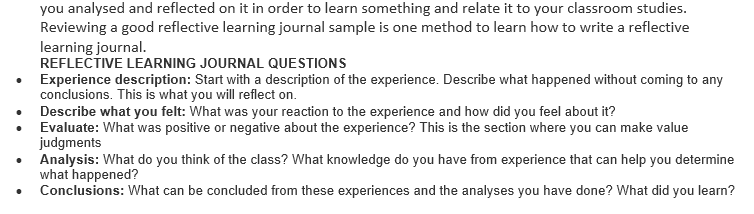
Reflective Learning Journal The Reflective Learning Reflective Journal is a brief account of what went on at each class and should include any learning gained from the teaching and activities during each class. Reflecting on the classes is an important part of the learning and these reflections should also be noted. Perhaps some activities particularly appealed to you and helped you to understand or grasp a concept| more clearly or you did not like others. Jot down these reactions as they happen and have a look at them when you have more time. The reflective learning journal will help you to develop your understanding of the attitudes, skills and knowledge which are part of the work of a student. Keep the reflective learning journal with all your handouts for each class and they will help you to identify any issues, which you might wish to clarify at the next class. REFLECTIVE JOURNAL SAMPLE AS A WRITING TOOL Reflective journals are common in many academic fields such as healthcare and education where studies are both theory and practice-based. Reflective writing not only considers the subject matter being studied but also encourages students to examine the learning process itself. By contemplating their practice-based experiences and writing these reflections in a journal, a student can analyse their experiences including their reactions and thoughts and improve their learning experience. Some of the benefits of reflective journaling include: Connecting theory and practice: Reflective learning journal writing allows you to see the connections between theory and practice more clearly Identify and clarify what you do and don't know: Reflective journal writing is a good way to pinpoint what areas you are lacking knowledge in and what your strong points are Promotes deeper thinking: Reflective writing forces you to think more carefully about what you did, how did it, and why you did it. This, in turn, leads you to asking if you did a task the best way and how you could do it better When reflective journals are evaluated, instructors are looking for your reactions to an experience and how you analysed and reflected on it in order to learn something and relate it to your classroom studies. you analysed and reflected on it in order to learn something and relate it to your classroom studies. Reviewing a good reflective learning journal sample is one method to learn how to write a reflective learning journal. REFLECTIVE LEARNING JOURNAL QUESTIONS Experience description: Start with a description of the experience. Describe what happened without coming to any conclusions. This is what you will reflect on. Describe what you felt: What was your reaction to the experience and how did you feel about it? Evaluate: What was positive or negative about the experience? This is the section where you can make value judgments Analysis: What do you think of the class? What knowledge do you have from experience that can help you determine what happened? Conclusions: What can be concluded from these experiences and the analyses you have done? What did you learn
Step by Step Solution
There are 3 Steps involved in it
1 Expert Approved Answer
Step: 1 Unlock

Question Has Been Solved by an Expert!
Get step-by-step solutions from verified subject matter experts
Step: 2 Unlock
Step: 3 Unlock
 Study Help