







Question: Answer the questions as early as possible and answer 3,5 answers briefly plz. Question 3 (a) Content theories of motivation are concerned with what motivates
Answer the questions as early as possible and answer 3,5 answers briefly plz.
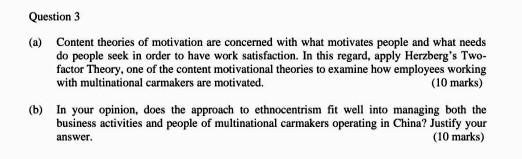
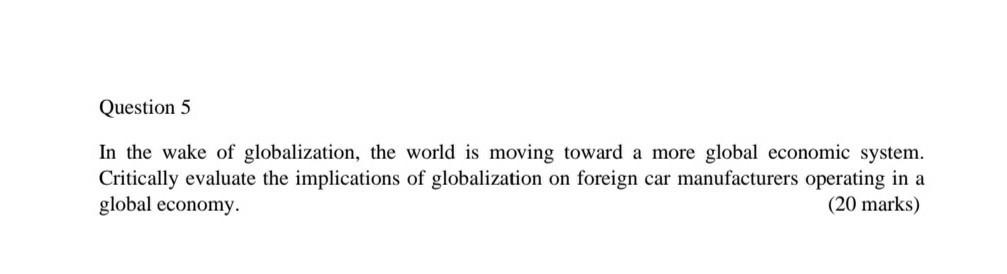
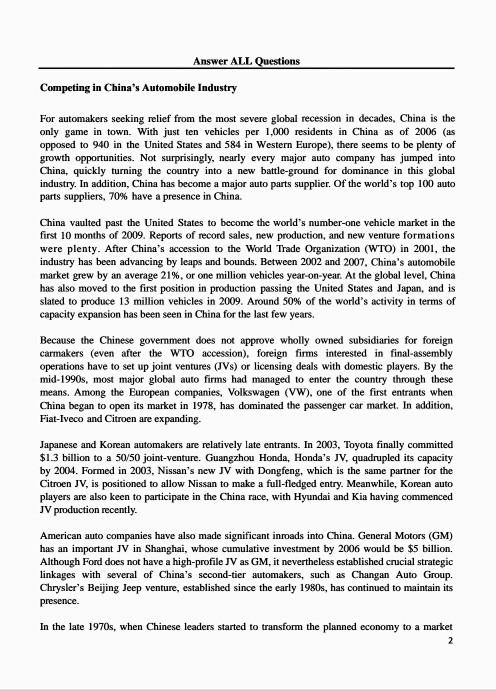
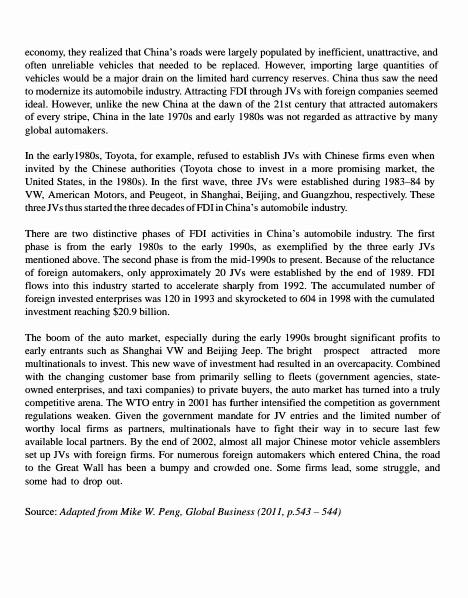
Question 3 (a) Content theories of motivation are concerned with what motivates people and what needs do people seek in order to have work satisfaction. In this regard, apply Herzberg's Two- factor Theory, one of the content motivational theories to examine how employees working with multinational carmakers are motivated. (10 marks) (b) In your opinion, does the approach to ethnocentrism fit well into managing both the business activities and people of multinational carmakers operating in China? Justify your (10 marks) answer. Question 5 In the wake of globalization, the world is moving toward a more global economic system. Critically evaluate the implications of globalization on foreign car manufacturers operating in a global economy. (20 marks) Answer ALL Questions Competing in China's Automobile Industry For automakers seeking relief from the most severe global recession in decades, China is the only game in town. With just ten vehicles per 1,000 residents in China as of 2006 (as opposed to 940 in the United States and 584 in Western Europe), there seems to be plenty of growth opportunities. Not surprisingly, nearly every major auto company has jumped into China, quickly turning the country into a new battle-ground for dominance in this global industry. In addition, China has become a major auto parts supplier. Of the world's top 100 auto parts suppliers, 70% have a presence in China China vaulted past the United States to become the world's number-one vehicle market in the first 10 months of 2009. Reports of record sales, new production, and new venture formations were plenty. After China's accession to the World Trade Organization (WTO) in 2001, the industry has been advancing by leaps and bounds. Between 2002 and 2007, China's automobile market grew by an average 21%, or one million vehicles year-on-year. At the global level. China has also moved to the first position in production passing the United States and Japan, and is slated to produce 13 million vehicles in 2009. Around 50% of the world's activity in terms of capacity expansion has been seen in China for the last few years. Because the Chinese government does not approve wholly owned subsidiaries for foreign carmakers (even after the WTO accession), foreign firms interested in final-assembly operations have to set up joint ventures (JV) or licensing deals with domestic players. By the mid-1990s, most major global auto firms had managed to enter the country through these means. Among the European companies, Volkswagen (VW), one of the first entrants when China began to open its market in 1978, has dominated the passenger car market. In addition, Fiat-Iveco and Citroen are expanding. Japanese and Korean automakers are relatively late entrants. In 2003, Toyota finally committed $1.3 billion to a 50/50 joint-venture. Guangzhou Honda, Honda's JV, quadrupled its capacity by 2004. Formed in 2003, Nissan's new JV with Dongfeng, which is the same partner for the Citroen JV, is positioned to allow Nissan to make a full-fledged entry. Meanwhile, Korean auto players are also keen to participate in the China race, with Hyundai and Kia having commenced JV production recently. American auto companies have also made significant inroads into China. General Motors (GM) has an important JV in Shanghai, whose cumulative investment by 2006 would be $5 billion. Although Ford does not have a high-profile JV as GM, it nevertheless established crucial strategic linkages with several of China's second-tier automakers, such as Changan Auto Group. Chrysler's Beijing Jeep venture, established since the early 1980s, has continued to maintain its presence. In the late 1970s, when Chinese leaders started to transform the planned economy to a market 2 economy, they realized that China's roads were largely populated by inefficient, unattractive, and often unreliable vehicles that needed to be replaced. However, importing large quantities of vehicles would be a major drain on the limited hard currency reserves. China thus saw the need to modernize its automobile industry. Attracting FDI through JVs with foreign companies seemed ideal. However, unlike the new China at the dawn of the 21st century that attracted automakers of every stripe, China in the late 1970s and early 1980s was not regarded as attractive by many global automakers. In the early 1980s, Toyota, for example, refused to establish JVs with Chinese firms even when invited by the Chinese authorities (Toyota chose to invest in a more promising market, the United States, in the 1980s). In the first wave, three JVs were established during 1983-84 by VW, American Motors, and Peugeot, in Shanghai, Beijing, and Guangzhou, respectively. These three JVs thus started the three decades of FDI in China's automobile industry. There are two distinctive phases of FDI activities in China's automobile industry. The first phase is from the early 1980s to the early 1990s, as exemplified by the three early JVs mentioned above. The second phase is from the mid-1990s to present. Because of the reluctance of foreign automakers, only approximately 20 JVs were established by the end of 1989. FDI flows into this industry started to accelerate sharply from 1992. The accumulated number of foreign invested enterprises was 120 in 1993 and skyrocketed to 604 in 1998 with the cumulated investment reaching $20.9 billion. The boom of the auto market, especially during the early 1990s brought significant profits to early entrants such as Shanghai VW and Beijing Jeep. The bright prospect attracted more multinationals to invest. This new wave of investment had resulted in an overcapacity. Combined with the changing customer base from primarily selling to fleets (government agencies, state- owned enterprises, and taxi companies) to private buyers, the auto market has turned into a truly competitive arena. The WTO entry in 2001 has further intensified the competition as government regulations weaken. Given the government mandate for JV entries and the limited number of worthy local firms as partners, multinationals have to fight their way in to secure last few available local partners. By the end of 2002, almost all major Chinese motor vehicle assemblers set up JVs with foreign firms. For numerous foreign automakers which entered China, the road to the Great Wall has been a bumpy and crowded one. Some firms lead, some struggle, and some had to drop out Source: Adapted from Mike W. Peng, Global Business (2011, p.543 - 544)Step by Step Solution
There are 3 Steps involved in it
1 Expert Approved Answer
Step: 1 Unlock

Question Has Been Solved by an Expert!
Get step-by-step solutions from verified subject matter experts
Step: 2 Unlock
Step: 3 Unlock
 Study Help