Question: Answer the questions below: Q1. Get deeper in the description of the different segments of the elderly people in China - segment 1 working elders,
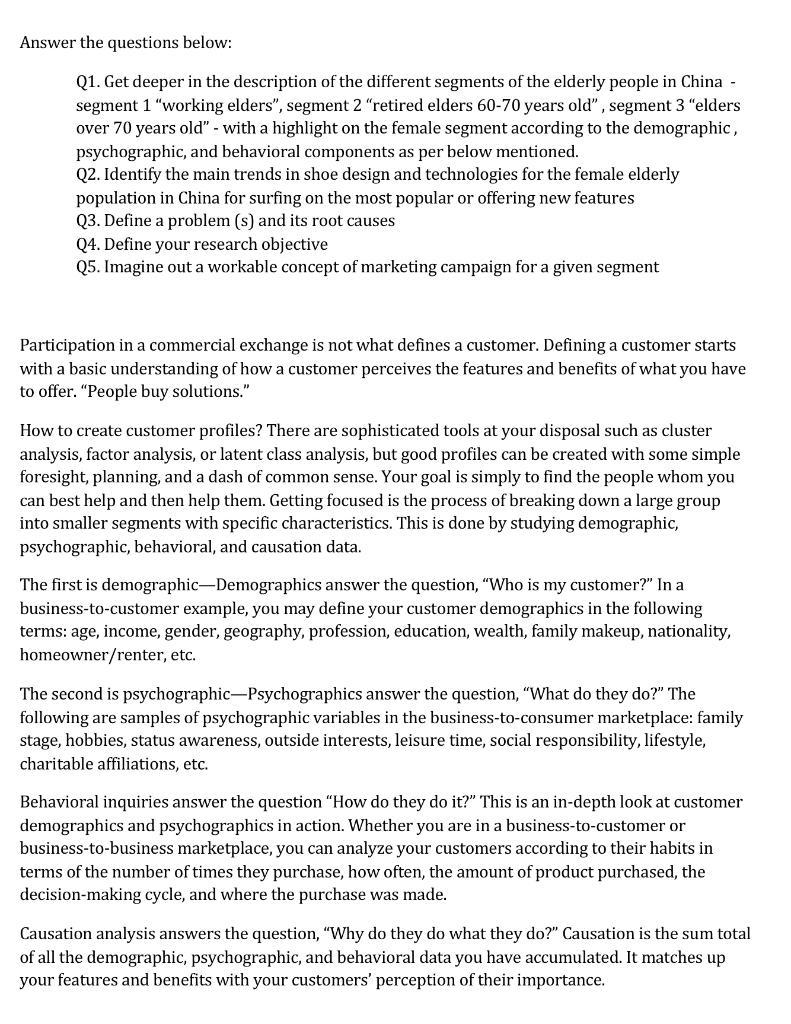
Answer the questions below: Q1. Get deeper in the description of the different segments of the elderly people in China - segment 1 "working elders", segment 2 retired elders 60-70 years old, segment 3 "elders over 70 years old - with a highlight on the female segment according to the demographic, psychographic, and behavioral components as per below mentioned. Q2. Identify the main trends in shoe design and technologies for the female elderly population in China for surfing on the most popular or offering new features Q3. Define a problem (s) and its root causes Q4. Define your research objective Q5. Imagine out a workable concept of marketing campaign for a given segment Participation in a commercial exchange is not what defines a customer. Defining a customer starts with a basic understanding of how a customer perceives the features and benefits of what you have to offer. "People buy solutions." How to create customer profiles? There are sophisticated tools at your disposal such as cluster analysis, factor analysis, or latent class analysis, but good profiles can be created with some simple foresight, planning, and a dash of common sense. Your goal is simply to find the people whom you can best help and then help them. Getting focused is the process of breaking down a large group into smaller segments with specific characteristics. This is done by studying demographic, psychographic, behavioral, and causation data. The first is demographic-Demographics answer the question, "Who is my customer?" In a business-to-customer example, you may define your customer demographics in the following terms: age, income, gender, geography, profession, education, wealth, family makeup, nationality, homeowner/renter, etc. The second is psychographic-Psychographics answer the question, "What do they do?" The following are samples of psychographic variables in the business-to-consumer marketplace: family stage, hobbies, status awareness, outside interests, leisure time, social responsibility, lifestyle, charitable affiliations, etc. Behavioral inquiries answer the question "How do they do it?" This is an in-depth look at customer demographics and psychographics in action. Whether you are in a business-to-customer or business-to-business marketplace, you can analyze your customers according to their habits in terms of the number of times they purchase, how often, the amount of product purchased, the decision-making cycle, and where the purchase was made. Causation analysis answers the question, "Why do they do what they do?" Causation is the sum total of all the demographic, psychographic, and behavioral data you have accumulated. It matches up your features and benefits with your customers' perception of their importance









 Study Help