Question: Answer the questions from case study. third pic are questions. Case Study: Manufacturing and Service Processes at Loganville Window Treatments (10 Marks] Introduction For nearly
Answer the questions from case study. third pic are questions.
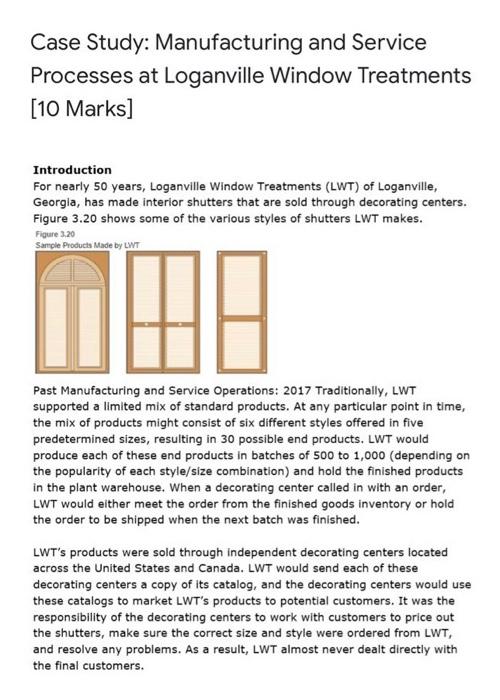
Case Study: Manufacturing and Service Processes at Loganville Window Treatments (10 Marks] Introduction For nearly 50 years, Loganville Window Treatments (LWT) of Loganville, Georgia, has made interior shutters that are sold through decorating centers. Figure 3.20 shows some of the various styles of shutters LWT makes. Figure 3.20 Sample Products Made by LWT TH: Past Manufacturing and Service Operations: 2017 Traditionally, LWT supported a limited mix of standard products. At any particular point in time, the mix of products might consist of six different styles offered in five predetermined sizes, resulting in 30 possible end products, LWT would produce each of these end products in batches of 500 to 1,000 (depending on the popularity of each style/size combination) and hold the finished products in the plant warehouse. When a decorating center called in with an order, LWT would either meet the order from the finished goods inventory or hold the order to be shipped when the next batch was finished. LWT's products were sold through independent decorating centers located across the United States and Canada. LWT would send each of these decorating centers a copy of its catalog, and the decorating centers would use these catalogs to market LWT's products to potential customers. It was the responsibility of the decorating centers to work with customers to price out the shutters, make sure the correct size and style were ordered from LWT, and resolve any problems. As a result, LWT almost never dealt directly with the final customers. Page-2: Case Study: Manufacturing and Service Processes at Loganville Window Treatments Manufacturing and Service Operations: 2018 By 2017, the influx of low-cost shutters made in China had forced LWT to reconsider its business model. Specifically, because of the low labor costs in China (20% of LWT's labor costs), Chinese manufacturers could make exact copies of LWT's products for substantially less and hold them in warehouses across the United States and Canada. LWT's traditional customers-the decorating centers-were turning more and more to these alternative sources. LWT decided to fight back. As Chuck Keown, president of LWT, put it: The only permanent advantage that we have over our competitors is that we are located here in the United States, closer to the final customer. So from now on, we will be a make-to-order manufacturer. We will deal directly with customers and make shutters to whatever specific measurements and finish they need. This means we can no longer count on producing batches of 500 to 1,000 shutters at a time and holding them in inventory. Rather, we will need to be able to make a few at a time in one-off sizes, if that's what the customer needs. On the service and marketing side of the house, we will now take orders directly from the customer. We will reach them through the Internet and through catalogs. We will work with them to determine what style best suits their needs, and to take the measurements needed to make the shutters. When there is a problem, we will work directly with the customer to resolve them. Yes, this will require dramatic changes to our business. But it also means we will be able to charge a premium for our products and create a relationship with the customers that our Chinese rivals will find difficult to emulate. As I see it, this is the only way we can survive. Questions: Case Study: Manufacturing and Service Processes at Loganville Window Treatments 1. Describe the LWT's past manufacturing and service operation; how many end products, volume of operation, storage facilities, distribution practices. 2. Describe the downstream activities in the supply chain; role of catalog. 3. Describe how the customer service was outsourced to the participating partners in the supply chain? 4. Why LWT had to reconsider its business model by 2017? 5. What was LWT's new business strategy to win the competition? 6. What changes Chuck Keown introduced in the customer service? 7. What impact the customer service changes had on operational strategies? 8. Describe the service and marketing side of the LWT. 9. What will the new managerial challenges be? 10. Will the new business model be more or less difficult to manage than the old one? Justify your









 Study Help