







Question: answer the questions in case study.. Case Study Two: In a US Bank Characters: Alice, a new manager of Training and Development Department Belinda, a
answer the questions in case study.. 
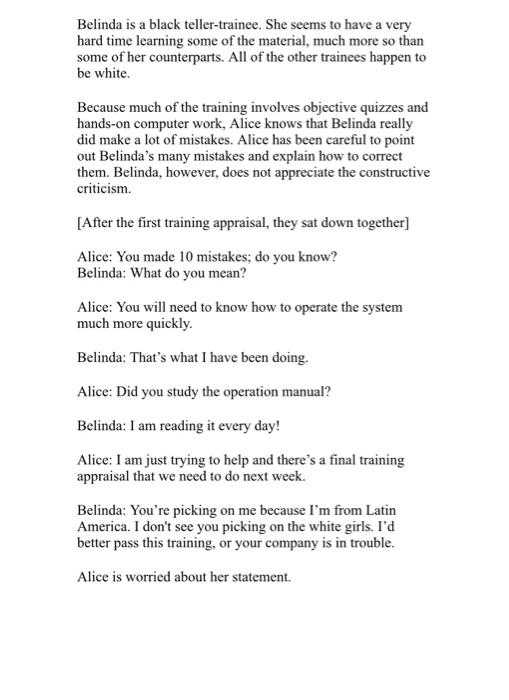
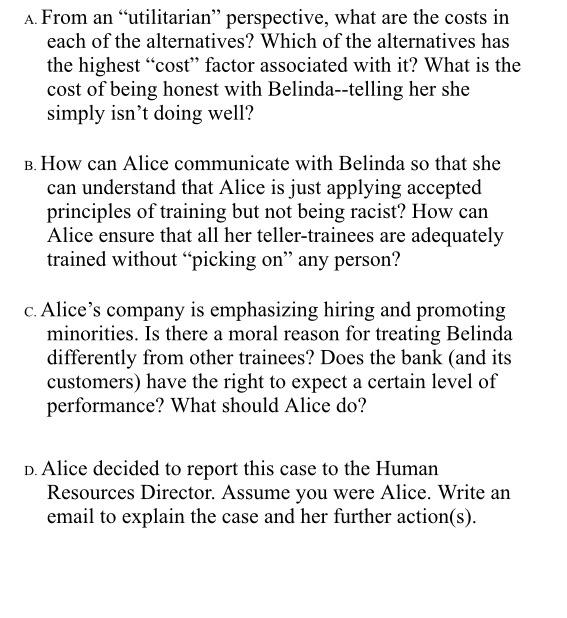
Case Study Two: In a US Bank Characters: Alice, a new manager of Training and Development Department Belinda, a teller-trainee Alice was hired last year as a first-line manager in the Training and Development department of the bank where she has worked part-time for several years while earning her bachelor's degree in business. Her main responsibility was to train bank tellers. The Bank is an American multinational banking and financial services corporation headquartered in Charlotte, North Carolina with over 23,680 employees. It is the second largest bank holding company in the United States by assets. As of 2013, the Bank was the twenty-first largest company in the United States by total revenue. The bank is very big on promotion from within, so most people start as tellers. The bank is also trying to hire (and eventually promote) more racial minorities, because there aren't a lot of minorities on the staff. In fact, the bank had been the target of several discrimination lawsuits the last few years and recently wanted to change its image of being a "racist" organization. The bank's classroom facility has training workstations of tellers' equipment. When a trainee is hired, training takes an entire work week, and each trainee is either passed or failed at the end of the week. Each class of new trainees usually consists of about a dozen of people. Alice has been using written and audiovisual materials developed by the bank. Also, she has taken a Training class while she was a student. Consequently, she knows that adults learn more effectively when they are given positive reinforcement (for doing something correctly) and constructive criticism (for making a mistake). So far, this has worked pretty well. Today, however, it's the time for the first training appraisal and Belinda didn't do well on it. Belinda is a black teller-trainee. She seems to have a very hard time learning some of the material, much more so than some of her counterparts. All of the other trainees happen to be white. Because much of the training involves objective quizzes and hands-on computer work, Alice knows that Belinda really did make a lot of mistakes. Alice has been careful to point out Belinda's many mistakes and explain how to correct them. Belinda, however, does not appreciate the constructive criticism. [After the first training appraisal, they sat down together] Alice: You made 10 mistakes; do you know? Belinda: What do you mean? Alice: You will need to know how to operate the system much more quickly. Belinda: That's what I have been doing. Alice: Did you study the operation manual? Belinda: I am reading it every day! Alice: I am just trying to help and there's a final training appraisal that we need to do next week. Belinda: You're picking on me because I'm from Latin America. I don't see you picking on the white girls. I'd better pass this training, or your company is in trouble. Alice is worried about her statement. A. From an "utilitarian" perspective, what are the costs in each of the alternatives? Which of the alternatives has the highest "cost" factor associated with it? What is the cost of being honest with Belinda--telling her she simply isn't doing well? B. How can Alice communicate with Belinda so that she can understand that Alice is just applying accepted principles of training but not being racist? How can Alice ensure that all her teller-trainees are adequately trained without picking on" any person? c. Alice's company is emphasizing hiring and promoting minorities. Is there a moral reason for treating Belinda differently from other trainees? Does the bank (and its customers) have the right to expect a certain level of performance? What should Alice do? D. Alice decided to report this case to the Human Resources Director. Assume you were Alice. Write an email to explain the case and her further action(s)
Step by Step Solution
There are 3 Steps involved in it
1 Expert Approved Answer
Step: 1 Unlock

Question Has Been Solved by an Expert!
Get step-by-step solutions from verified subject matter experts
Step: 2 Unlock
Step: 3 Unlock
 Study Help