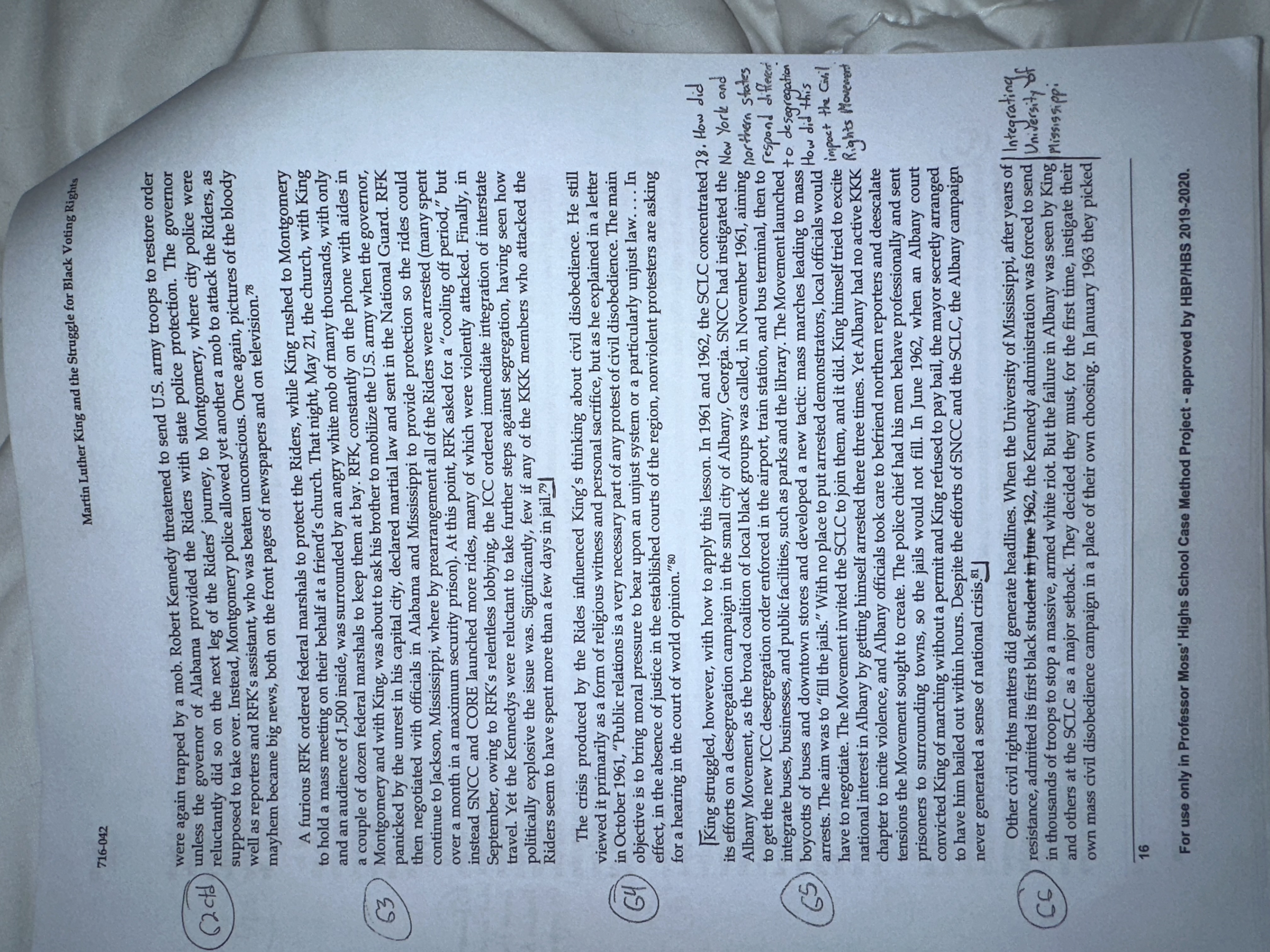
Question: Answer the questions that is on the packet, like the right side of the page in the picture from the text, by HIGHLIGHTING FROM THE
Answer the questions that is on the packet, like the right side of the page in the picture from the text, by HIGHLIGHTING FROM THE TEXT as the answer, thank you~
Martin Luther King and the Struggle for Black Voting Rights 716-042 were again trapped by a mob. Robert Kennedy threatened to send U.S. army troops to restore order unless the governor of Alabama provided the Riders with state police protection. The governor 62 ctd reluctantly did so on the next leg of the Riders' journey, to Montgomery, where city police were supposed to take over. Instead, Montgomery police allowed yet another a mob to attack the Riders, as well as reporters and RFK's assistant, who was beaten unconscious. Once again, pictures of the bloody mayhem became big news, both on the front pages of newspapers and on television.78 A furious RFK ordered federal marshals to protect the Riders, while King rushed to Montgomery to hold a mass meeting on their behalf at a friend's church. That night, May 21, the church, with King and an audience of 1,500 inside, was surrounded by an angry white mob of many thousands, with only a couple of dozen federal marshals to keep them at bay. RFK, constantly on the phone with aides in Montgomery and with King, was about to ask his brother to mobilize the U.S. army when the governor, panicked by the unrest in his capital city, declared martial law and sent in the National Guard. RFK then negotiated with officials in Alabama and Mississippi to provide protection so the rides could continue to Jackson, Mississippi, where by prearrangement all of the Riders were arrested (many spent over a month in a maximum security prison). At this point, RFK asked for a "cooling off period," but instead SNCC and CORE launched more rides, many of which were violently attacked. Finally, in September, owing to RFK's relentless lobbying, the ICC ordered immediate integration of interstate travel. Yet the Kennedys were reluctant to take further steps against segregation, having seen how politically explosive the issue was. Significantly, few if any of the KKK members who attacked the Riders seem to have spent more than a few days in jail.79/ The crisis produced by the Rides influenced King's thinking about civil disobedience. He still viewed it primarily as a form of religious witness and personal sacrifice, but as he explained in a letter in October 1961, "Public relations is a very necessary part of any protest of civil disobedience. The main objective is to bring moral pressure to bear upon an unjust system or a particularly unjust law. . . . In effect, in the absence of justice in the established courts of the region, nonviolent protesters are asking for a hearing in the court of world opinion."80 King struggled, however, with how to apply this lesson. In 1961 and 1962, the SCLC concentrated 28. How did its efforts on a desegregation campaign in the small city of Albany, Georgia. SNCC had instigated the New York and Albany Movement, as the broad coalition of local black groups was called, in November 1961, aiming northern States to get the new ICC desegregation order enforced in the airport, train station, and bus terminal, then to respond different integrate buses, businesses, and public facilities, such as parks and the library. The Movement launched SS boycotts of buses and downtown stores and developed a new tactic: mass marches leading to mass y to desegregation arrests. The aim was to "fill the jails." With no place to put arrested demonstrators, local officials would How did this have to negotiate. The Movement invited the SCLC to join them, and it did. King himself tried to excite impact the Civil national interest in Albany by getting himself arrested there three times. Yet Albany had no active KKK Rights Movement chapter to incite violence, and Albany officials took care to befriend northern reporters and deescalate tensions the Movement sought to create. The police chief had his men behave professionally and sent prisoners to surrounding towns, so the jails would not fill. In June 1962, when an Albany court convicted King of marching without a permit and King refused to pay bail, the mayor secretly arranged to have him bailed out within hours. Despite the efforts of SNCC and the SCLC, the Albany campaign never generated a sense of national crisis.81 Other civil rights matters did generate headlines. When the University of Mississippi, after years of | Integrating resistance, admitted its first black student in june 1962, the Kennedy administration was forced to send University of in thousands of troops to stop a massive, armed white riot. But the failure in Albany was seen by King |Mississippi and others at the SCLC as a major setback. They decided they must, for the first time, instigate their own mass civil disobedience campaign in a place of their own choosing. In January 1963 they picked 16 For use only in Professor Moss' Highs School Case Method Project - approved by HBP/HBS 2019-2020
Step by Step Solution
There are 3 Steps involved in it
1 Expert Approved Answer
Step: 1 Unlock
Question Has Been Solved by an Expert!
Get step-by-step solutions from verified subject matter experts
Step: 2 Unlock
Step: 3 Unlock
Students Have Also Explored These Related Accounting Questions!