







Question: answer the subquestion base on lecture like a) answer b) answer C) answer. thanks Questions for Discussion 3-28. What factors in an evaluation of the
answer the subquestion base on lecture like a) answer b) answer C) answer. thanks 
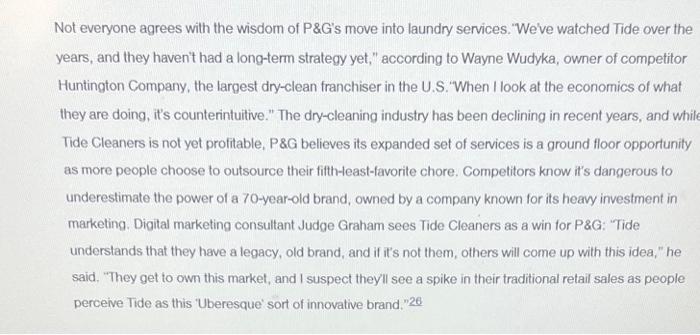
Questions for Discussion 3-28. What factors in an evaluation of the extemal environment might have led P&G to pursue the Tide Cleaners initiative? What other factors should it consider as it further develops and promotes Tide Cleaners? 3-29. Review the Product-Market Growth Matrix in Figure 3.4. Which of the four approaches is P&G using with its Tide Cleaners initiative? What other growth strategies could it use to stimulate further growth? 3-30. With the Tide Cleaners venture, P&G is responding to consumers' choice to spend their money on a service to realize the benefit they sok rather than through the purchase of a product. What other industries are or should be taking a similar approach? Marketing in Action Case: Real Choices at P&G Do you love doing laundry? If so, you are the exception The American Cleaning Instituto says that cleaning our clothos is our fifth-most-loathed household choro, right behind cleaning the kitchen, dusting, mopping, and cleaning the bathroom. A Labor Department study found that Americans spend up to 375 hours per year keeping our clothes looking great (or at least presentable). For many of us, doing that task means grabbing a box or bottle of P&G's product. Tide dotorent. In an effort to continue to dominate the comment- care segment, P&G is trying a new initiative as part of its growth strategy-Tide Cleaners Launched in 1946 as "The Washday Miracle, " Tide has been the number one laundry detergent in the U.S. since 1949. About 40 million Americans use it cach year. Regular innovations have helped the brand to stay on top, including Liquid Tide, Tide Pods, and Tide to Go stain releaser pens. While clearly the leader among its industry rivals, P&G also has to stay on top of changing domographic and consumer behavior trends that influence how Americans do laundry or avoid doing it. The company identified a growing desire among consumers to outsource this unpleasant chore, so it realized it's not enough just to sell a popular detergent if customers to pay others to wish their clothes instead P&G began to explore a service-oriented approach to meeting consumers garment-care needs. The company initially launched a dry-cleaning chain as a venture to sell more detergent and to learn about consumers laundry preferences-kind of a "real life" laboratory to observe what people do with dirty clothes Sure enough, P&G started to pick up on changes, especially among millennials and Gen Z consumers. Compared to their parents, they tend to wear their clothing many more times before they wash them. And they appear to be less loyal to leading laundry brands than their parents. P&G also observed that these younger customers are willing to pay for on-demand servicos like DoorDash, UberEats, and GrubHub. In general, they're just more used to using apps and hiring others to do routine tasks for them, such as food delivery and rides around town That spells opportunity for expanded laundry services. For some younger people, it's a practical matter their urban apartments dont have washer-dryer hookups, or the shared laundry room or neighborhood laundromat may be tar away. Consumers are also trying to recover time in their jam-packed schedules, particularly those in the millennial and Gen generations who place a high value on their free time. "I's critical we go for this because it's a natural extension of the brand, according to Sundar Raran, vice president of P&G North American Fabric Care. "The time people spend on chores is decreasing, and there's loss and less consumption happening at home. The market for out-of-home laundry is just as big as for in-home and growing faster." From its start with dry-cleaning outlets, Tide Cleaners has expanded to include wash-and-lold laundry and lockers in city buildings where you can drop off and pick up your laundry. Its Tide University won't eam you college credits, but it will free up some time for you to study if you attend one of the 20 schools where the service is currently available. There's no need to drive to an off-campus shop or to find a locker somewhere for a drop-off, Just load up your bag with dirty clothes and give it to the friendly attendant who drives a truck right onto your campus. Tide Cleaners uses a personalized mobile app to communicate with customers, a must for the digitally sawy market it wants to attract. The app can also track your laundry as it moves through the cleaning process, using bar-coded laundry bags and chips attached to dry-clean-only garments, P&G's marketing for Tide Cleaners is focused primarily on direct mail, email, digital, and posters. It also produced a video ad with the tagline "Life, Not Laundry." But its biggest marketing effort is the expansion of its physical locations. The company now plans to increase to 2,000 outlets by the end of 2020, most of which will be operated by franchisees. If doing laundry every day all day sounds good to you, save up your money: franchisees are required to have $1.1 million in liquid capital and a net worth of $2 million. Each of these locations prominently displays the familiar Tide logo, walich not only identifies it as a drop-off point for laundry but reinforces the brand imagery for purchasers of Tide products for home use. The impact on product sales could be one of the biggest wins out of the initiative for P&G, as it connects directly to consumers and collects valuable behavioral information about its customers. Not everyone agrees with the wisdom of P&G's move into laundry services. "We've watched Tide over the years, and they haven't had a long-term strategy yet," according to Wayne Wudyka, owner of competitor Huntington Company, the largest dry-clean franchiser in the U.S. "When I look at the economics of what they are doing, it's counterintuitive." The dry-cleaning industry has been declining in recent years, and while Tide Cleaners is not yet profitable, P&G believes its expanded set of services is a ground floor opportunity as more people choose to outsource their fifth-east-favorite chore. Competitors know it's dangerous to underestimate the power of a 70-year-old brand, owned by a company known for its heavy investment in marketing Digital marketing consultant Judge Graham sees Tide Cleaners as a win for P&G: "Tide understands that they have a legacy, old brand, and if it's not them, others will come up with this idea," he said. "They get to own this market, and I suspect they'll see a spike in their traditional retail sales as people perceive Tide as this 'Uberesque sort of innovative brand "28 Step by Step Solution
There are 3 Steps involved in it
1 Expert Approved Answer
Step: 1 Unlock

Question Has Been Solved by an Expert!
Get step-by-step solutions from verified subject matter experts
Step: 2 Unlock
Step: 3 Unlock
 Study Help