







Question: Answer the true/false statements. Write a short paragraph explaining each of your answers and include examples wherever possible. Statements 1. The manager's loyalty to the
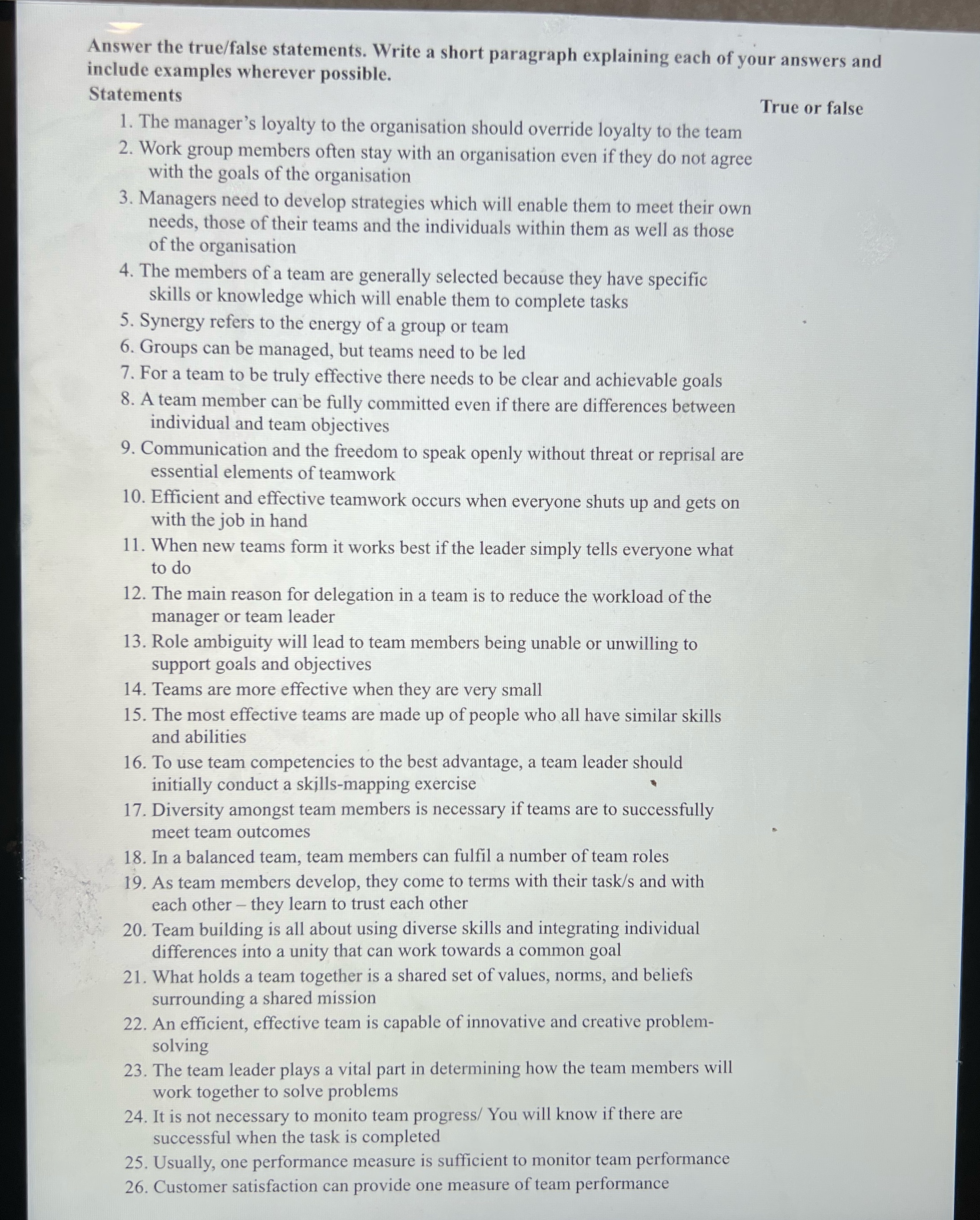
Answer the true/false statements. Write a short paragraph explaining each of your answers and include examples wherever possible. Statements 1. The manager's loyalty to the organisation should override loyalty to the team 2. Work group members often stay with an organisation even if they do not agree with the goals of the organisation 3. Managers need to develop strategies which will enable them to meet their own needs, those of their teams and the individuals within them as well as those of the organisation 4. The members of a team are generally selected because they have specific skills or knowledge which will enable them to complete tasks 5. Synergy refers to the energy of a group or team 6. Groups can be managed, but teams need to be led 7. For a team to be truly effective there needs to be clear and achievable goals 8. A team member can be fully committed even if there are differences between individual and team objectives 9. Communication and the freedom to speak openly without threat or reprisal are essential elements of teamwork 10. Efficient and effective teamwork occurs when everyone shuts up and gets on with the job in hand 11. When new teams form it works best if the leader simply tells everyone what to do 12. The main reason for delegation in a team is to reduce the workload of the manager or team leader 13. Role ambiguity will lead to team members being unable or unwilling to support goals and objectives 14. Teams are more effective when they are very small 15. The most effective teams are made up of people who all have similar skills and abilities 16. To use team competencies to the best advantage, a team leader should initially conduct a skills-mapping exercise 17. Diversity amongst team members is necessary if teams are to successfully meet team outcomes 18. In a balanced team, team members can fulfil a number of team roles 19. As team members develop, they come to terms with their task/s and with each other they learn to trust each other 20. Team building is all about using diverse skills and integrating individual differences into a unity that can work towards a common goal 21. What holds a team together is a shared set of values, norms, and beliefs surrounding a shared mission 22. An efficient, effective team is capable of innovative and creative problem- solving 23. The team leader plays a vital part in determining how the team members will work together to solve problems 24. It is not necessary to monito team progress/ You will know if there are successful when the task is completed 25. Usually, one performance measure is sufficient to monitor team performance 26. Customer satisfaction can provide one measure of team performance True or false
Answer the true/false statements. Write a short paragraph explaining each of your answers and include examples wherever possible. Statements 1. The manager's loyalty to the organisation should override loyalty to the team 2. Work group members often stay with an organisation even if they do not agree with the goals of the organisation 3. Managers need to develop strategies which will enable them to meet their own needs, those of their teams and the individuals within them as well as those of the organisation 4. The members of a team are generally selected because they have specific skills or knowledge which will enable them to complete tasks 5. Synergy refers to the energy of a group or team 6. Groups can be managed, but teams need to be led 7. For a team to be truly effective there needs to be clear and achievable goals 8. A team member can be fully committed even if there are differences between individual and team objectives 9. Communication and the freedom to speak openly without threat or reprisal are essential elements of teamwork 10. Efficient and effective teamwork occurs when everyone shuts up and gets on with the job in hand 11. When new teams form it works best if the leader simply tells everyone what to do 12. The main reason for delegation in a team is to reduce the workload of the manager or team leader 13. Role ambiguity will lead to team members being unable or unwilling to support goals and objectives 14. Teams are more effective when they are very small 15. The most effective teams are made up of people who all have similar skills and abilities 16. To use team competencies to the best advantage, a team leader should initially conduct a skills-mapping exercise 17. Diversity amongst team members is necessary if teams are to successfully meet team outcomes 18. In a balanced team, team members can fulfil a number of team roles 19. As team members develop, they come to terms with their task/s and with each other they learn to trust each other 20. Team building is all about using diverse skills and integrating individual differences into a unity that can work towards a common goal 21. What holds a team together is a shared set of values, norms, and beliefs surrounding a shared mission 22. An efficient, effective team is capable of innovative and creative problem- solving 23. The team leader plays a vital part in determining how the team members will work together to solve problems 24. It is not necessary to monito team progress/ You will know if there are successful when the task is completed 25. Usually, one performance measure is sufficient to monitor team performance 26. Customer satisfaction can provide one measure of team performance True or false
Step by Step Solution
There are 3 Steps involved in it
The detailed answer for the above question is provided below 1 True The managers loyalty to the organization should typically override loyalty to the team because the manager is responsible for the br... View full answer

Get step-by-step solutions from verified subject matter experts
 Study Help