







Question: answer the two discussion questions Article 2: OM in the News: Stockpiles of Personal Protective Equipment JULY 5, 2021 tags: COVID-19 hospital supply chains inventory,
answer the two discussion questions 
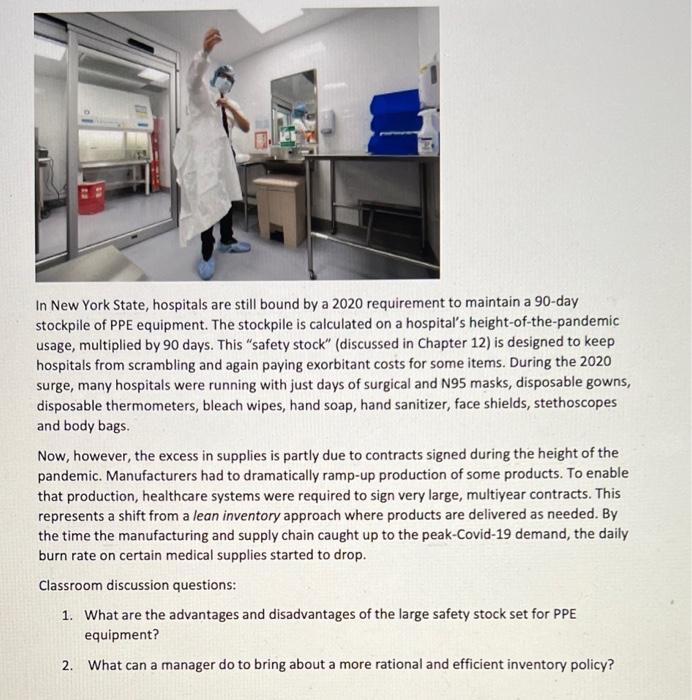
Article 2: OM in the News: Stockpiles of Personal Protective Equipment JULY 5, 2021 tags: COVID-19 hospital supply chains inventory, safety stock by Barry Render Millions of masks. Pallets of disposable isolation gowns. Tons of gloves. Caught in bidding wars for medical supplies and forced to scour the globe for personal protective equipment when Covid-19 ripped through last year, hospitals are now sitting on stockpiles of gear. reports The Wall Street Journal (July 2, 2021). How they got to this point is a mix of state policy, market forces and timing. The pandemic has forever shifted the way hospitals purchase supplies, requiring procurement departments to diversify their suppliers and become adept at understanding where raw materials are sourced. "There are some items that are going to take us 6-9 months to kind of wean down because we bought so much of it. And then, there's items we might have for years," said one hospital VP. "It will last us forever the amount of masks that we have." In New York State, hospitals are still bound by a 2020 requirement to maintain a 90-day stockpile of PPE equipment. The stockpile is calculated on a hospital's height-of-the-pandemic usage, multiplied by 90 days. This "safety stock" (discussed in Chapter 12) is designed to keep hospitals from scrambling and again paying exorbitant costs for some items. During the 2020 surge, many hospitals were running with just days of surgical and N95 masks, disposable gowns, disposable thermometers, bleach wipes, hand soap, hand sanitizer, face shields, stethoscopes and body bags. Now, however, the excess in supplies is partly due to contracts signed during the height of the pandemic. Manufacturers had to dramatically ramp-up production of some products. To enable that production, healthcare systems were required to sign very large, multiyear contracts. This represents a shift from a lean inventory approach where products are delivered as needed. By the time the manufacturing and supply chain caught up to the peak-Covid-19 demand, the daily burn rate on certain medical supplies started to drop. Classroom discussion questions: 1. What are the advantages and disadvantages of the large safety stock set for PPE equipment? What can a manager do to bring about a more rational and efficient inventory policy? 2
Step by Step Solution
There are 3 Steps involved in it
1 Expert Approved Answer
Step: 1 Unlock

Question Has Been Solved by an Expert!
Get step-by-step solutions from verified subject matter experts
Step: 2 Unlock
Step: 3 Unlock
 Study Help