Question: answer the two discussion questions please Article 4: SEPTEMBER 25, 2017 OM in the News: Apple Wrestles With Conflicts in its Supply Chain JUNE 27,
answer the two discussion questions please
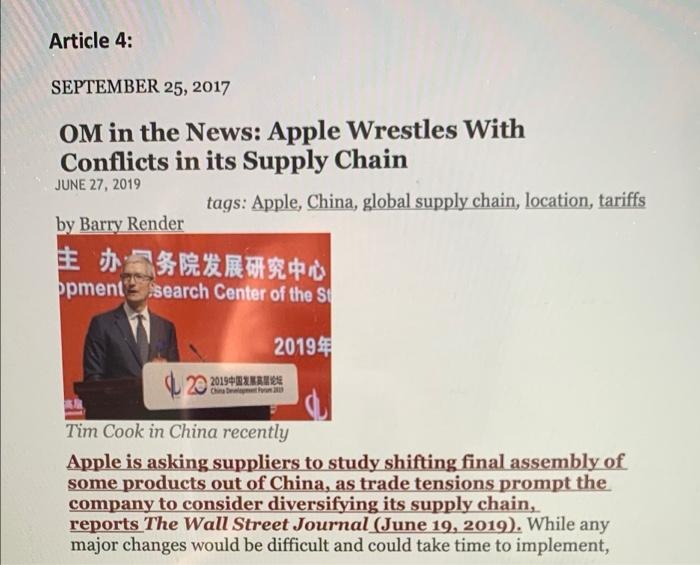
Article 4: SEPTEMBER 25, 2017 OM in the News: Apple Wrestles With Conflicts in its Supply Chain JUNE 27, 2019 tags: Apple, China, global supply chain, location, tariffs by Barry Render ppment search Center of the St 2019 20 2019 China Tim Cook in China recently Apple is asking suppliers to study shifting final assembly of some products out of China, as trade tensions prompt the company to consider diversifying its supply chain, reports The Wall Street Journal (June 19, 2019). While any major changes would be difficult and could take time to implement, Apple is looking into the feasibility of shifting 1/3 of the production for some devices to S.E. Asia. Manufacturers of apparel, footwear and other low-margin items have been moving out of China for years due to rising costs, and tariffs have accelerated that trend. Many tech companies, however, find it more difficult to move. Among China's chief attractions are well- developed chains of suppliers and reliable infrastructure, much of it built in the past 20 years. A plentiful labor force skilled in precision manufacturing as well as trained engineers and pro-business government policies also make China appealing. And for those companies looking to sell into the large Chinese market, producing in the country is more competitive than importing. Apple remains deeply rooted in China. About 1/5 of its total sales are recorded there, while on the manufacturing side its supply chain accounts for three million jobs. Foxconn, which assembles iPhones, iPads and Macs, is, however, ready to shift some Apple production to plants elsewhere. It has also put more than $213 million into India recently and is looking to invest in Vietnam. Outsourcing to China helped solidify Apple as one of the world's largest and most profitable companies. CEO Tim Cook helped build the company's sophisticated and efficient supply chain there, relying on Foxconn and others to crank out hundreds of millions of iPhones annually International moves won't come easy. Production equipment and assembly lines would need to be dismantled and packed. They then must be reinstalled, tested and calibrated, and their output rate adjusted. Software and environmental-control systems would need to be put in place, and line operators, engineers and quality managers must be available and trained. Classroom discussion questions: 1. Why isn't more of Apple's manufacturing coming to the U.S? 2. What are the advantages and disadvantages of moving production









 Study Help