







Question: Answer these problems on your own paper, preferably notebook paper. All problem solutions are to include the work for every calculation necessary to resolve the
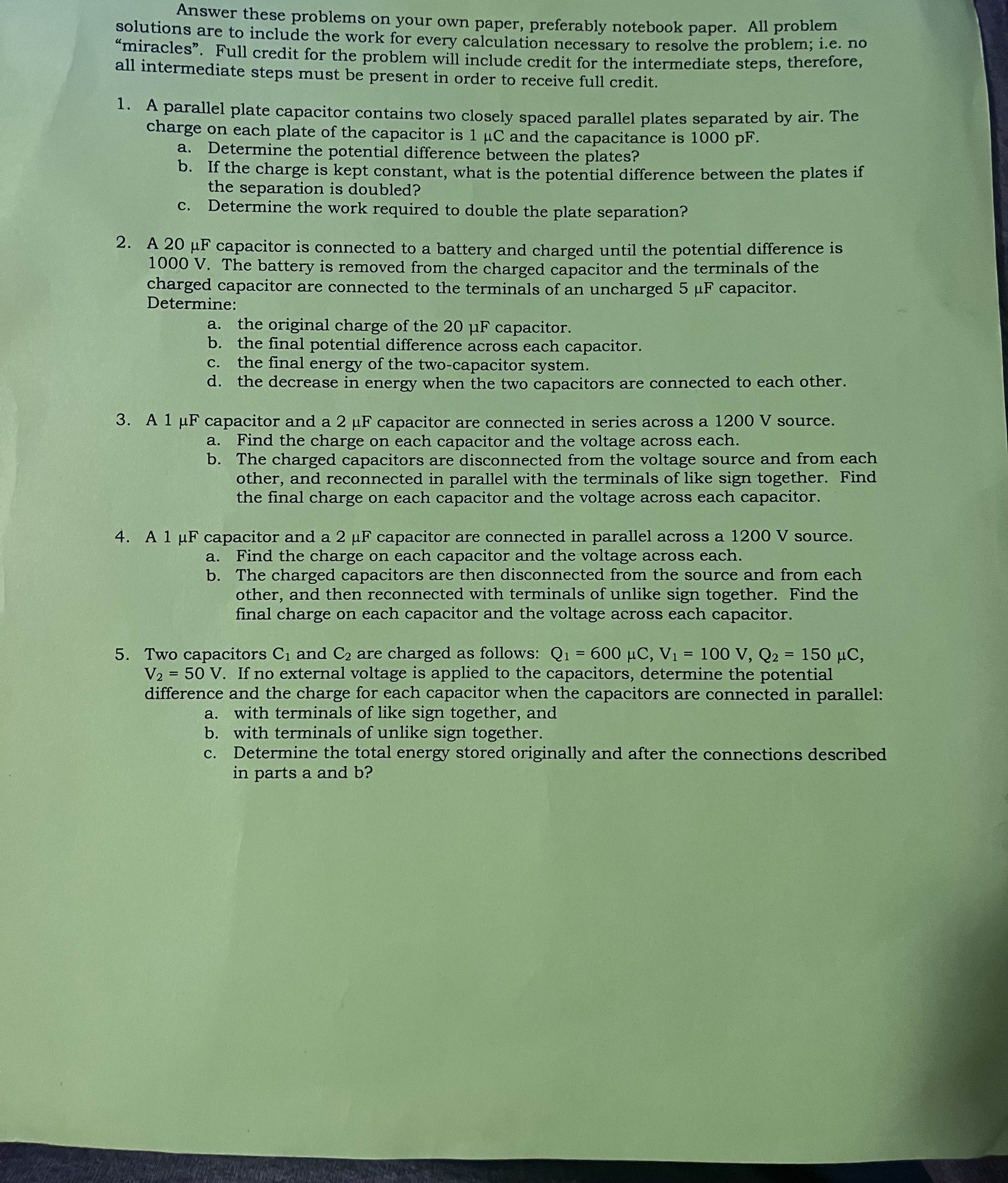
Answer these problems on your own paper, preferably notebook paper. All problem solutions are to include the work for every calculation necessary to resolve the problem; ie no "miracles". Full credit for the problem will include credit for the intermediate steps, therefore, all intermediate steps must be present in order to receive full credit.
A parallel plate capacitor contains two closely spaced parallel plates separated by air. The charge on each plate of the capacitor is mu mathrmC and the capacitance is pF
a Determine the potential difference between the plates?
b If the charge is kept constant, what is the potential difference between the plates if the separation is doubled?
c Determine the work required to double the plate separation?
A mu mathrm~F capacitor is connected to a battery and charged until the potential difference is V The battery is removed from the charged capacitor and the terminals of the charged capacitor are connected to the terminals of an uncharged mu mathrm~F capacitor. Determine:
a the original charge of the mu mathrm~F capacitor.
b the final potential difference across each capacitor.
c the final energy of the twocapacitor system.
d the decrease in energy when the two capacitors are connected to each other.
A mu mathrm~F capacitor and a mu mathrm~F capacitor are connected in series across a V source.
a Find the charge on each capacitor and the voltage across each.
b The charged capacitors are disconnected from the voltage source and from each other, and reconnected in parallel with the terminals of like sign together. Find the final charge on each capacitor and the voltage across each capacitor.
A mu mathrm~F capacitor and a mu mathrm~F capacitor are connected in parallel across a V source.
a Find the charge on each capacitor and the voltage across each.
b The charged capacitors are then disconnected from the source and from each other, and then reconnected with terminals of unlike sign together. Find the final charge on each capacitor and the voltage across each capacitor.
Two capacitors mathrmC and mathrmC are charged as follows: mathrmQmu mathrmCmathrmVmathrm~VmathrmQmu mathrmCmathrmVmathrm~V If no external voltage is applied to the capacitors, determine the potential difference and the charge for each capacitor when the capacitors are connected in parallel:
a with terminals of like sign together, and
b with terminals of unlike sign together.
c Determine the total energy stored originally and after the connections described in parts a and b
Step by Step Solution
There are 3 Steps involved in it
1 Expert Approved Answer
Step: 1 Unlock

Question Has Been Solved by an Expert!
Get step-by-step solutions from verified subject matter experts
Step: 2 Unlock
Step: 3 Unlock
 Study Help