







Question: ANSWER THESE QUESTIONS USING TRUE OR FALSE: a. Gauss's Law describes the relationship between the net electric flux through a closed surface and the charge
ANSWER THESE QUESTIONS USING TRUE OR FALSE:
a. Gauss's Law describes the relationship between the net electric flux through a closed surface and the charge enclosed INSIDE the surface.
b. Gauss's Law describes the relationship between the net electric flux through any surface (either open or closed) and the charge around (either inside or outside) the surface.
c. When a point charge is at the center of a spherical surface, its E field is EVERYWHERE normal to the surface and constant in magnitude.
d. When a point charge is inside some closed Gaussian surfaces, the total net E field flux depends on the shape and size of the surfaces.
e. When charges are only located OUTSIDE an enclosed Gaussian surface, the number of E field lines entering the surface may be more or less than that of the lines leaving the surface.
f. Chapter 24-2 derived the formula of Gauss's law using a positive point charge located inside a cubic Gaussian surface.
g. Dr. Gauss made contributions on many fields and a picture of him was shown in chapter 24.2
h. Gauss's law is not true when there are multiple charges.
i. Zero flux means zero electric field.
j. There is zero flux through a closed surface when there are no charge inside or when there are charges inside but the net charge is zero (Same amount of positive and negative charges).
k. Gauss's law calculation uses the value of charges inside the Gaussian surface, but it finds the Total E field at the surface, due to both charges inside and outside of the surface.
l. If the point charge inside the Gaussian surface is tripled, the total flux through the surface must be tripled.
m. If the radius of a spherical Gaussian surface is doubled when a point charge is inside, the total flux through the surface is doubled.
n. If the point charge inside the Gaussian surface moves to a different location, the total flux through the surface is not changed.
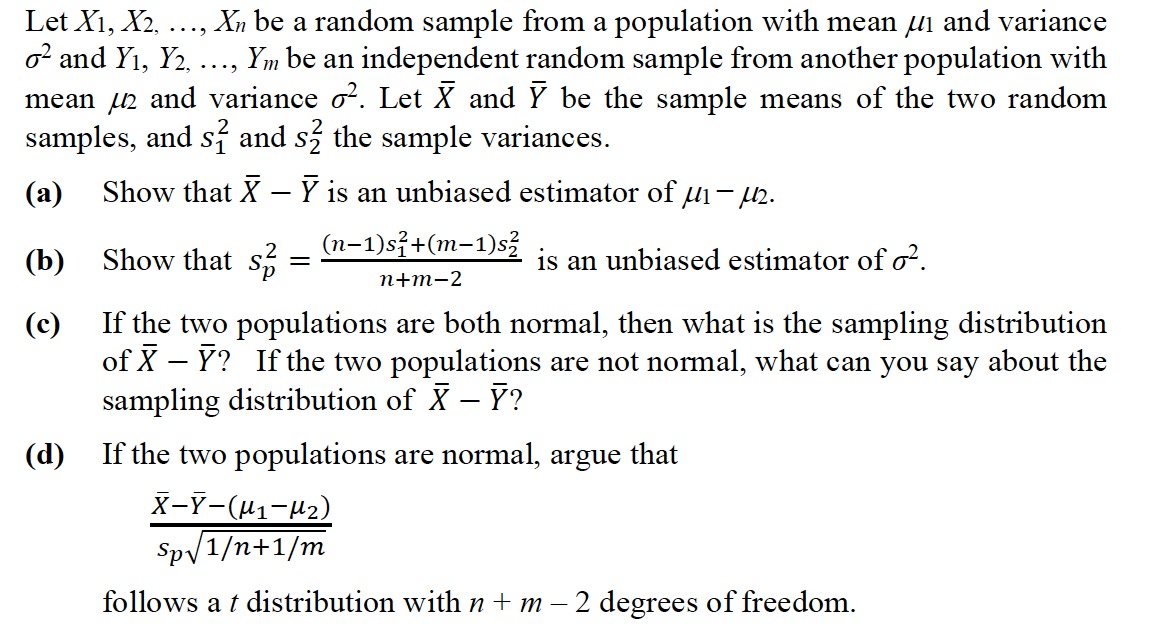
Let X1, X2, ..., Xn be a random sample from a population with mean #1 and variance 0'2 and Y 1, Y2, ..., Y m be an independent random sample from another population with mean #2 and variance 0'2. Let 2? and 17 be the sample means of the two random samples, and SE and 8% the sample variances. (a) Show that I? 17 is an unbiased estimator of,u1,u2. _ 2 _ 2 (b) Show that $5 = W is an unbiased estimator of 02. (c) If the two populations are both normal, then what is the sampling distribution of X Y? If the two populations are not normal, what can you say about the sampling distribution of X 17? (d) If the two populations are normal, argue that I? -17-(#1-#2) Sp,/1+1/m follows a 1' distribution with n + m 2 degrees of freedom
Step by Step Solution
There are 3 Steps involved in it

Get step-by-step solutions from verified subject matter experts
 Study Help