Question: answer this and I provide some examples and the table of NEWTON'S method ( pls pls follow the attachment that I gave ) EXAMPLES NEWTON'S
answer this and I provide some examples and the table of NEWTON'S method ( pls pls follow the attachment that I gave)
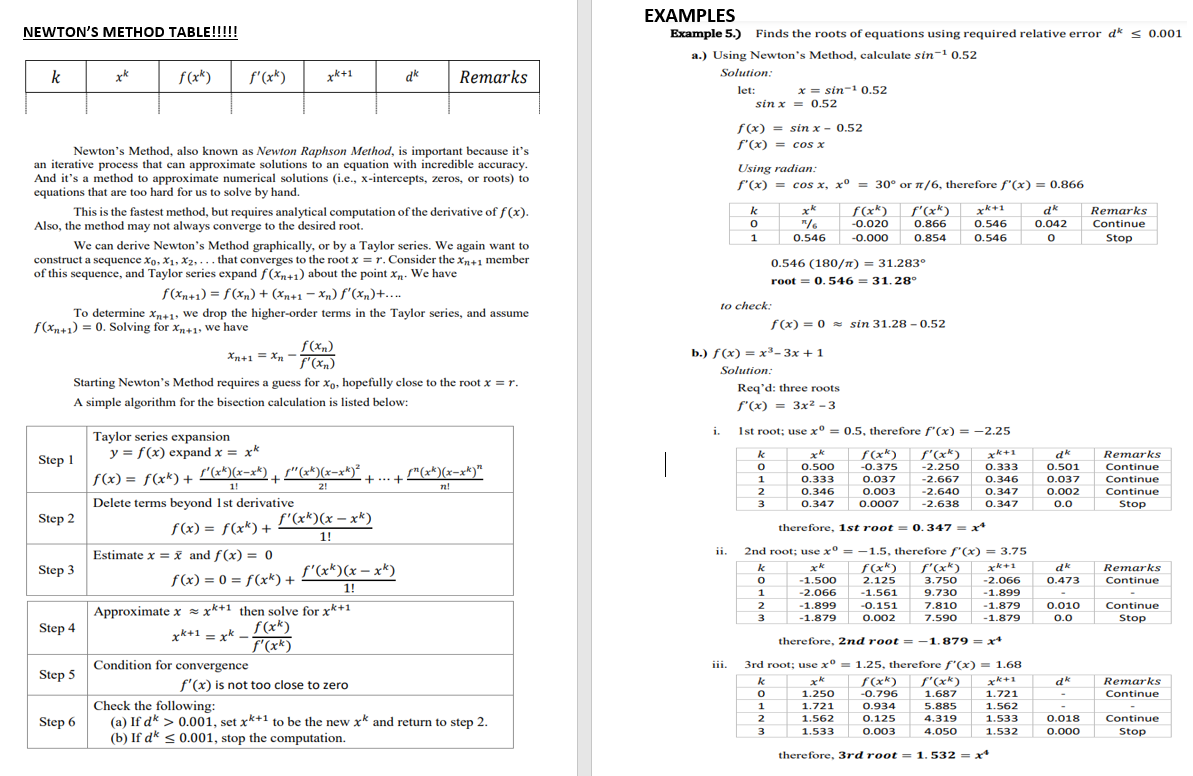
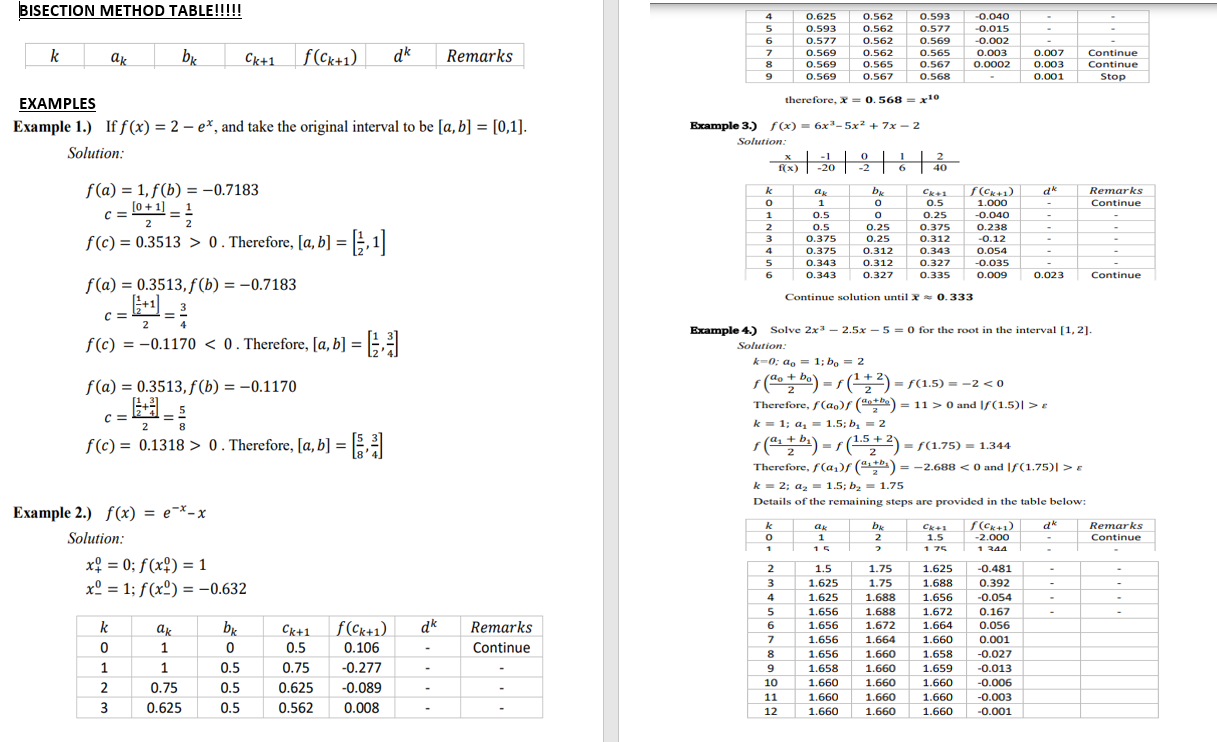
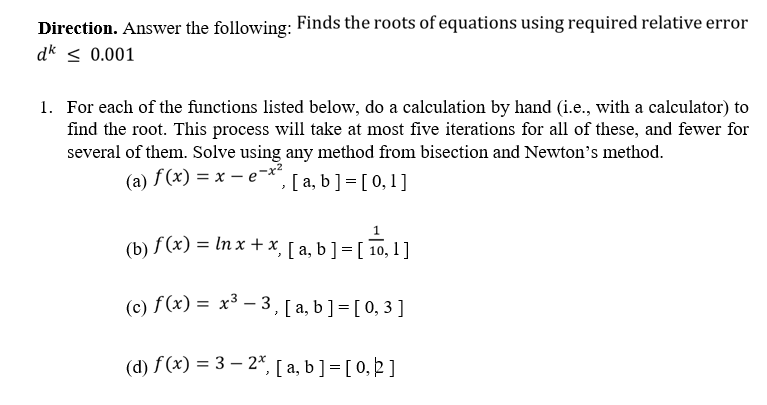
EXAMPLES NEWTON'S METHOD TABLE!!!! Example 5.) Finds the roots of equations using required relative error d* s 0.001 a.) Using Newton's Method, calculate sin-1 0.52 k xk f (x*) f' (x* ) xk+1 dk Remarks Solution: let: x = sin 1 0.52 sin x = 0.52 f(x) = sin x - 0.52 Newton's Method, also known as Newton Raphson Method, is important because it's f(x) = cos x an iterative process that can approximate solutions to an equation with incredible accuracy. Using radian: And it's a method to approximate numerical solutions (i.e., X-intercepts, zeros, or roots) to equations that are too hard for us to solve by hand. f(x) = cos x, x = 30' or m/6, therefore f(x) = 0.866 This is the fastest method, but requires analytical computation of the derivative of f (x). k xk f(x * ) f' (x k) xk+1 dk Remarks Also, the method may not always converge to the desired root. 0 0.020 0.866 0.546 0.042 Continue 0.546 -0.000 0.854 We can derive Newton's Method graphically, or by a Taylor series. We again want to 0.546 Stop construct a sequence Xo, X1, X2, . . . that converges to the root x = r. Consider the Xn+ 1 member 0.546 (180/m) = 31.283 of this sequence, and Taylor series expand f(*+1) about the point X,. We have root = 0.546 = 31.28 f ( x n+ 1 ) = f( Xn ) + (xn+ 1 - Xn ) f (xn)+... To determine X+1, we drop the higher-order terms in the Taylor series, and assume to check: f(xn+1) = 0. Solving for Xn+1, we have f(x) = 0 = sin 31.28 - 0.52 f ( x, ) *n+1 = Xn b.) f(x) = x3- 3x + 1 f' (X ) Solution: Starting Newton's Method requires a guess for Xo, hopefully close to the root x = r. Req'd: three roots A simple algorithm for the bisection calculation is listed below: f(x) = 3x2 -3 Taylor series expansion i. Ist root; use x0 = 0.5, therefore f'(x) = -2.25 Step 1 y = f(x) expand x = x* k f(xcky f'(xk) xk+1 dk Remarks f(x) = f(xk) + [(x)(x-x4) "(x*)(x-x*) - + ... + !" ( acht ) ( xx - ack( ) me 0.500 0.375 -2.250 0.333 0.501 Continue WNHO n! 0.333 0.037 2! -2.667 0.346 0.037 Continue 0.346 0.003 -2.640 0.347 0.002 Continue Delete terms beyond Ist derivative 0.347 0.0007 -2.638 0.347 0.0 Stop Step 2 f ( x) = f(xk) +! ( x")( x -x*) therefore, 1st root = 0.347 = x* 1! Estimate x = x and f(x) = 0 ii. 2nd root; use x = -1.5, therefore f(x) = 3.75 Step 3 f ( x) = 0 = f (xk) + / ( x" )(x-x*) k f(x*) F'(xk ) xk+1 Remarks -1.500 2.125 3.750 -2.066 0.473 Continue 1! WNHO -2.066 -1.561 9.730 -1.899 Approximate x = x*+1 then solve for x*+1 1.899 0.151 7.810 -1.879 0.010 Continue -1.879 0.002 7.590 -1.879 0.0 Stop Step 4 xk+1 = xk _ f (xk ) f' (xk ) therefore, 2nd root = -1.879 =x4 Condition for convergence iii. 3rd root; use x = 1.25, therefore f'(x) = 1.68 Step 5 f'(x) is not too close to zero k f(x*) I'(xk) xk+1 Remarks 1.250 0.796 1.687 1.721 Continue Check the following: WNPO 1.72: 0.934 5.885 1.562 Step 6 (a) If d* > 0.001, set x*+1 to be the new x* and return to step 2. 1.562 0.125 4.319 1.533 0.018 Continue (b) If d' 0 . Therefore, [a, b] = [2.1] 0.375 0.25 0.312 -0.12 0.375 0.312 0.343 0.054 0.343 0.312 0.327 -0.035 0.343 0.327 0.335 0.009 0.023 Continue f(a) = 0.3513, f (b) = -0.7183 Continue solution until ? = 0.333 c= +1 Example 4.) Solve 2x3 - 2.5x - 5 = 0 for the root in the interval [1, 2]. f(c) = -0.1170 0 and If (1.5)| > 2 k = 1; a, = 1.5; b, = 2 f(c) = 0.1318 > 0 . Therefore, [a, b] = (6.;] F (21 + b.) =f(-2 1.5 + 2) = f(1.75) = 1.344 Therefore, f(a,)f (#1the ) = -2.688 = k = 2; a2 = 1.5; b2 = 1.75 Details of the remaining steps are provided in the table below: Example 2.) f(x) = ex-x k ag bk Ck+1 S(CK+1) Remarks Solution: 0 1 1.5 -2.000 Continue 1 344 x4 = 0; f (x9) = 1 2 1.5 1.75 1.625 0.481 x! = 1; f(x9) = -0.632 3 1.625 1.75 1.688 0.392 4 1.625 1.688 1.656 -0.054 5 1.656 1.688 1.672 0.167 k ak bk Ck+ 1 f(Ck+1) dk Remarks 6 1.656 1.672 1.664 0.056 7 0 1 0 0.5 0.106 Continue 1.656 1.664 1.660 0.001 1.656 1.660 1.658 0.027 1 0.5 0.75 -0.277 1.658 1.660 1.659 -0.013 W N P 0.75 0.5 0.625 -0.089 10 1.660 1.660 1.660 -0.006 11 1.660 1.660 1.660 -0.003 0.625 0.5 0.562 0.008 12 1.660 1.660 1.660 -0.001Direction. Answer the following: Finds the roots of equations using required relative error dk
Step by Step Solution
There are 3 Steps involved in it
1 Expert Approved Answer
Step: 1 Unlock
Question Has Been Solved by an Expert!
Get step-by-step solutions from verified subject matter experts
Step: 2 Unlock
Step: 3 Unlock
Students Have Also Explored These Related Mathematics Questions!









 Study Help