



Question: Answer this, DO NOT COPT FROM EXISTING ONLINE SOLUTIONS 4.mConsider the following: Suppose that two neighbours with identical preferences derive utility from the number of
Answer this, DO NOT COPT FROM EXISTING ONLINE SOLUTIONS
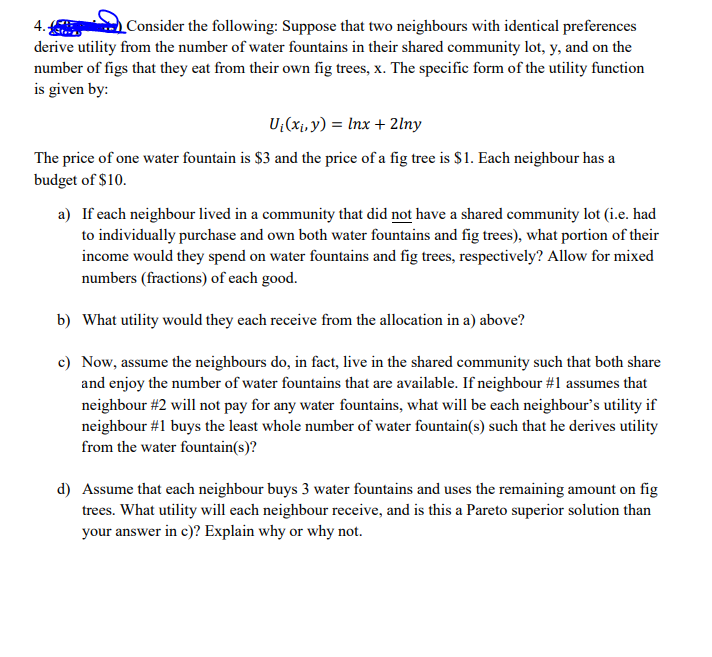
4.mConsider the following: Suppose that two neighbours with identical preferences derive utility from the number of water fountains in their shared community lot, y, and on the number of gs that they eat from their own fig ms, at. The specic form of the utility function is given by: \"1(x1.}') = lax + Eloy The price of one water fountain is $3 and the price of a g tree is $1. Each neighbour has a budget of $ l. 3) b} d) If each neighbour lived in a community that did n_ot have a shared community lot {i.e. had to individually purchase and oWn both water fountains and fig trees}, what portion of their income would they spend on wateI fountains and g trees, respectively? Allow for mixed numbers {fractions} of each good. What utility would they each receive fmm the allocation in a] above? Now, assume the neighbours do1 in fact, live in the shared community such that both share and enjoy the number of water fountains that are available. If neighbour #1 assumes that neighbour #2 will not pay for any water fountains, what will be each neighbour's utility if neighbour #1 buys the least whole number of water fountain{s] such that he derives utility from the wateT fountain{s]? Assume that each neighbour buys 3 water fountains and Uses the remaining amount on fig trees. What utility will each neighbour receive1 and is this a Pareto superior solution than your answer in c}? Explain why or why not
Step by Step Solution
There are 3 Steps involved in it

Get step-by-step solutions from verified subject matter experts