







Question: Answer this one, thanks Question 5 (20 marks) Table 1 below presents estimates from linear regression models using panel data on log wages, education (Educ
Answer this one, thanks
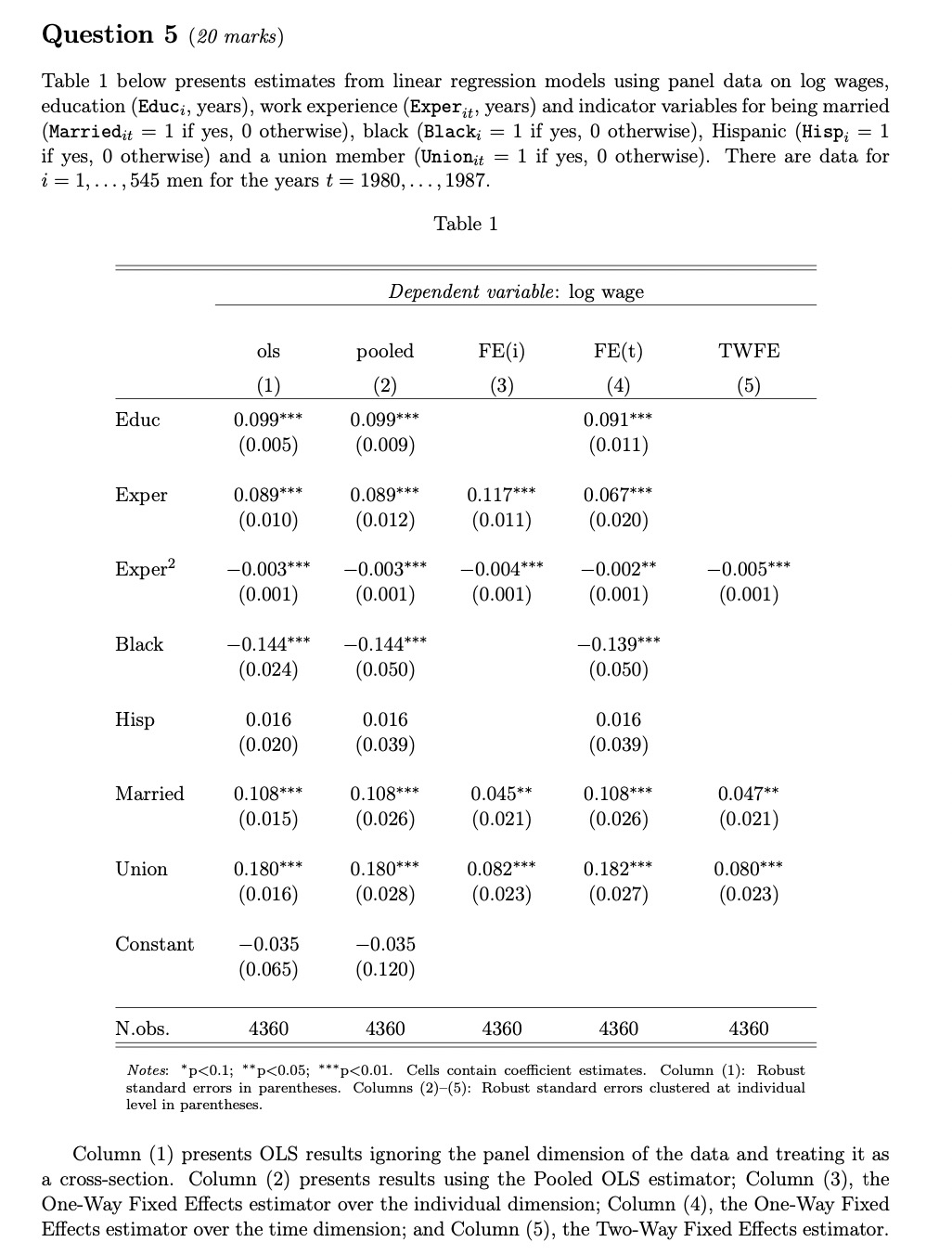
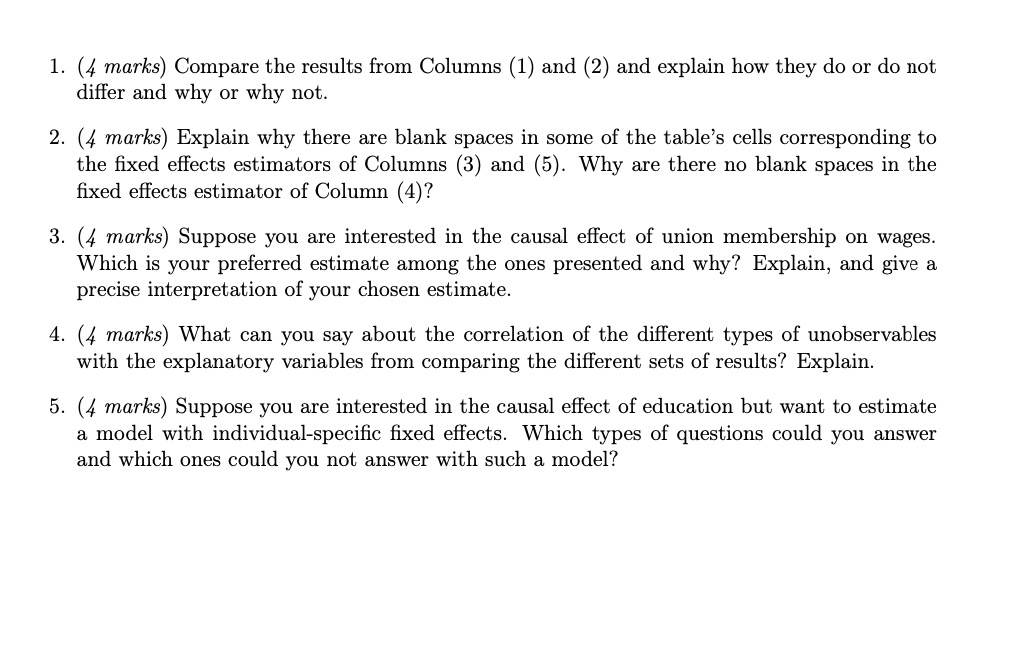
Question 5 (20 marks) Table 1 below presents estimates from linear regression models using panel data on log wages, education (Educ i, years), work experience (Exper it, years) and indicator variables for being married (Married it=1 if yes, 0 otherwise), black (Black i=1 if yes, 0 otherwise), Hispanic ( Hisp i=1 if yes, 0 otherwise) and a union member ( Union it=1 if yes, 0 otherwise). There are data for i=1,,545 men for the years t=1980,,1987. Table 1 standard errors in parentheses. Columns (2)-(5): Robust standard errors clustered at individual level in parentheses. Column (1) presents OLS results ignoring the panel dimension of the data and treating it as a cross-section. Column (2) presents results using the Pooled OLS estimator; Column (3), the One-Way Fixed Effects estimator over the individual dimension; Column (4), the One-Way Fixed Effects estimator over the time dimension; and Column (5), the Two-Way Fixed Effects estimator. 1. (4 marks) Compare the results from Columns (1) and (2) and explain how they do or do not differ and why or why not. 2. (4 marks) Explain why there are blank spaces in some of the table's cells corresponding to the fixed effects estimators of Columns (3) and (5). Why are there no blank spaces in the fixed effects estimator of Column (4)? 3. (4 marks) Suppose you are interested in the causal effect of union membership on wages. Which is your preferred estimate among the ones presented and why? Explain, and give a precise interpretation of your chosen estimate. 4. (4 marks) What can you say about the correlation of the different types of unobservables with the explanatory variables from comparing the different sets of results? Explain. 5. (4 marks) Suppose you are interested in the causal effect of education but want to estimate a model with individual-specific fixed effects. Which types of questions could you answer and which ones could you not answer with such a model? Question 5 (20 marks) Table 1 below presents estimates from linear regression models using panel data on log wages, education (Educ i, years), work experience (Exper it, years) and indicator variables for being married (Married it=1 if yes, 0 otherwise), black (Black i=1 if yes, 0 otherwise), Hispanic ( Hisp i=1 if yes, 0 otherwise) and a union member ( Union it=1 if yes, 0 otherwise). There are data for i=1,,545 men for the years t=1980,,1987. Table 1 standard errors in parentheses. Columns (2)-(5): Robust standard errors clustered at individual level in parentheses. Column (1) presents OLS results ignoring the panel dimension of the data and treating it as a cross-section. Column (2) presents results using the Pooled OLS estimator; Column (3), the One-Way Fixed Effects estimator over the individual dimension; Column (4), the One-Way Fixed Effects estimator over the time dimension; and Column (5), the Two-Way Fixed Effects estimator. 1. (4 marks) Compare the results from Columns (1) and (2) and explain how they do or do not differ and why or why not. 2. (4 marks) Explain why there are blank spaces in some of the table's cells corresponding to the fixed effects estimators of Columns (3) and (5). Why are there no blank spaces in the fixed effects estimator of Column (4)? 3. (4 marks) Suppose you are interested in the causal effect of union membership on wages. Which is your preferred estimate among the ones presented and why? Explain, and give a precise interpretation of your chosen estimate. 4. (4 marks) What can you say about the correlation of the different types of unobservables with the explanatory variables from comparing the different sets of results? Explain. 5. (4 marks) Suppose you are interested in the causal effect of education but want to estimate a model with individual-specific fixed effects. Which types of questions could you answer and which ones could you not answer with such a model
Step by Step Solution
There are 3 Steps involved in it

Get step-by-step solutions from verified subject matter experts
 Study Help