





Question: answer this please Instructor Resource Bates/Swan, Juvenile Delinquency in a Diverse Society, 2e SAGE, 2018 Lecture Notes Chapter 2: The Creation of Delinquency Chapter Summary

answer this please
answer this please Instructor Resource
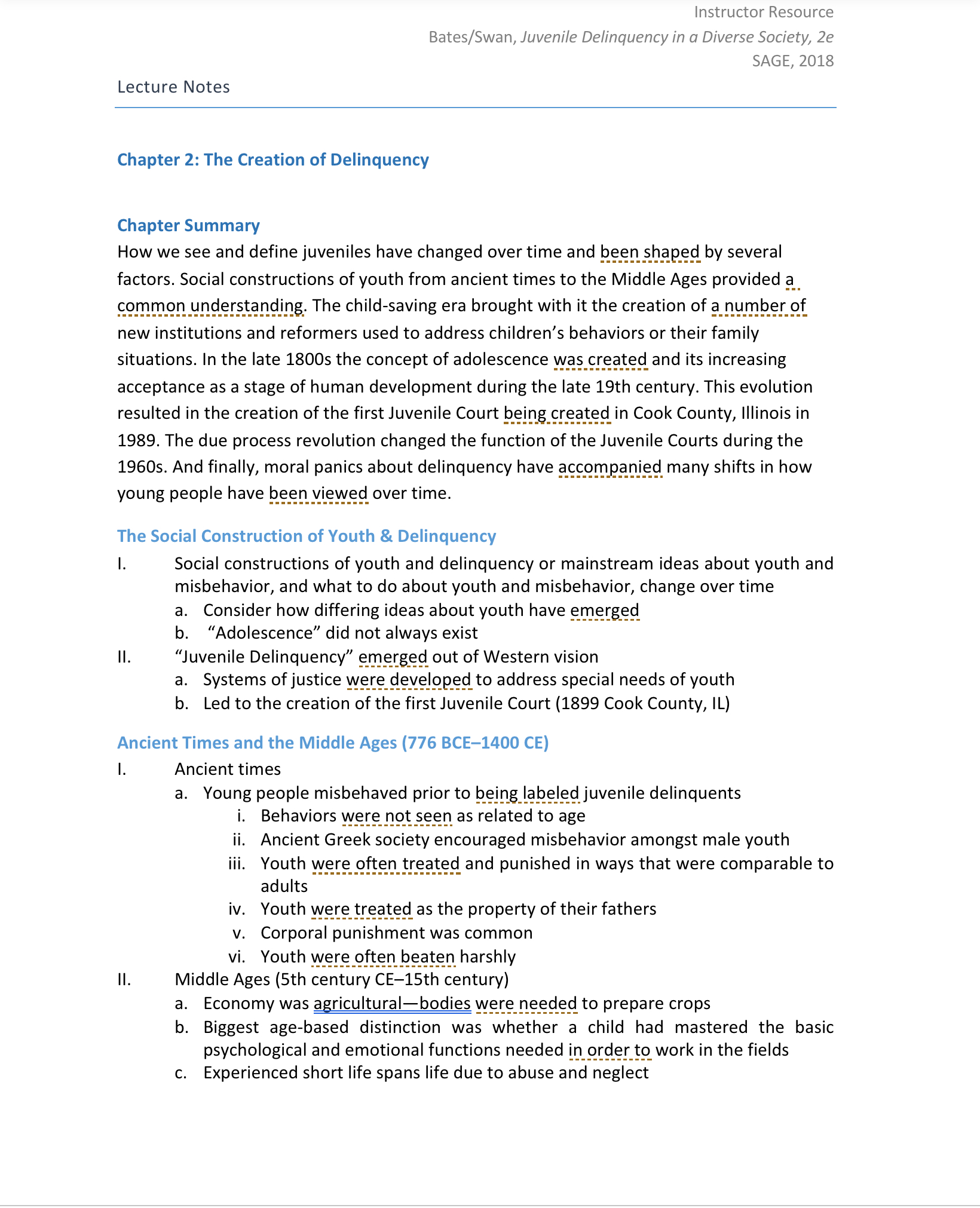
Instructor Resource Bates/Swan, Juvenile Delinquency in a Diverse Society, 2e SAGE, 2018 Lecture Notes Chapter 2: The Creation of Delinquency Chapter Summary How we see and define juveniles have changed over time and been shaped by several factors. Social constructions of youth from ancient times to the Middle Ages provided a. common understanding. The child-saving era brought with it the creation of a number of new institutions and reformers used to address children's behaviors or their family situations. In the late 1800s the concept of adolescence was created and its increasing acceptance as a stage of human development during the late 19th century. This evolution resulted in the creation of the first Juvenile Court being created in Cook County, Illinois in 1989. The due process revolution changed the function of the Juvenile Courts during the 1960s. And finally, moral panics about delinquency have accompanied many shifts in how young people have been viewed over time. The Social Construction of Youth & Delinquency 1. Social constructions of youth and delinquency or mainstream ideas about youth and misbehavior, and what to do about youth and misbehavior, change over time a. Consider how differing ideas about youth have emerged b. "Adolescence" did not always exist 11. "Juvenile Delinquency" emerged out of Western vision a. Systems of justice were developed to address special needs of youth b. Led to the creation of the first Juvenile Court (1899 Cook County, IL) Ancient Times and the Middle Ages (776 BCE-1400 CE) 1. Ancient times a. Young people misbehaved prior to being labeled juvenile delinquents i. Behaviors were not seen as related to age ii. Ancient Greek society encouraged misbehavior amongst male youth iii. Youth were often treated and punished in ways that were comparable to adults iv. Youth were treated as the property of their fathers v. Corporal punishment was common vi. Youth were often beaten harshly 11. Middle Ages (5th century CE-15th century) a. Economy was agricultural-bodies were needed to prepare crops b. Biggest age-based distinction was whether a child had mastered the basic psychological and emotional functions needed in order to work in the fields c. Experienced short life spans life due to abuse and neglect

Step by Step Solution

There are 3 Steps involved in it

1 Expert Approved Answer
Step: 1 Unlock blur-text-image

Question Has Been Solved by an Expert!

Get step-by-step solutions from verified subject matter experts

Step: 2 Unlock
Step: 3 Unlock

Students Have Also Explored These Related Accounting Questions!