







Question: answer this question (1 point) Consider your Statistics 213 lecture section. There are 120 students registered. Of these 120 students, 56 are Haskayne School of
answer this question
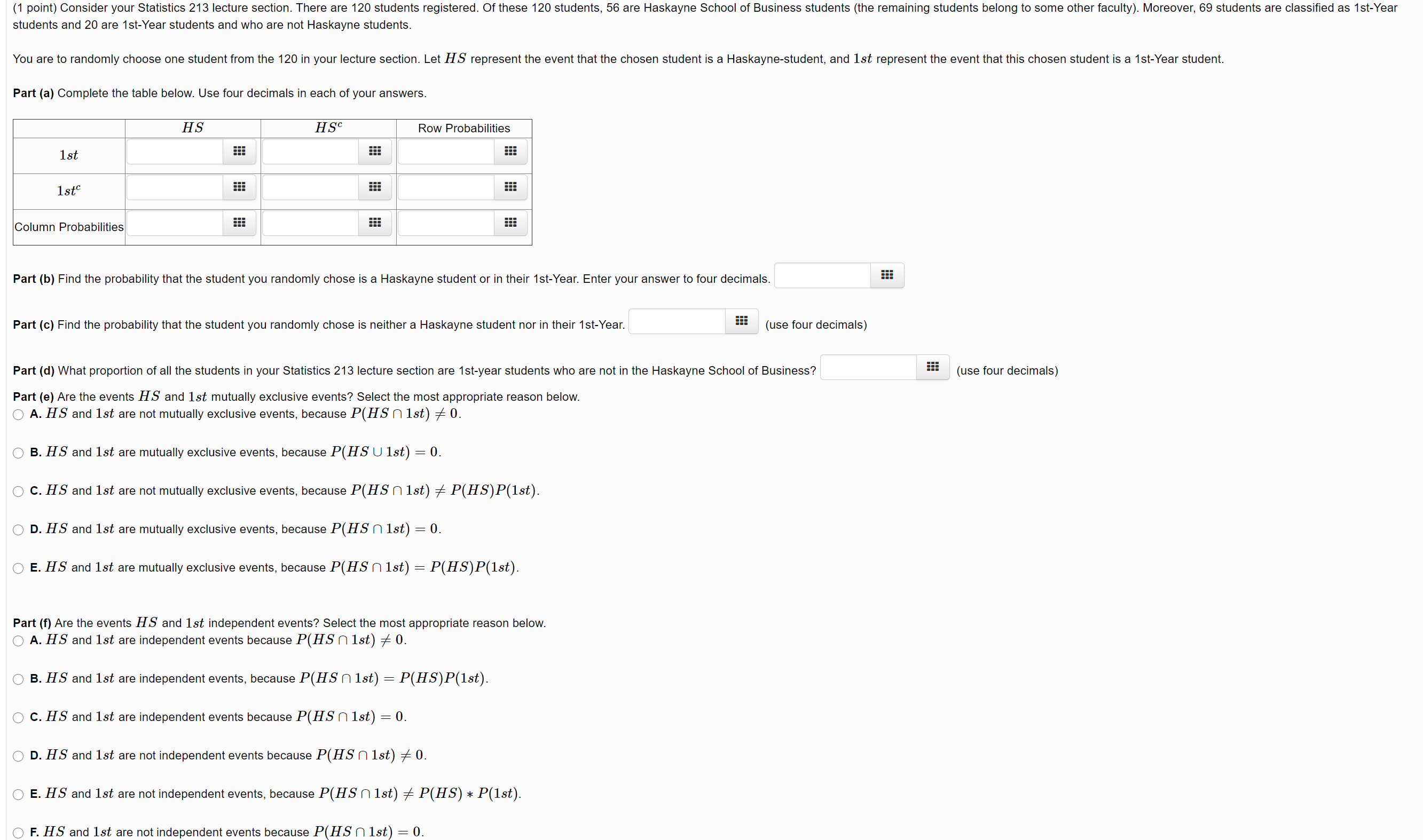
(1 point) Consider your Statistics 213 lecture section. There are 120 students registered. Of these 120 students, 56 are Haskayne School of Business students (the remaining students belong to some other faculty). Moreover, 69 students are classified as 1st-Year students and 20 are 1st-Year students and who are not Haskayne students. You are to randomly choose one student from the 120 in your lecture section. Let HIS represent the event that the chosen student is a Haskayne-student, and Ist represent the event that this chosen student is a 1st-Year student. Part (a) Complete the table below. Use four decimals in each of your answers. HS HS Row Probabilities 1st 1 stc Column Probabilities Part (b) Find the probability that the student you randomly chose is a Haskayne student or in their 1st-Year. Enter your answer to four decimals. Part (c) Find the probability that the student you randomly chose is neither a Haskayne student nor in their 1st-Year. (use four decimals) Part (d) What proportion of all the students in your Statistics 213 lecture section are 1st-year students who are not in the Haskayne School of Business? (use four decimals) Part (e) Are the events HS and 1st mutually exclusive events? Select the most appropriate reason below. O A. HS and 1st are not mutually exclusive events, because P(HS n Ist) # 0. O B. HS and 1st are mutually exclusive events, because P(HS U Ist) = 0. O c. HS and 1st are not mutually exclusive events, because P(HS n Ist) # P(HS) P(1st). O D. HS and 1st are mutually exclusive events, because P(HS n 1st) = 0. O E. HS and 1st are mutually exclusive events, because P(HS n Ist) = P(HS) P(1st). Part (f) Are the events HIS and 1st independent events? Select the most appropriate reason below. O A. HS and 1st are independent events because P(HS n Ist) # 0 O B. HS and 1st are independent events, because P(HS n 1st) = P(HS) P(1st). O C. HS and 1st are independent events because P(HS n Ist) = 0. O D. HS and Ist are not independent events because P(HS n Ist) # 0. O E. HS and 1st are not independent events, because P(HS n Ist) # P(HS) * P(1st). F. HS and 1st are not independent events because P(HS n 1st) = 0
Step by Step Solution
There are 3 Steps involved in it

Get step-by-step solutions from verified subject matter experts
 Study Help