







Question: answer this question for me please 2. A client is trying to connect to a web server on an overloaded machine that only accepts an
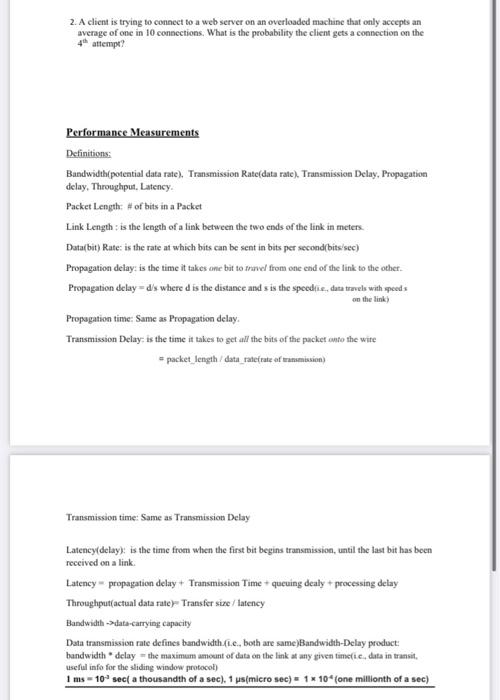
2. A client is trying to connect to a web server on an overloaded machine that only accepts an average of one in 10 connections. What is the probability the client gets a connection on the 4 attempt? Performance Measurements Definitions Bandwidth potential data rate). Transmission Rate(data rate). Transmission Delay, Propagation delay, Throughput. Latency. Packet Length: # of bits in a Packet Link Length: is the length of a link between the two ends of the link in meters Data(bit) Rate: is the rate at which bits can be sent in bits per secondbits/sec) Propagation delay: is the time it takes one but to travel from one end of the link to the other. Propagation delay = dis whered is the distance and s is the speedie, data travels with speeds on the link Propagation time: Same as Propagation delay. Transmission Delay: is the time it takes to get all the bits of the packet onto the wite -packet_length/data_raheftate of wransmission) Transmission time: Same as Transmission Delay Latency/delay); is the time from when the first bit begins transmission, until the last bit has been received on a link Latency - propagation delay + Transmission Time + queuing deaty + processing delay Throughput(actual data rate Transfer size/ latency Bandwidth ->data-carrying capacity Data transmission rate defines bandwidth.fl., both are sameBandwidth-Delay product: bandwidth delay the maximum amount of data on the link at any given timefic, data in transit useful info for the sliding window protocol) 1 ms -10sect a thousandth of a sec), 1 ps micro sec) = 1 * 10 (one millionth of a sec)
Step by Step Solution
There are 3 Steps involved in it

Get step-by-step solutions from verified subject matter experts
 Study Help