







Question: Answer this question Given the two input patterns p1 and p2 shown in the figure. Use column-major order to scan the patterns and each white
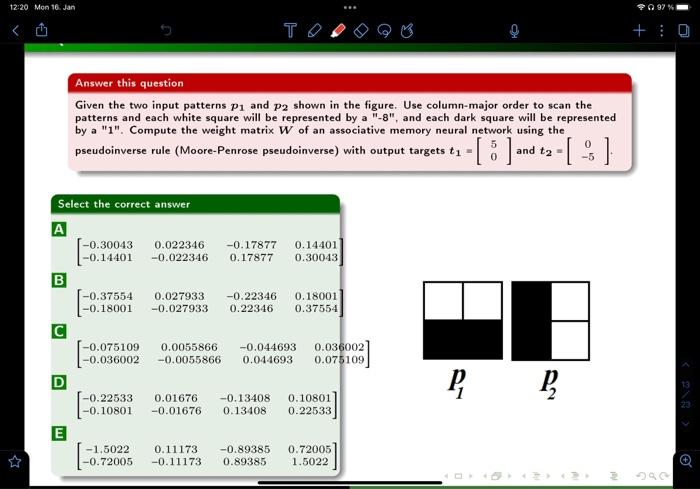
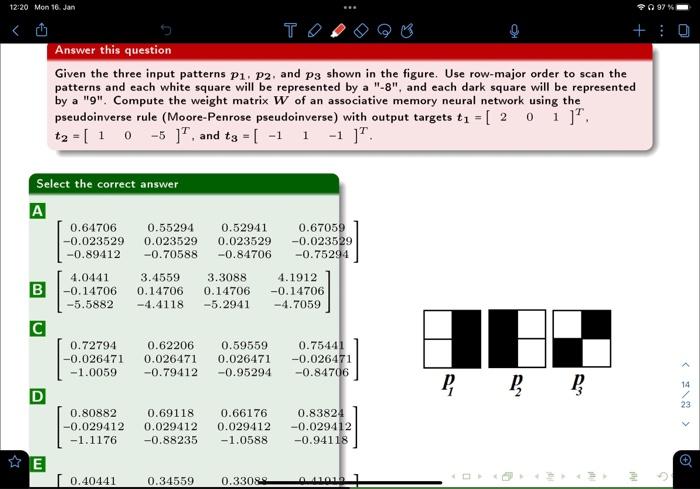
Answer this question Given the two input patterns p1 and p2 shown in the figure. Use column-major order to scan the patterns and each white square will be represented by a " 8, and each dark square will be represented by a "1". Compute the weight matrix W of an associative memory neural network using the pseudoinverse rule (Moore-Penrose pseudoinverse) with output targets t1=[50] and t2=[05]. Given the three input patterns p1,p2, and p3 shown in the figure. Use row-major order to scan the patterns and each white square will be represented by a8, and each dark square will be represented by a "9". Compute the weight matrix W of an associative memory neural network using the pseudoinverse rule (Moore-Penrose pseudoinverse) with output targets t1=[201]T, t2=[105]T, and t3=[111]T Answer this question Given the two input patterns p1 and p2 shown in the figure. Use column-major order to scan the patterns and each white square will be represented by a " 8, and each dark square will be represented by a "1". Compute the weight matrix W of an associative memory neural network using the pseudoinverse rule (Moore-Penrose pseudoinverse) with output targets t1=[50] and t2=[05]. Given the three input patterns p1,p2, and p3 shown in the figure. Use row-major order to scan the patterns and each white square will be represented by a8, and each dark square will be represented by a "9". Compute the weight matrix W of an associative memory neural network using the pseudoinverse rule (Moore-Penrose pseudoinverse) with output targets t1=[201]T, t2=[105]T, and t3=[111]T
Step by Step Solution
There are 3 Steps involved in it

Get step-by-step solutions from verified subject matter experts
 Study Help