







Question: answer this question. What people, organization, and technology factors contributed to Carters problems with its business processes? 1. People: 2. Organization: 3. Technology: separate answer
answer this question.
What people, organization, and technology factors contributed to Carters problems with its business processes? 1. People: 2. Organization: 3. Technology:
separate answer for each point please
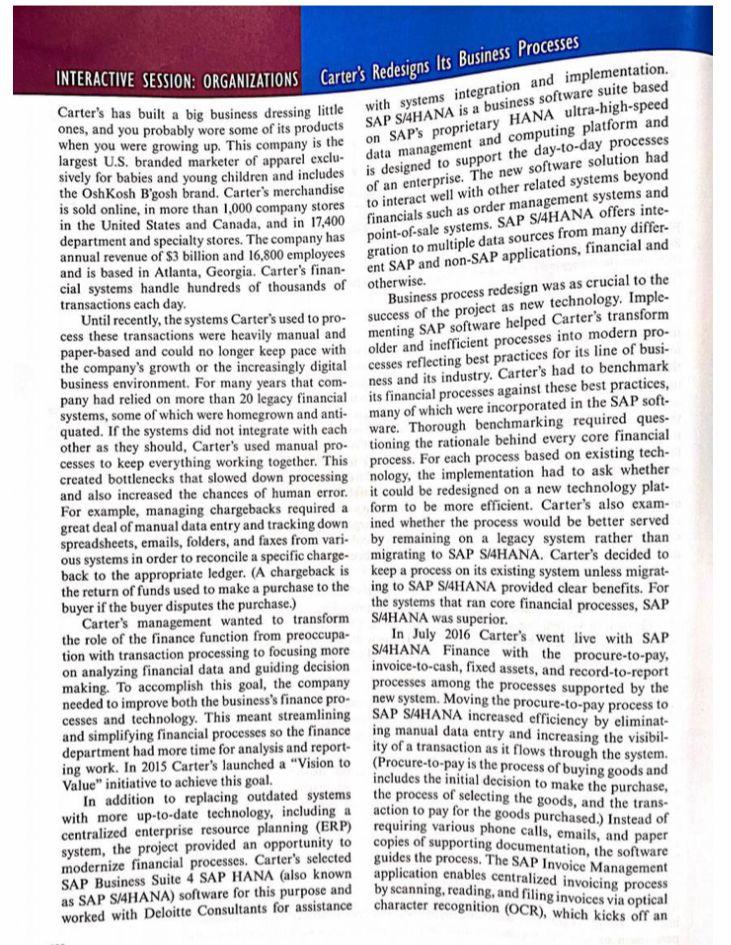
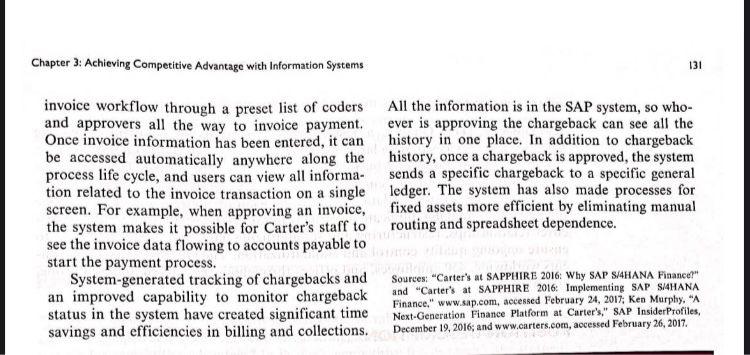
INTERACTIVE SESSION: ORGANIZATIONS Carter's Redesigns Its Business Processes Carter's has built a big business dressing little with systems integration and implementation. when you were growing up. This company is the on SAP's proprietary HANA ultra-high-speed ones, and you probably wore some of its products SAP S/4HANA is a business software suite based largest U.S. branded marketer of apparel exclu- data management and computing platform and sively for babies and young children and includes the OshKosh B'gosh brand. Carter's merchandise is sold online, in more than 1,000 company stores in the United States and Canada, and in 17,400 department and specialty stores. The company has annual revenue of $3 billion and 16,800 employees and is based in Atlanta, Georgia. Carter's finan- cial systems handle hundreds of thousands of transactions each day. is designed to support the day-to-day processes of an enterprise. The new software solution had to interact well with other related systems beyond financials such as order management systems and point-of-sale systems. SAP S/4HANA offers inte- gration to multiple data sources from many differ- ent SAP and non-SAP applications, financial and otherwise. Until recently, the systems Carter's used to pro- cess these transactions were heavily manual and paper-based and could no longer keep pace with the company's growth or the increasingly digital business environment. For many years that com- pany had relied on more than 20 legacy financial systems, some of which were homegrown and anti- quated. If the systems did not integrate with each other as they should, Carter's used manual pro- cesses to keep everything working together. This created bottlenecks that slowed down processing and also increased the chances of human error. For example, managing chargebacks required a great deal of manual data entry and tracking down spreadsheets, emails, folders, and faxes from vari- ous systems in order to reconcile a specific charge- back to the appropriate ledger. (A chargeback is the return of funds used to make a purchase to the buyer if the buyer disputes the purchase.) Business process redesign was as crucial to the success of the project as new technology. Imple- menting SAP software helped Carter's transform older and inefficient processes into modern pro- cesses reflecting best practices for its line of busi- ness and its industry. Carter's had to benchmark its financial processes against these best practices, many of which were incorporated in the SAP soft- ware. Thorough benchmarking required ques- tioning the rationale behind every core financial process. For each process based on existing tech- nology, the implementation had to ask whether it could be redesigned on a new technology plat- form to be more efficient. Carter's also exam- ined whether the process would be better served by remaining on a legacy system rather than migrating to SAP S/4HANA. Carter's decided to keep a process on its existing system unless migrat- ing to SAP S/4HANA provided clear benefits. For the systems that ran core financial processes, SAP S/4HANA was superior. Carter's management wanted to transform the role of the finance function from preoccupa- tion with transaction processing to focusing more on analyzing financial data and guiding decision making. To accomplish this goal, the company needed to improve both the business's finance pro- cesses and technology. This meant streamlining and simplifying financial processes so the finance department had more time for analysis and report- ing work. In 2015 Carter's launched a "Vision to Value" initiative to achieve this goal. In July 2016 Carter's went live with SAP S/4HANA Finance with the procure-to-pay, invoice-to-cash, fixed assets, and record-to-report processes among the processes supported by the new system. Moving the procure-to-pay process to SAP S/4HANA increased efficiency by eliminat- ing manual data entry and increasing the visibil- ity of a transaction as it flows through the system. (Procure-to-pay is the process of buying goods and includes the initial decision to make the purchase, the process of selecting the goods, and the trans- action to pay for the goods purchased.) Instead of requiring various phone calls, emails, and paper copies of supporting documentation, the software guides the process. The SAP Invoice Management application enables centralized invoicing process by scanning, reading, and filing invoices via optical character recognition (OCR), which kicks off an In addition to replacing outdated systems with more up-to-date technology, including a centralized enterprise resource planning (ERP) system, the project provided an opportunity to modernize financial processes. Carter's selected SAP Business Suite 4 SAP HANA (also known as SAP S/4HANA) software for this purpose and worked with Deloitte Consultants for assistance Chapter 3: Achieving Competitive Advantage with Information Systems invoice workflow through a preset list of coders and approvers all the way to invoice payment. Once invoice information has been entered, it can be accessed automatically anywhere along the process life cycle, and users can view all informa- tion related to the invoice transaction on a single screen. For example, when approving an invoice, the system makes it possible for Carter's staff to see the invoice data flowing to accounts payable to start the payment process. System-generated tracking of chargebacks and an improved capability to monitor chargeback status in the system have created significant time savings and efficiencies in billing and collections. 131 All the information is in the SAP system, so who- ever is approving the chargeback can see all the history in one place. In addition to chargeback history, once a chargeback is approved, the system sends a specific chargeback to a specific general ledger. The system has also made processes for fixed assets more efficient by eliminating manual routing and spreadsheet dependence. muntan Sources: "Carter's at SAPPHIRE 2016: Why SAP S/4HANA Finance?" and "Carter's at SAPPHIRE 2016: Implementing SAP S/4HANA Finance," www.sap.com, accessed February 24, 2017; Ken Murphy, "A Next-Generation Finance Platform at Carter's," SAP InsiderProfiles, December 19, 2016; and www.carters.com, accessed February 26, 2017Step by Step Solution
There are 3 Steps involved in it
1 Expert Approved Answer
Step: 1 Unlock

Question Has Been Solved by an Expert!
Get step-by-step solutions from verified subject matter experts
Step: 2 Unlock
Step: 3 Unlock
 Study Help