



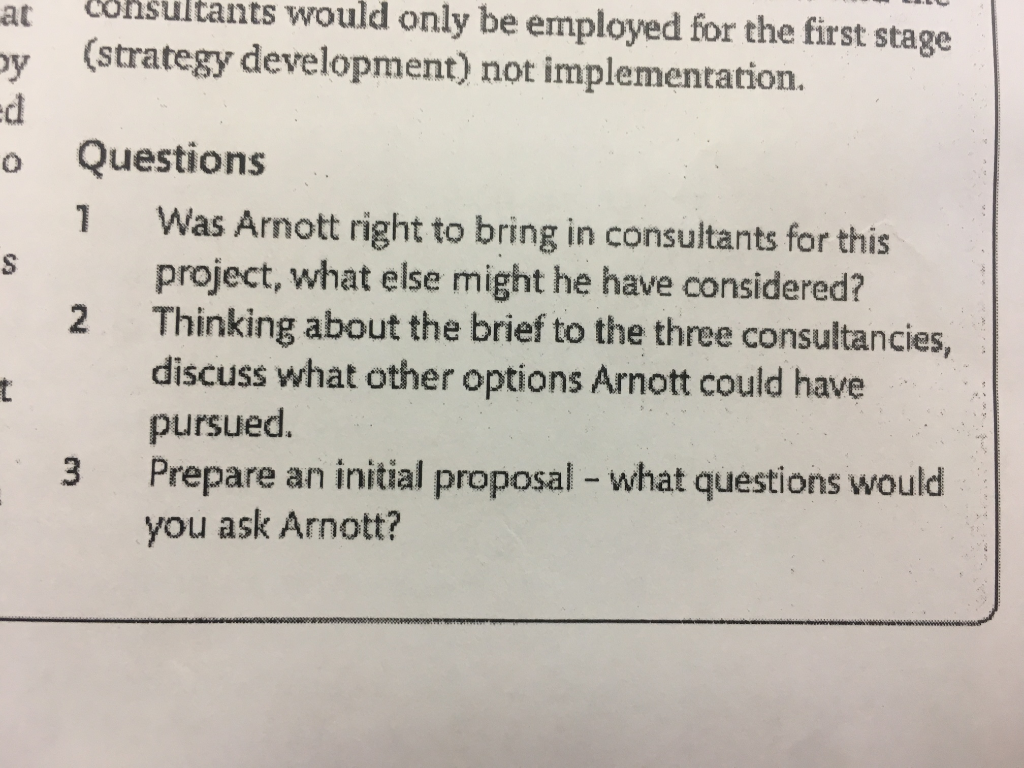
Question: answer this questions 3 : at ohsultants would only be employed for the first stage y (strategy development) not implementation. o Questions 1 Was Arnott
answer this questions 3 :
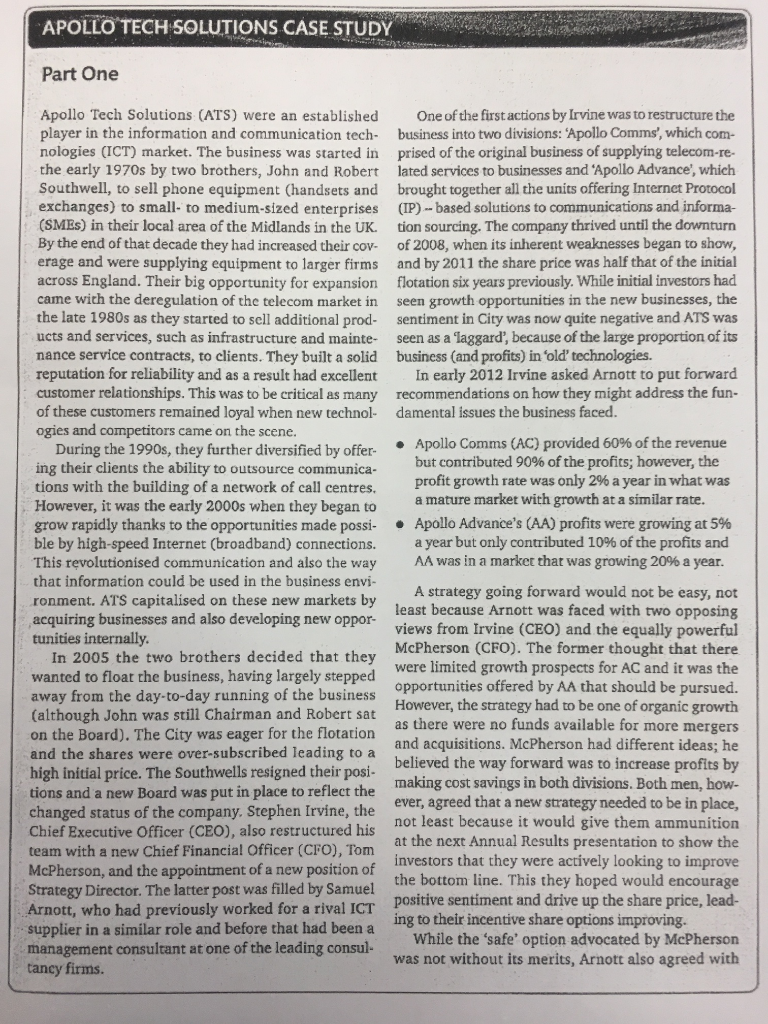
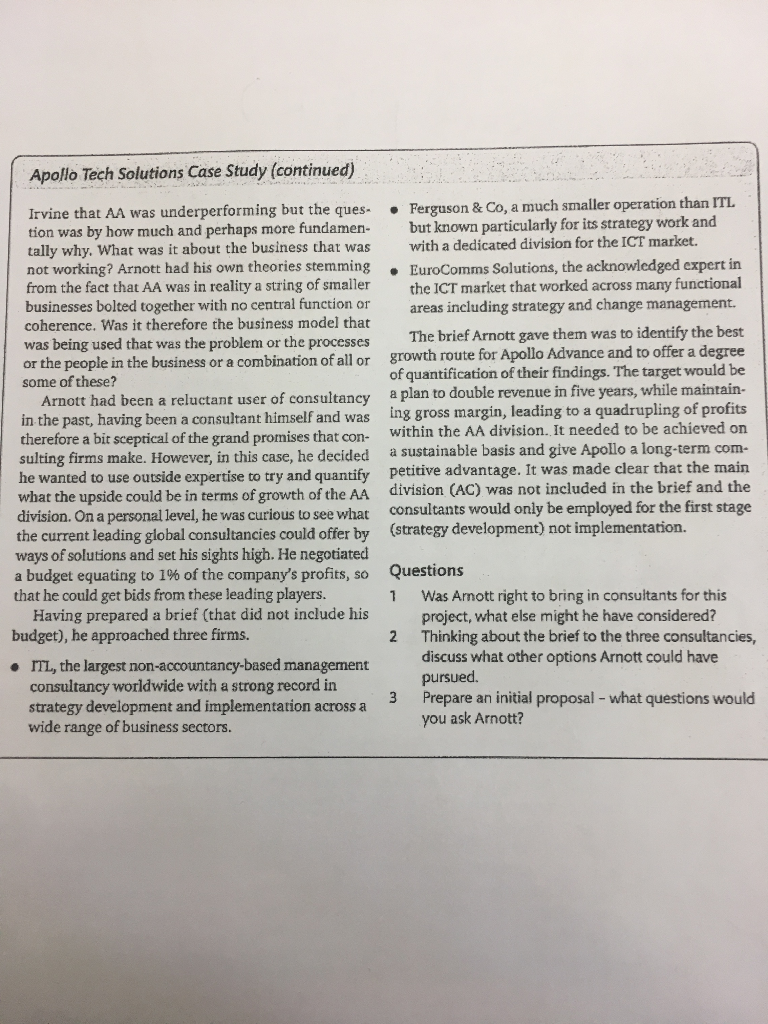
at ohsultants would only be employed for the first stage y (strategy development) not implementation. o Questions 1 Was Arnott right to bring in consultants for this project, what else might he have considered? Thinking about the brief to the three consultancies, discuss what other options Arnott could have pursued. Prepare an initial proposal - what questions would you ask Arnott? 2 3 APOLLO TECH SOLUTIONS CASE STUDY Part One Apollo Tech Solutions (ATS) were an established One of the first actions by Irvine was to restructure the player in the information and communication tech- business into two divisions: 'Apollo Comms, which com- nologies (TCT) market. The business was started in prised of the original business of supplying telecom-re- the early 1970s by two brothers, John and Robert lated services to businesses and 'Apollo Advance', which outhwell, to sell phone equipment (handsets and brought together all the units offering Internet Protocol exchanges) to small- to medium-sized enterprises (IP)-based solutions to communications and informa- (SMEs) in their local area of the Midlands in the UK. tion sourcing. The company thrived until the downturn By the end of that decade they had increased their cov of 2008, when its inherent weaknesses began to show, erage and were supplying equipment to larger firms and by 2011 the share price was half that of the initial across England. Their big opportunity for expansion flotation six years previously. While initial investors had came with the deregulation of the telecom market in seen growth opportunities in the new businesses, the the late 1980s as they started to sell additional prod- sentiment in City was now quite negative and ATS was ucts and services, such as infrastructure and mainte- seen as a laggard', because of the large proportion of its nance service contracts, to clients. They built a solid business (and profits) in 'old' technologies. reputation for reliability and as a result had excellent In early 2012 Irvine asked Arnott to put forward customer relationships. This was to be critical as many recommendations on how they might address the fun of these customers remained loyal when new technol- damental issues the business faced ogies and competitors came on the scene. Apollo Comms (AC) provided 60% of the revenue During the 1990s, they further diversified by offer- ing their clients the ability to outsource communica tions with the building of a network of call centres, However, it was the early 2000s when they began to grow rapidly thanks to the opportunities made possi- ble by high-speed Internet (broadband) connections, This revolutionised communication and also the way that information could be used in the business envi ronment. ATS capitalised on these new markets by acquiring businesses and also developing new oppor but contributed 90% of the profits; however, the profit growth rate was only 2% a year in what was a mature market with growth at a similar rate Apollo Advance's (AA) profits were growing at 5% a year but only contributed 10% of the profits and AA was in a market that was growing 20% a year . A strategy going forward would not be easy, not least because Arnott was faced with two opposing views from Irvine (CEO) and the equally powerful McPherson (CFO). The former thought that there tunities internally In 2005 the two brothers decided that they wanted to float the business, having largely stepped away from the day-to-day running of the business (although John was still Chairman and Robert sat on the Board). The City was eager for the flotation and the shares were over-subscribed leading to a high initial price. The Southwells resigned their posi ons and a new Board was put in place to reflect the nged status of the company. Stephen Irvine, the Chief Executive Officer (CEO), also restructured his team with a new Chief Financial Officer (CFO), Tom McPherson, and the appointment of a new position of Strategy Director. The latter post was filled by Samuel Arnott, who had previously worked for a rival ICT supplier in a similar role and before that had a management consultant at one of the leading consul- e limited growth prospects for AC and it was th opportunities offered by AA that should be pursued. However, the strategy had to be one of organic growth as there were no funds available for more mergers and acquisitions. McPherson had different ideas; h believed the way forward was to increase profits by making cost savings in both divisions. Both men, how- ever, agreed that a new strategy needed to be in place not least because it would give them ammunition at the next Annual Results presentation to show the investors that they were actively looking to improve the bottom line. This they hoped would encourage positive sentiment and drive up the share price, lead- beena ing to their incentive share options improving While the 'safe' option advocated by McPherson was not without its merits, Arnott also agreed with tancy firms Apollo Tech Solutions Case Study (continued) Irvine that AA was underperforming but the ques erguson & Co, a much smaller operation than ITL tion was by how much and perhap tally why. What was it about the business that was with a dedicated division for the ICT market. not working? Arnott had his own theories stemmingEuroComms Solutions, the acknowledged expert in from the fact that AA was in reality a string of smaller the 1CT market that worked across many functional businesses bolted together with no central function or areas including strategy and change management. coherence. Was it therefore the business model that was being used that was the problem or the processes or the people in the business or a combination of all or growth route for Apollo Advance and to offer a degree some of these? ps more fundamen but known particularly for its strategy work and The brief Arnott gave them was to identify the best of quantification of their findings. The target would be while maintain- Arnott had been a reluctant user of consultancy a plan to double revenue in five years, in the past, having been a consultant himself and was ing gross margin, leading to a qu adrupling of profits ore a bit sceptical of the grand promises that con- tise to try and quantify level, he was curious to see what within the AA division. It needed to be achieved on a sustainable basis and give Apollo a long-term com- petitive advantage. It was made clear that the main division (AC) was not included in the brief and the consultants would only be employed for the first stage (strategy development) not implementation. sulting firms make. However, in this case, he decided what the upside could be in terms of growth of the AA division. On a personal the current leading global consultancies could offer by ways of solutions and set his sights high. He negotiated a budget equating to 1% of the company's profits, so that he could get bids from these leading players. Questions 1 Was Arnott right to bring in consultants for this project, what else might he have considered? Thinking about the brief to the three consultancies, discuss what other options Arnott could have pursued. Prepare an initial proposal - what questions would you ask Arnott? Having prepared a brief (that did not include his budget), he approached three firms. ITL, the largest non-accountancy-based management 2 consultancy worldwide with a strong record in strategy development and implementation across a wide range of business sectors. 3 at ohsultants would only be employed for the first stage y (strategy development) not implementation. o Questions 1 Was Arnott right to bring in consultants for this project, what else might he have considered? Thinking about the brief to the three consultancies, discuss what other options Arnott could have pursued. Prepare an initial proposal - what questions would you ask Arnott? 2 3 APOLLO TECH SOLUTIONS CASE STUDY Part One Apollo Tech Solutions (ATS) were an established One of the first actions by Irvine was to restructure the player in the information and communication tech- business into two divisions: 'Apollo Comms, which com- nologies (TCT) market. The business was started in prised of the original business of supplying telecom-re- the early 1970s by two brothers, John and Robert lated services to businesses and 'Apollo Advance', which outhwell, to sell phone equipment (handsets and brought together all the units offering Internet Protocol exchanges) to small- to medium-sized enterprises (IP)-based solutions to communications and informa- (SMEs) in their local area of the Midlands in the UK. tion sourcing. The company thrived until the downturn By the end of that decade they had increased their cov of 2008, when its inherent weaknesses began to show, erage and were supplying equipment to larger firms and by 2011 the share price was half that of the initial across England. Their big opportunity for expansion flotation six years previously. While initial investors had came with the deregulation of the telecom market in seen growth opportunities in the new businesses, the the late 1980s as they started to sell additional prod- sentiment in City was now quite negative and ATS was ucts and services, such as infrastructure and mainte- seen as a laggard', because of the large proportion of its nance service contracts, to clients. They built a solid business (and profits) in 'old' technologies. reputation for reliability and as a result had excellent In early 2012 Irvine asked Arnott to put forward customer relationships. This was to be critical as many recommendations on how they might address the fun of these customers remained loyal when new technol- damental issues the business faced ogies and competitors came on the scene. Apollo Comms (AC) provided 60% of the revenue During the 1990s, they further diversified by offer- ing their clients the ability to outsource communica tions with the building of a network of call centres, However, it was the early 2000s when they began to grow rapidly thanks to the opportunities made possi- ble by high-speed Internet (broadband) connections, This revolutionised communication and also the way that information could be used in the business envi ronment. ATS capitalised on these new markets by acquiring businesses and also developing new oppor but contributed 90% of the profits; however, the profit growth rate was only 2% a year in what was a mature market with growth at a similar rate Apollo Advance's (AA) profits were growing at 5% a year but only contributed 10% of the profits and AA was in a market that was growing 20% a year . A strategy going forward would not be easy, not least because Arnott was faced with two opposing views from Irvine (CEO) and the equally powerful McPherson (CFO). The former thought that there tunities internally In 2005 the two brothers decided that they wanted to float the business, having largely stepped away from the day-to-day running of the business (although John was still Chairman and Robert sat on the Board). The City was eager for the flotation and the shares were over-subscribed leading to a high initial price. The Southwells resigned their posi ons and a new Board was put in place to reflect the nged status of the company. Stephen Irvine, the Chief Executive Officer (CEO), also restructured his team with a new Chief Financial Officer (CFO), Tom McPherson, and the appointment of a new position of Strategy Director. The latter post was filled by Samuel Arnott, who had previously worked for a rival ICT supplier in a similar role and before that had a management consultant at one of the leading consul- e limited growth prospects for AC and it was th opportunities offered by AA that should be pursued. However, the strategy had to be one of organic growth as there were no funds available for more mergers and acquisitions. McPherson had different ideas; h believed the way forward was to increase profits by making cost savings in both divisions. Both men, how- ever, agreed that a new strategy needed to be in place not least because it would give them ammunition at the next Annual Results presentation to show the investors that they were actively looking to improve the bottom line. This they hoped would encourage positive sentiment and drive up the share price, lead- beena ing to their incentive share options improving While the 'safe' option advocated by McPherson was not without its merits, Arnott also agreed with tancy firms Apollo Tech Solutions Case Study (continued) Irvine that AA was underperforming but the ques erguson & Co, a much smaller operation than ITL tion was by how much and perhap tally why. What was it about the business that was with a dedicated division for the ICT market. not working? Arnott had his own theories stemmingEuroComms Solutions, the acknowledged expert in from the fact that AA was in reality a string of smaller the 1CT market that worked across many functional businesses bolted together with no central function or areas including strategy and change management. coherence. Was it therefore the business model that was being used that was the problem or the processes or the people in the business or a combination of all or growth route for Apollo Advance and to offer a degree some of these? ps more fundamen but known particularly for its strategy work and The brief Arnott gave them was to identify the best of quantification of their findings. The target would be while maintain- Arnott had been a reluctant user of consultancy a plan to double revenue in five years, in the past, having been a consultant himself and was ing gross margin, leading to a qu adrupling of profits ore a bit sceptical of the grand promises that con- tise to try and quantify level, he was curious to see what within the AA division. It needed to be achieved on a sustainable basis and give Apollo a long-term com- petitive advantage. It was made clear that the main division (AC) was not included in the brief and the consultants would only be employed for the first stage (strategy development) not implementation. sulting firms make. However, in this case, he decided what the upside could be in terms of growth of the AA division. On a personal the current leading global consultancies could offer by ways of solutions and set his sights high. He negotiated a budget equating to 1% of the company's profits, so that he could get bids from these leading players. Questions 1 Was Arnott right to bring in consultants for this project, what else might he have considered? Thinking about the brief to the three consultancies, discuss what other options Arnott could have pursued. Prepare an initial proposal - what questions would you ask Arnott? Having prepared a brief (that did not include his budget), he approached three firms. ITL, the largest non-accountancy-based management 2 consultancy worldwide with a strong record in strategy development and implementation across a wide range of business sectors. 3
Step by Step Solution
There are 3 Steps involved in it

Get step-by-step solutions from verified subject matter experts