Question: Answer three Question which are highlighted CASE STUDY Muhammad Yunus; Founder of Grameen Bank and Winner of the Nobel Peace Prize (2006) Muhammad Yunus is
Answer three Question which are highlighted
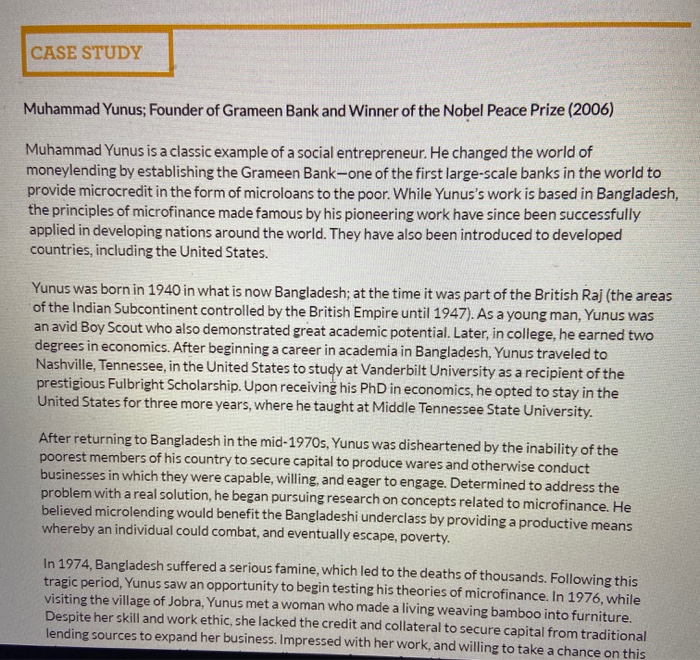
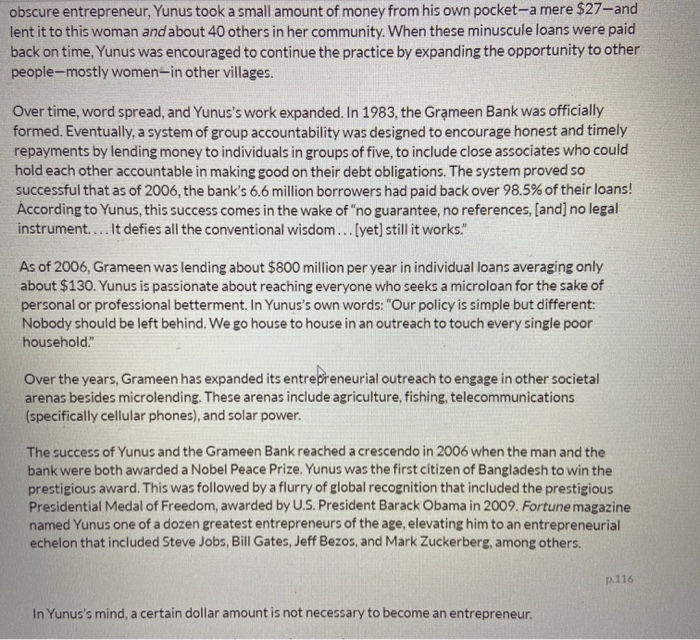
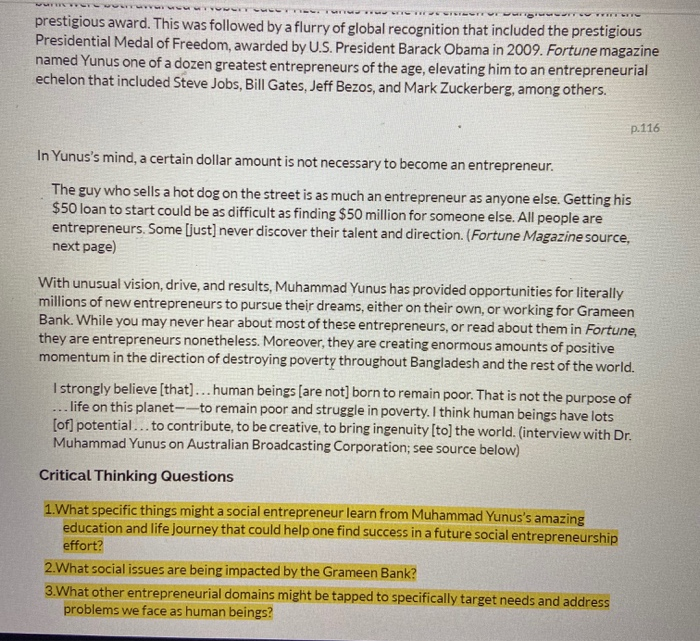
CASE STUDY Muhammad Yunus; Founder of Grameen Bank and Winner of the Nobel Peace Prize (2006) Muhammad Yunus is a classic example of a social entrepreneur. He changed the world of moneylending by establishing the Grameen Bank-one of the first large-scale banks in the world to provide microcredit in the form of microloans to the poor. While Yunus's work is based in Bangladesh, the principles of microfinance made famous by his pioneering work have since been successfully applied in developing nations around the world. They have also been introduced to developed countries, including the United States. Yunus was born in 1940 in what is now Bangladesh; at the time it was part of the British Raj (the areas of the Indian Subcontinent controlled by the British Empire until 1947). As a young man, Yunus was an avid Boy Scout who also demonstrated great academic potential. Later, in college, he earned two degrees in economics. After beginning a career in academia in Bangladesh, Yunus traveled to Nashville, Tennessee, in the United States to study at Vanderbilt University as a recipient of the prestigious Fulbright Scholarship. Upon receiving his PhD in economics, he opted to stay in the United States for three more years, where he taught at Middle Tennessee State University. After returning to Bangladesh in the mid-1970s, Yunus was disheartened by the inability of the poorest members of his country to secure capital to produce wares and otherwise conduct businesses in which they were capable, willing, and eager to engage. Determined to address the problem with a real solution, he began pursuing research on concepts related to microfinance. He believed microlending would benefit the Bangladeshi underclass by providing a productive means whereby an individual could combat, and eventually escape, poverty. In 1974, Bangladesh suffered a serious famine, which led to the deaths of thousands. Following this tragic period, Yunus saw an opportunity to begin testing his theories of microfinance. In 1976, while visiting the village of Jobra, Yunus met a woman who made a living weaving bamboo into furniture. Despite her skill and work ethic, she lacked the credit and collateral to secure capital from traditional lending sources to expand her business. Impressed with her work, and willing to take a chance on this obscure entrepreneur, Yunus took a small amount of money from his own pocket-a mere $27-and lent it to this woman and about 40 others in her community. When these minuscule loans were paid back on time, Yunus was encouraged to continue the practice by expanding the opportunity to other people-mostly women-in other villages. Over time, word spread, and Yunus's work expanded. In 1983, the Grameen Bank was officially formed. Eventually, a system of group accountability was designed to encourage honest and timely repayments by lending money to individuals in groups of five, to include close associates who could hold each other accountable in making good on their debt obligations. The system proved so successful that as of 2006, the bank's 6.6 million borrowers had paid back over 98.5% of their loans! According to Yunus, this success comes in the wake of "no guarantee, no references, [and] no legal instrument.... It defies all the conventional wisdom... [yet] still it works." As of 2006, Grameen was lending about $800 million per year in individual loans averaging only about $130. Yunus is passionate about reaching everyone who seeks a microloan for the sake of personal or professional betterment. In Yunus's own words: "Our policy is simple but different: Nobody should be left behind. We go house to house in an outreach to touch every single poor household." Over the years, Grameen has expanded its entrepreneurial outreach to engage in other societal arenas besides microlending. These arenas include agriculture, fishing, telecommunications (specifically cellular phones), and solar power. The success of Yunus and the Grameen Bank reached a crescendo in 2006 when the man and the bank were both awarded a Nobel Peace Prize. Yunus was the first citizen of Bangladesh to win the prestigious award. This was followed by a flurry of global recognition that included the prestigious Presidential Medal of Freedom, awarded by U.S. President Barack Obama in 2009. Fortune magazine named Yunus one of a dozen greatest entrepreneurs of the age, elevating him to an entrepreneurial echelon that included Steve Jobs, Bill Gates, Jeff Bezos, and Mark Zuckerberg, among others. p. 116 In Yunus's mind, a certain dollar amount is not necessary to become an entrepreneur E ELARVEST www wwwwwwwwwwwwww prestigious award. This was followed by a flurry of global recognition that included the prestigious Presidential Medal of Freedom, awarded by U.S. President Barack Obama in 2009. Fortune magazine named Yunus one of a dozen greatest entrepreneurs of the age, elevating him to an entrepreneurial echelon that included Steve Jobs, Bill Gates, Jeff Bezos, and Mark Zuckerberg, among others. p.116 In Yunus's mind, a certain dollar amount is not necessary to become an entrepreneur. The guy who sells a hot dog on the street is as much an entrepreneur as anyone else. Getting his $50 loan to start could be as difficult as finding $50 million for someone else. All people are entrepreneurs. Some (just) never discover their talent and direction. (Fortune Magazine source, next page) With unusual vision, drive, and results, Muhammad Yunus has provided opportunities for literally millions of new entrepreneurs to pursue their dreams, either on their own, or working for Grameen Bank. While you may never hear about most of these entrepreneurs, or read about them in Fortune, they are entrepreneurs nonetheless. Moreover, they are creating enormous amounts of positive momentum in the direction of destroying poverty throughout Bangladesh and the rest of the world. I strongly believe (that)... human beings (are not] born to remain poor. That is not the purpose of ... life on this planet-- to remain poor and struggle in poverty. I think human beings have lots [of] potential... to contribute, to be creative, to bring ingenuity (to) the world. (interview with Dr. Muhammad Yunus on Australian Broadcasting Corporation; see source below) Critical Thinking Questions 1. What specific things might a social entrepreneur learn from Muhammad Yunus's amazing education and life journey that could help one find success in a future social entrepreneurship effort? 2.What social issues are being impacted by the Grameen Bank? 3.What other entrepreneurial domains might be tapped to specifically target needs and address problems we face as human beings









 Study Help