







Question: Answer to #3 in MATLAB code Example given 1.) Use dsolve to obtain a symbolic expression for the zero-input response for the following system: y
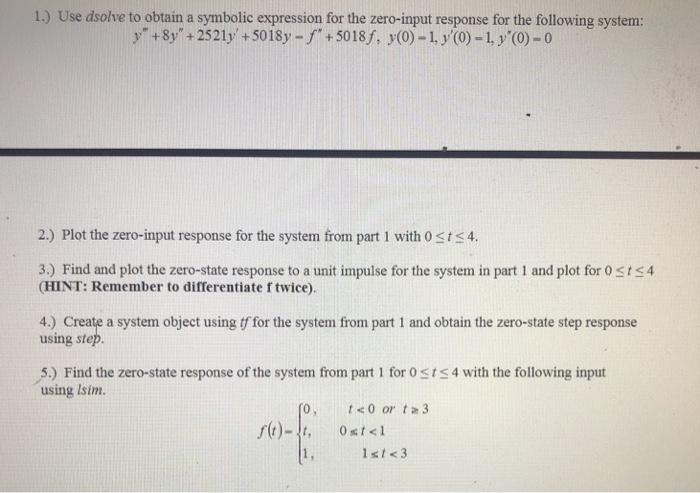
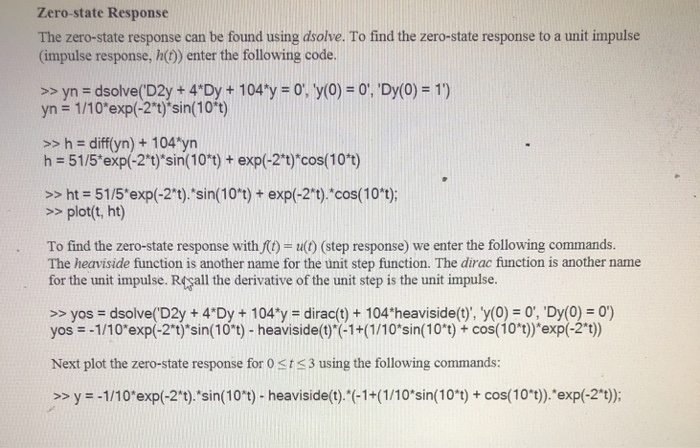
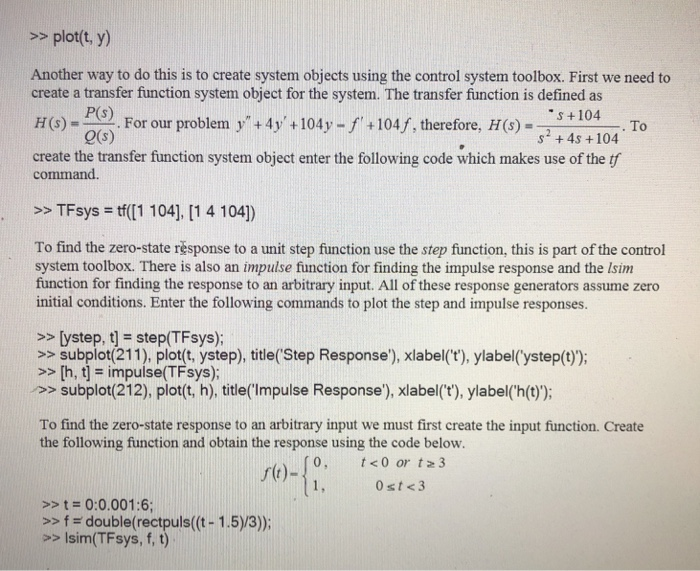
1.) Use dsolve to obtain a symbolic expression for the zero-input response for the following system: y" + 8y" + 25 21 y, + 50 18y-/" + 5018/, y(0)-l, y(0)-1, y"(0)-0 2.) Plot the zero-input response for the system from part 1 with 0 sts4. 3.) Find and plot the zero-state response to a unit impulse for the system in part 1 and plot for Osts4 CHINT: Remember to differentiate f twice). 4.) Create a system object using tffor the system from part 1 and obtain the zero-state step response using step. 5.) Find the zero-state response of the system from part 1 for OSts4 with the following input using Isim 0, t plott, y) Another way to do this is to create system objects using the control system toolbox. First we need to create a transfer function system object for the system. The transfer function is defined as -PG). For our problem y" +4y, +104y-j" +104/, therefore, H(s). s+104 s +4s +104 0 O(s) create the transfer function system object enter the following code which makes use of the tf command >> TFsys t1 104], [1 4 104]) To find the zero-state response to a unit step function use the step function, this is part of the control system toolbox. There is also an impulse function for finding the impulse response and the Isim function for finding the response to an arbitrary input. All of these response generators assume zero initial conditions. Enter the following commands to plot the step and impulse responses. >> [ystep, t step(TFsys); >subplot(211), plot(t, ystep), title(Step Response), xlabel('t), ylabel('ystep()); >> h, t]impulse(TFsys); >s subplot(212), plot(t, h), title(Impulse Response), xlabel(t), ylabel(h(t); To find the zero-state response to an arbitrary input we must first create the input function. Create the following function and obtain the response using the code below. so)- 0, tt 0:0.001:6; >>f double(rectpuls(t- 1.5)/3)); >> Isim(TFsys, f, t)
Step by Step Solution
There are 3 Steps involved in it

Get step-by-step solutions from verified subject matter experts
 Study Help