Question: Answer two questions from this section. 1. (a) 'The girls' parents pay fees that contribute towards the operating costs of the school. Using two examples,
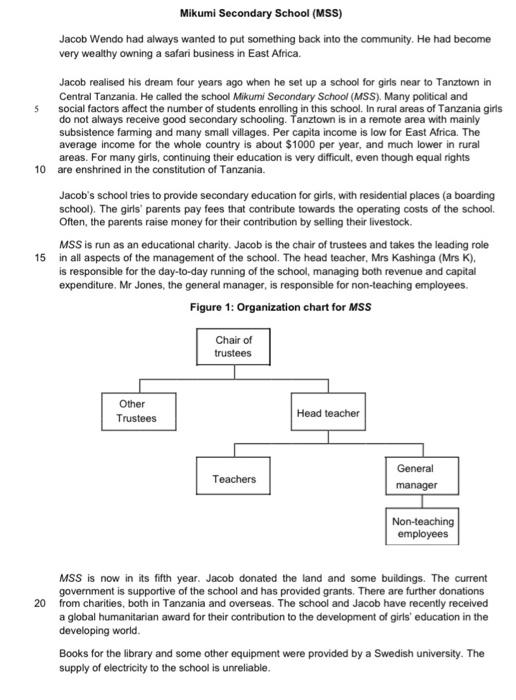
Answer two questions from this section. 1. (a) 'The girls' parents pay fees that contribute towards the operating costs of the school. Using two examples, explain the impact of operating costs incurred by MSS on their break-even point. (b) Explain how the school could overcome high labour turnover using one financial and one non-financial reward. 2. (a) Identify and describe any two functions carried out by Jacob as the chair of trustees. (b) Suggest any two promotional strategies that MSS could implement to attract more students from Dodoma and the neighbouring countries. 3. (a) Identify any two external sources of finance available to MSS. Explain how MSS CO use these funds. (b) Explain two features of MSS's organisation structure using appropriate examples from the case study 5 Mikumi Secondary School (MSS) Jacob Wendo had always wanted to put something back into the community. He had become very wealthy owning a safari business in East Africa. Jacob realised his dream four years ago when he set up a school for girls near to Tanztown in Central Tanzania. He called the school Mikumi Secondary School (MSS). Many political and social factors affect the number of students enrolling in this school . In rural areas of Tanzania girls do not always receive good secondary schooling. Tanztown is in a remote area with mainly subsistence farming and many small villages. Per capita income is low for East Africa. The average income for the whole country is about $1000 per year, and much lower in rural areas. For many girls, continuing their education is very difficult, even though equal rights 10 are enshrined in the constitution of Tanzania. Jacob's school tries to provide secondary education for girls, with residential places (a boarding school). The girls' parents pay fees that contribute towards the operating costs of the school. Often, the parents raise money for their contribution by selling their livestock. MSS is run as an educational charity. Jacob is the chair of trustees and takes the leading role 15 in all aspects of the management of the school. The head teacher, Mrs Kashinga (Mrs K). is responsible for the day-to-day running of the school, managing both revenue and capital expenditure, Mr Jones, the general manager, is responsible for non-teaching employees Figure 1: Organization chart for MSS Chair of trustees Other Trustees Head teacher Teachers General manager Non-teaching employees MSS is now in its fifth year. Jacob donated the land and some buildings. The current government is supportive of the school and has provided grants. There are further donations 20 from charities, both in Tanzania and overseas. The school and Jacob have recently received a global humanitarian award for their contribution to the development of girls' education in the developing world Books for the library and some other equipment were provided by a Swedish university. The supply of electricity to the school is unreliable. 25 Jacob wants the students to do a lot more than just study. They are very active in sports and engage in varied activities, such as singing, debating, community service and putting on drama performances. They also grow some of their own food on land that the school owns, which helps with economic and ecological sustainability. Jacob is also keen that the students are taught a strong sense of ethical values, and the whole school is managed based on ethical 30 considerations. Results of national tests have been very good and many of the students are excited to continue their education beyond school. Starting MSS from nothing was difficult and Jacob recognized the need for expansion in the early years to break-even. Initially, recruiting students was straightforward, but now the school needs to be marketed to a wider area, including Dodoma, the capital city. The school will have 35 to attract girls away from some of the schools in Dodoma, and could attract students from neighbouring countries. This could achieve economies of scale. Jacob thinks that the school should produce mission and vision statements and capitalize on the very positive word-of- mouth promotion that has come from the humanitarian award. MSS pays teachers according to the standard government pay scales. However, the school 40 is finding it difficult to recruit and retain teachers. There is high labour turnover of about 30 %. Some of the teachers who left said that they enjoyed teaching at the school and agreed with its vision, but that the teachers' living accommodation, which is essential because of the remote location of the school, was of poor quality. Others said that they found it difficult teaching only in English, as required for the national examinations, rather than sometimes using Ki-Swahili, 45 which is spoken by most of the students. Some also said that there were no possibilities for career and professional development because the only possible promotion post is held by Mrs K. The school has a flat organizational structure. Until now, MSS has had no IT facilities, but it has recently received ten laptops from Africa Infinity, a UK-based organization that recycles laptops for use in developing countries. 50 The head teacher sees this as an opportunity to convert one of the classrooms into an IT centre. Few local schools have any IT facilities and an IT centre could be included in the marketing mix and become a unique selling point (USP), at least locally. The conversion of the classroom would be expensive and MSS needs external finance. Companies, products, or individuals named in this case study are fictitious and any similarities with actual entities are purely coincidental. Answer two questions from this section. 1. (a) 'The girls' parents pay fees that contribute towards the operating costs of the school. Using two examples, explain the impact of operating costs incurred by MSS on their break-even point. (b) Explain how the school could overcome high labour turnover using one financial and one non-financial reward. 2. (a) Identify and describe any two functions carried out by Jacob as the chair of trustees. (b) Suggest any two promotional strategies that MSS could implement to attract more students from Dodoma and the neighbouring countries. 3. (a) Identify any two external sources of finance available to MSS. Explain how MSS CO use these funds. (b) Explain two features of MSS's organisation structure using appropriate examples from the case study 5 Mikumi Secondary School (MSS) Jacob Wendo had always wanted to put something back into the community. He had become very wealthy owning a safari business in East Africa. Jacob realised his dream four years ago when he set up a school for girls near to Tanztown in Central Tanzania. He called the school Mikumi Secondary School (MSS). Many political and social factors affect the number of students enrolling in this school . In rural areas of Tanzania girls do not always receive good secondary schooling. Tanztown is in a remote area with mainly subsistence farming and many small villages. Per capita income is low for East Africa. The average income for the whole country is about $1000 per year, and much lower in rural areas. For many girls, continuing their education is very difficult, even though equal rights 10 are enshrined in the constitution of Tanzania. Jacob's school tries to provide secondary education for girls, with residential places (a boarding school). The girls' parents pay fees that contribute towards the operating costs of the school. Often, the parents raise money for their contribution by selling their livestock. MSS is run as an educational charity. Jacob is the chair of trustees and takes the leading role 15 in all aspects of the management of the school. The head teacher, Mrs Kashinga (Mrs K). is responsible for the day-to-day running of the school, managing both revenue and capital expenditure, Mr Jones, the general manager, is responsible for non-teaching employees Figure 1: Organization chart for MSS Chair of trustees Other Trustees Head teacher Teachers General manager Non-teaching employees MSS is now in its fifth year. Jacob donated the land and some buildings. The current government is supportive of the school and has provided grants. There are further donations 20 from charities, both in Tanzania and overseas. The school and Jacob have recently received a global humanitarian award for their contribution to the development of girls' education in the developing world Books for the library and some other equipment were provided by a Swedish university. The supply of electricity to the school is unreliable. 25 Jacob wants the students to do a lot more than just study. They are very active in sports and engage in varied activities, such as singing, debating, community service and putting on drama performances. They also grow some of their own food on land that the school owns, which helps with economic and ecological sustainability. Jacob is also keen that the students are taught a strong sense of ethical values, and the whole school is managed based on ethical 30 considerations. Results of national tests have been very good and many of the students are excited to continue their education beyond school. Starting MSS from nothing was difficult and Jacob recognized the need for expansion in the early years to break-even. Initially, recruiting students was straightforward, but now the school needs to be marketed to a wider area, including Dodoma, the capital city. The school will have 35 to attract girls away from some of the schools in Dodoma, and could attract students from neighbouring countries. This could achieve economies of scale. Jacob thinks that the school should produce mission and vision statements and capitalize on the very positive word-of- mouth promotion that has come from the humanitarian award. MSS pays teachers according to the standard government pay scales. However, the school 40 is finding it difficult to recruit and retain teachers. There is high labour turnover of about 30 %. Some of the teachers who left said that they enjoyed teaching at the school and agreed with its vision, but that the teachers' living accommodation, which is essential because of the remote location of the school, was of poor quality. Others said that they found it difficult teaching only in English, as required for the national examinations, rather than sometimes using Ki-Swahili, 45 which is spoken by most of the students. Some also said that there were no possibilities for career and professional development because the only possible promotion post is held by Mrs K. The school has a flat organizational structure. Until now, MSS has had no IT facilities, but it has recently received ten laptops from Africa Infinity, a UK-based organization that recycles laptops for use in developing countries. 50 The head teacher sees this as an opportunity to convert one of the classrooms into an IT centre. Few local schools have any IT facilities and an IT centre could be included in the marketing mix and become a unique selling point (USP), at least locally. The conversion of the classroom would be expensive and MSS needs external finance. Companies, products, or individuals named in this case study are fictitious and any similarities with actual entities are purely coincidental









 Study Help