Question: Answer underline? Points will be awarded based on participation (both days required for full points), following directions, effort, and correct answers for certain select questions.
Answer underline?
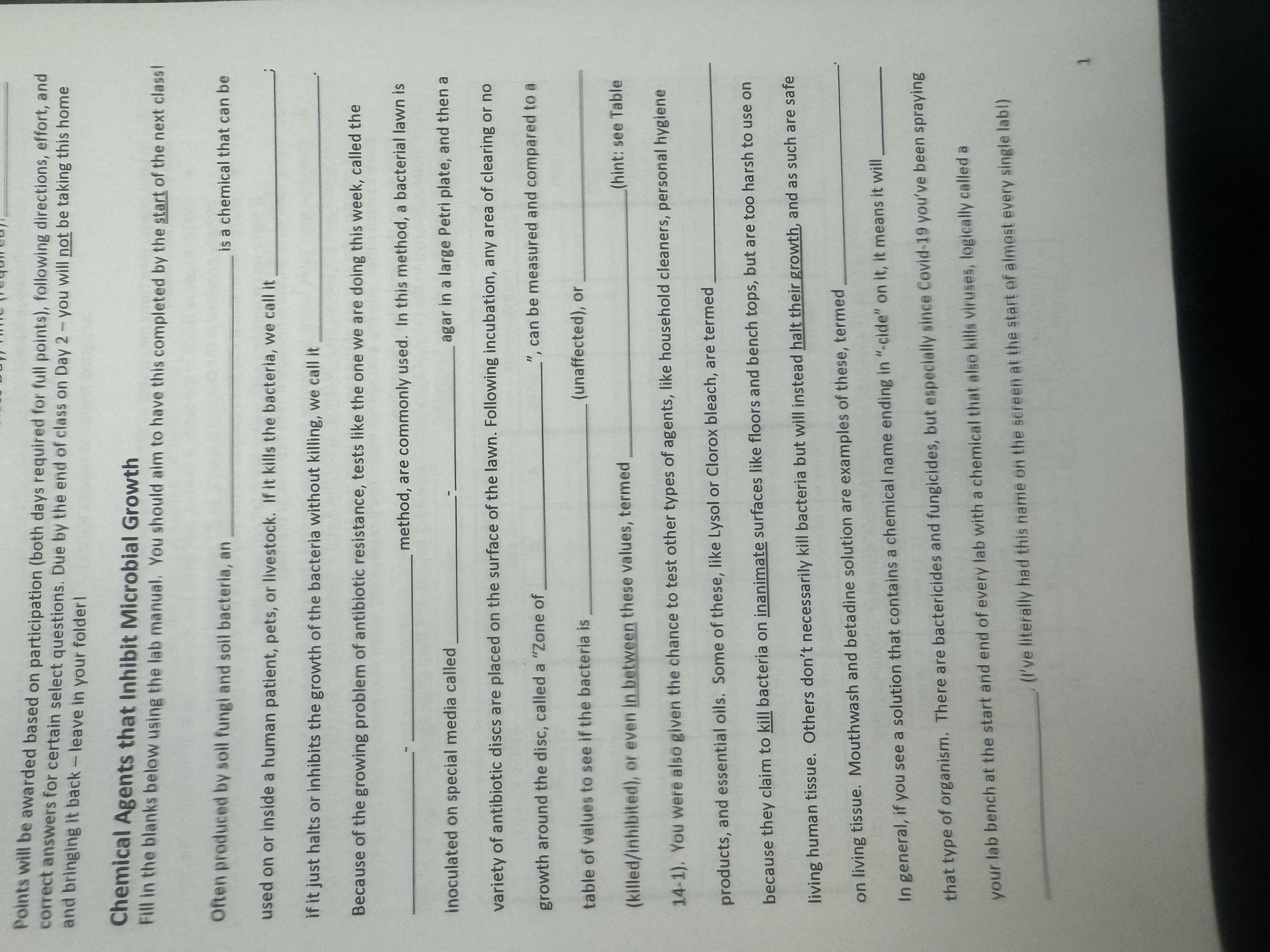
Points will be awarded based on participation (both days required for full points), following directions, effort, and correct answers for certain select questions. Due by the end of class on Day 2 - you will not be taking this home and bringing it back - leave in your folderl Chemical Agents that Inhibit Microbial Growth Fill in the blanks below using the lab manual, You should aim to have this completed by the start of the next class! Often produced by soll fungi and soil bacteria, an is a chemical that can be used on or inside a human patient, pets, or livestock. If it kills the bacteria, we call it if it just halts or inhibits the growth of the bacteria without killing, we call it Because of the growing problem of antibiotic resistance, tests like the one we are doing this week, called the method, are commonly used. In this method, a bacterial lawn is inoculated on special media called agar in a large Petri plate, and then a variety of antibiotic discs are placed on the surface of the lawn. Following incubation, any area of clearing or no growth around the disc, called a "Zone of ", can be measured and compared to a table of values to see if the bacteria is (unaffected), or (killed/inhibited), or even in between these values, termed (hint: see Table 14-1). You were also given the chance to test other types of agents, like household cleaners, personal hygiene products, and essential oils. Some of these, like Lysol or Clorox bleach, are termed because they claim to kill bacteria on inanimate surfaces like floors and bench tops, but are too harsh to use on living human tissue. Others don't necessarily kill bacteria but will instead halt their growth, and as such are safe on living tissue. Mouthwash and betadine solution are examples of these, termed In general, if you see a solution that contains a chemical name ending in "-cide" on it, it means it will that type of organism. There are bactericides and fungicides, but especially since Covid-19 you've been spraying your lab bench at the start and end of every lab with a chemical that also kills viruses, logically called a (I've literally had this name on the screen at the start of almost every single labl)









 Study Help