







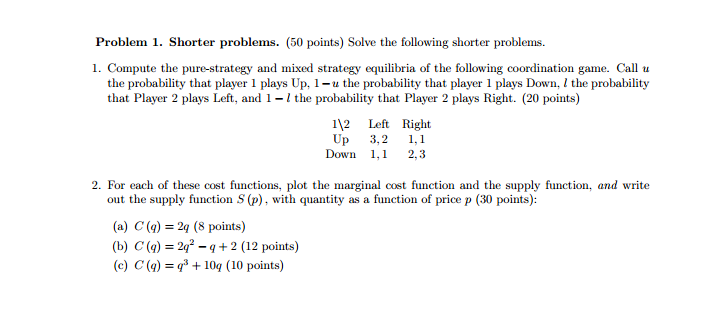
Question: Answers plus calculations Problem 1. Shorter problems. (50 points) Solve the following shorter problems. 1. Compute the pure-strategy and mixed strategy equilibria of the following
Answers plus calculations
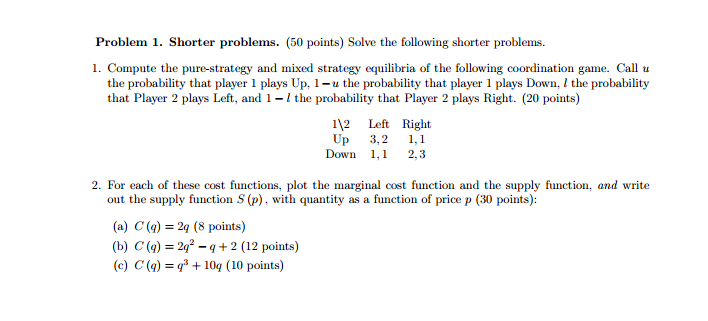
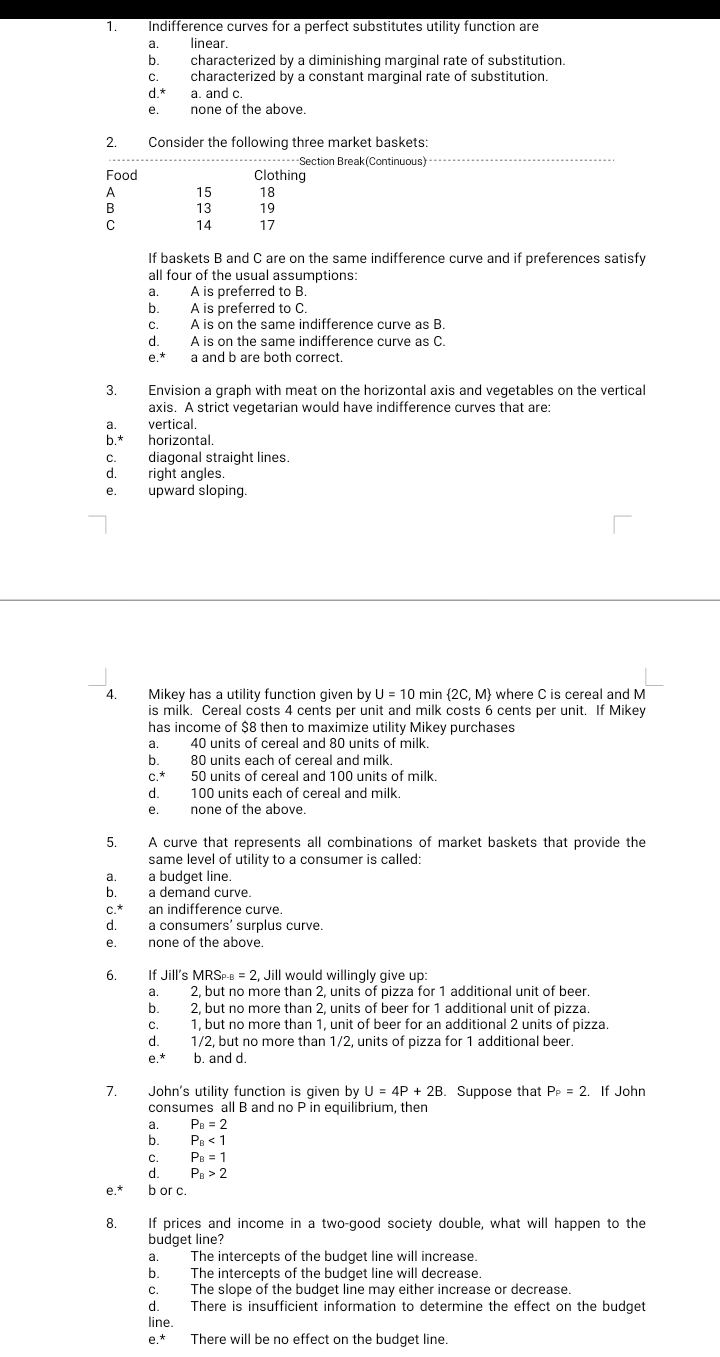
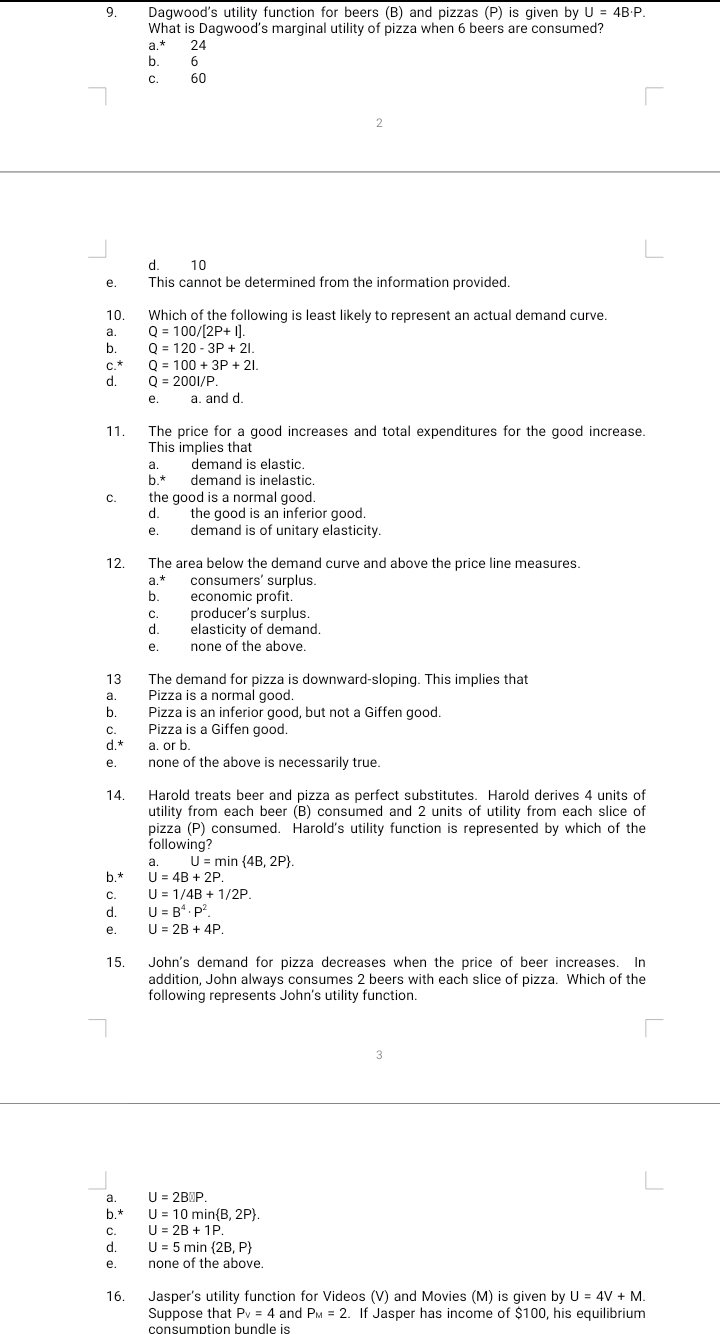
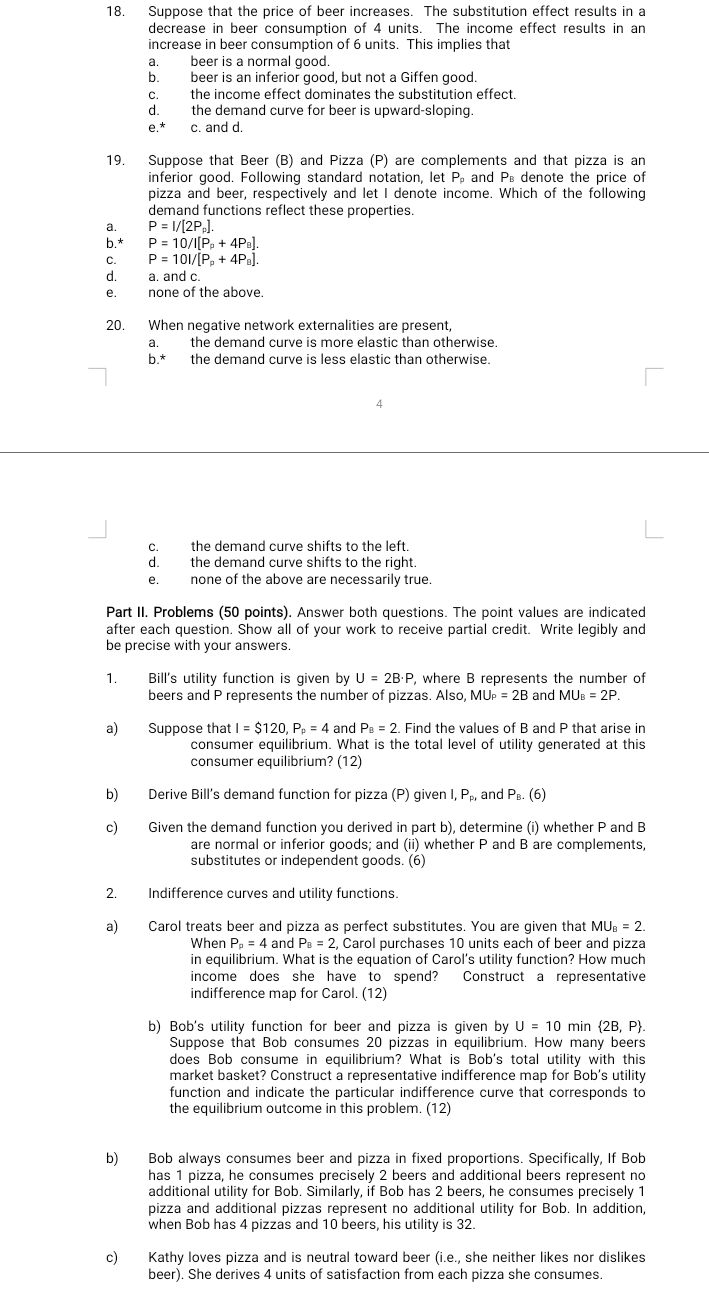
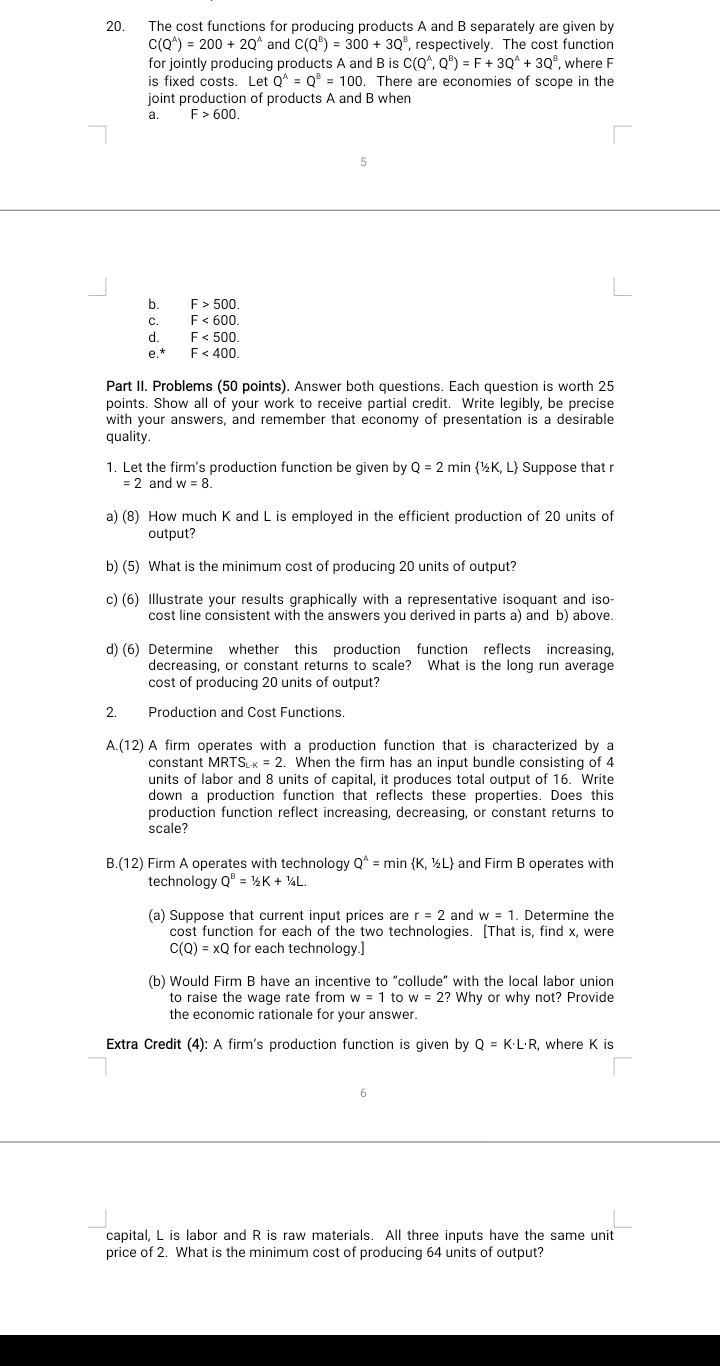
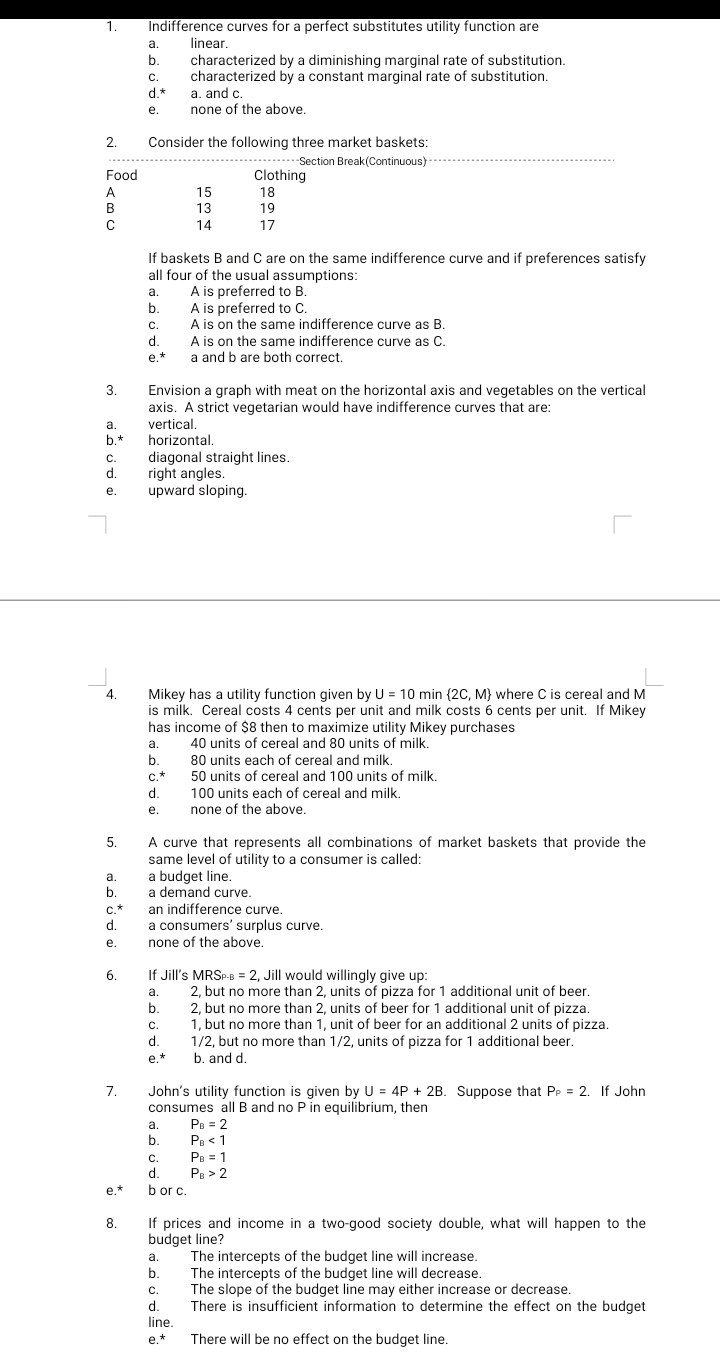
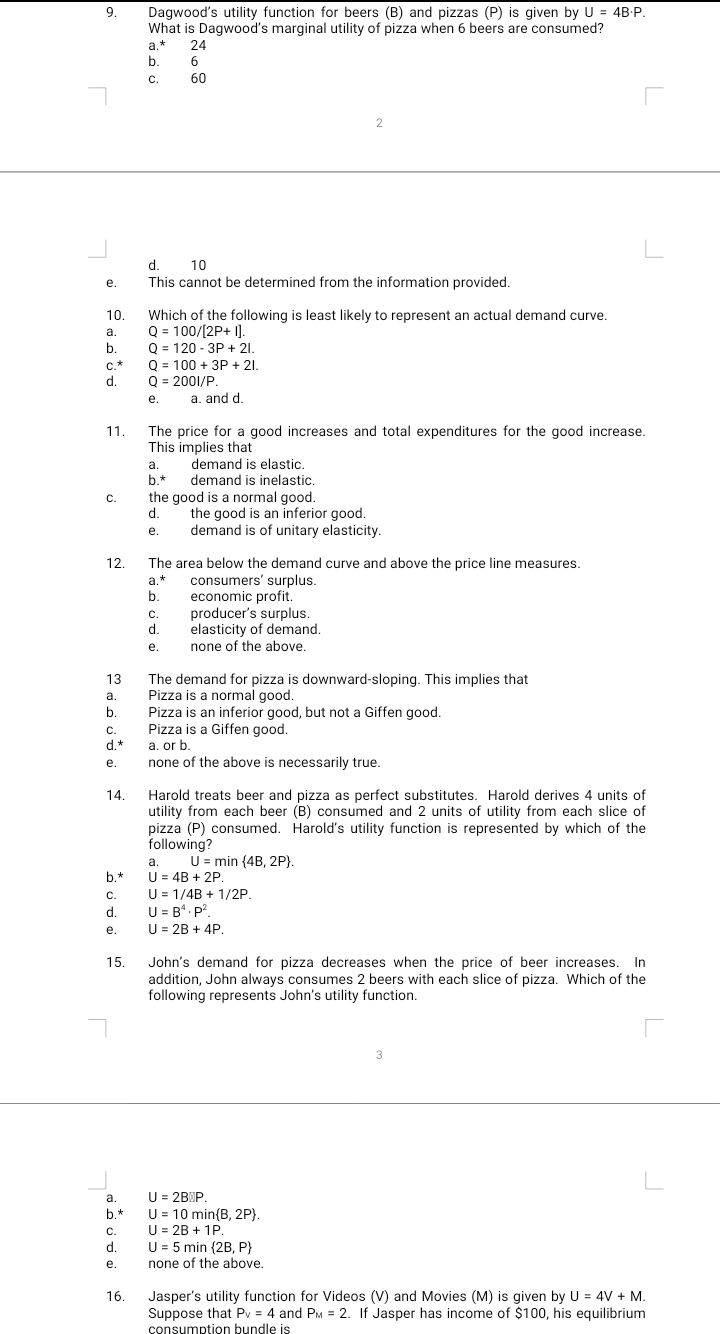
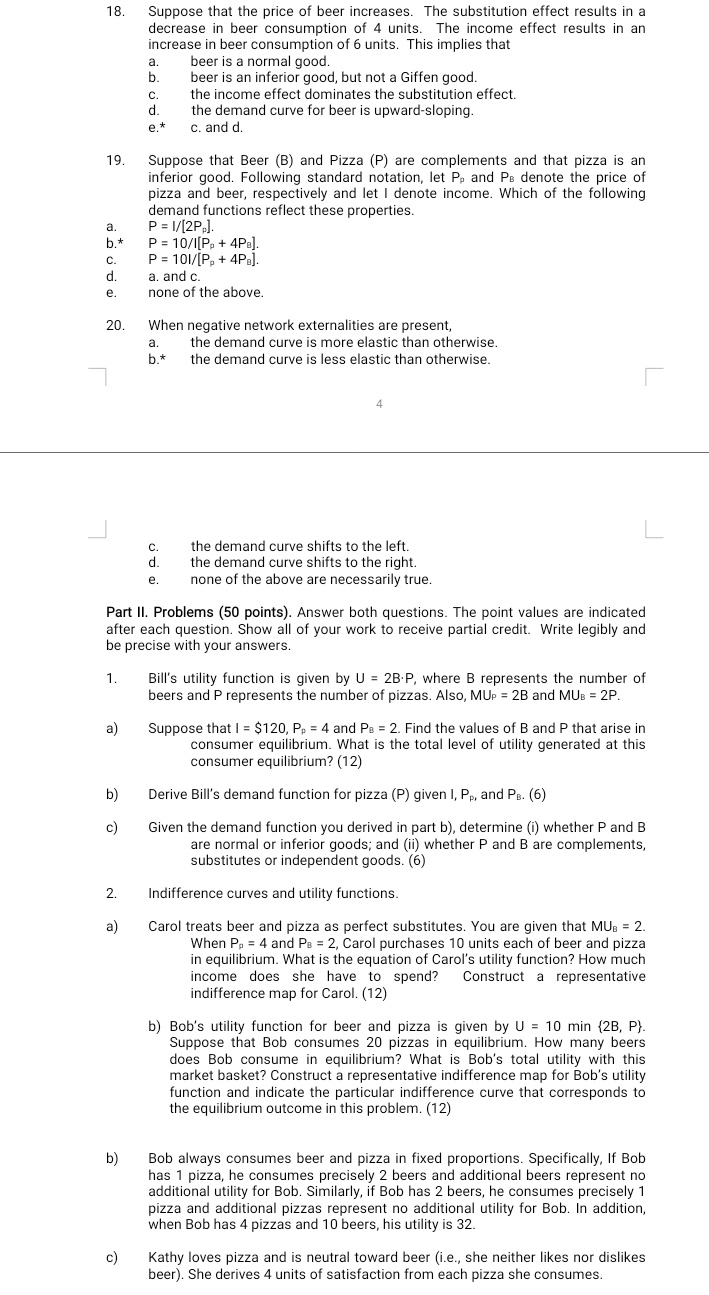
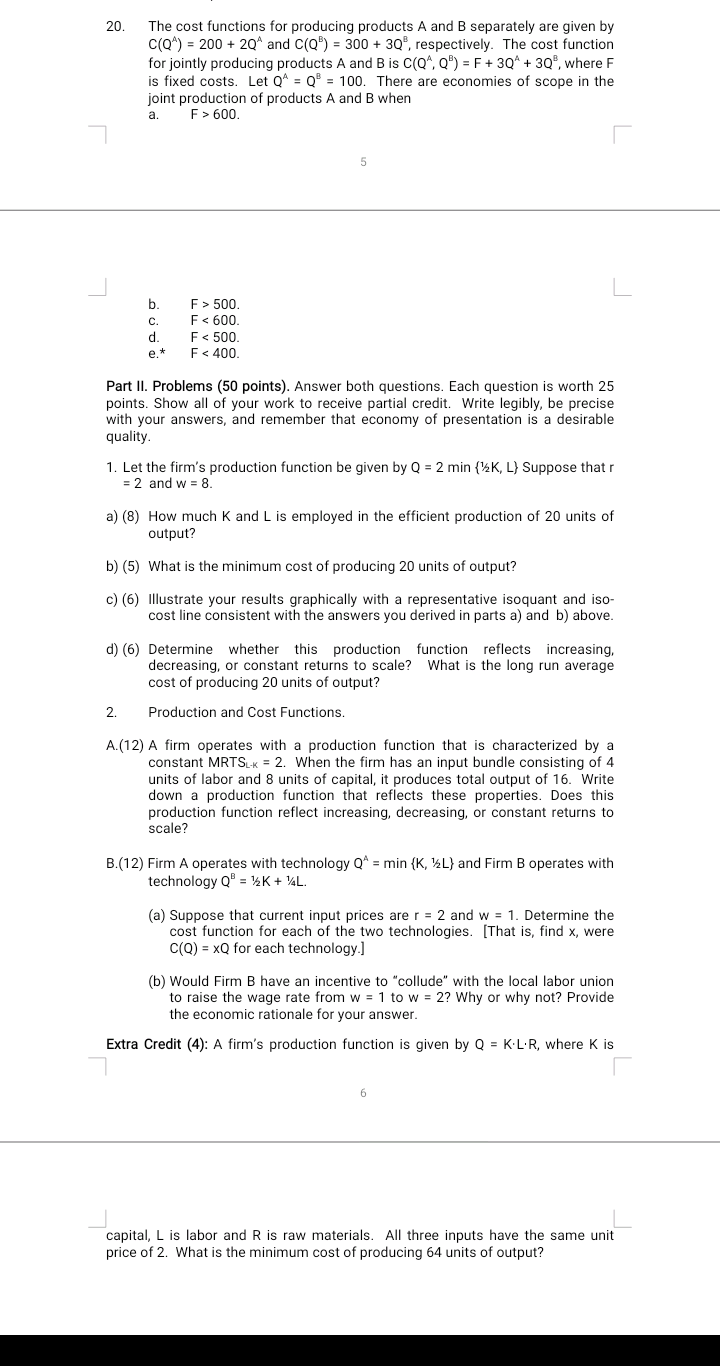
Problem 1. Shorter problems. (50 points) Solve the following shorter problems. 1. Compute the pure-strategy and mixed strategy equilibria of the following coordination game. Call u the probability that player 1 plays Up. 1-a the probability that player 1 plays Down, / the probability that Player 2 plays Left, and 1 -/ the probability that Player 2 plays Right. (20 points) 1\\2 Left Right Up 3,2 1, 1 Down 1, 1 2,3 2. For each of these cost functions, plot the marginal cost function and the supply function, and write out the supply function S (p) , with quantity as a function of price p (30 points): (a) C (q) = 2q (8 points) (b) C (4) =2q' - q + 2 (12 points) (c) C (q) =q3 + 10q (10 points)1. Indifference curves for a perfect substitutes utility function are a. linear. b. characterized by a diminishing marginal rate of substitution. c. characterized by a constant marginal rate of substitution. d.* a. and c. e. none of the above. 2. Consider the following three market baskets: -- Section Break(Coritinuous}---------------- - Food Clothing A 15 13 B 13 19 C 14 1? If baskets B and C are on the same indifference curve and if preferences satisfy all four of the usual assumptions: a. A is preferred to B. b. A is preferred to C. c. A is on the same indifference curve as B. d A is on the same indifference curve as C. e.* a and b are both correct. 3. Envision a graph with meat on the horizontal axis and vegetables on the vertical axis. A strict vegetarian would have indifference curves that are: vertical. .* horizontal. diagonal straight lines. right angles. upward sloping. ruinous 4. Mikey has a utility function given by U = 10 min {20: M} where C is cereal and M is milk. Cereal costs 4 cents per unit and milk costs 5 cents per unit. If Mikey has income of $8 then to maximize utility Mikey purchases a. 40 units of cereal and 30 units of milk. b. 30 units each of cereal and milk. c.* 50 units of cereal and 1 DD units of milk. d. 100 units each of cereal and milk. e. none of the above. 5. A curve that represents all combinations of market baskets that provide the same level of utility to a consumer is called: a. a budget line. b. a demand curve. c.* an indifference curve. d. a consumers\" surplus curve. none of the above. ll\"' 5. If Jill's MRSP-a = 2. .Jill would willingly give up: a. 2. but no more than 2, units of pizza for 1 additional unit of beer. b. 2. but no more than 2, units of beer for 1 additional unit of pizza. c. 1. but no more than 1, unit of beer for an additional 2 units of pizza. d. U2, but no more than 1i'2u units of pizza for 1 additional beer. e.* b. and d. it\". John's utility function is given by U = 4P + EB. Suppose that Pp = 2. If .John consumes all 3 and no P in equilibrium, then a. Pa = 2 '3. Pa '5 1 0. Pa = 1 d. Pa F 2 e.* b or c. S. If prices and income in a two~good society double, what will happen to the budget line? a. The intercepts of the budget line will increase. b. The intercepts of the budget line will decrease. c. The slope of the budget line may either increase or decrease. d. There is insufficient information to determine the effect on the budget line. e.* There will be no effect on the budget line. 9. Dagwood's utility function for beers (B) and pizzas (P) is given by U = 4B.P. What is Dagwood's marginal utility of pizza when 6 beers are consumed? a.* 24 b. 6 C. 60 2 d. 10 e. This cannot be determined from the information provided. 10. Which of the following is least likely to represent an actual demand curve. a. Q = 100/[2P+ 1]. b. Q = 120 - 3P + 21. C.* Q = 100 + 3P + 21. d Q = 2001/P e. a. and d. 11. The price for a good increases and total expenditures for the good increase. This implies that a. demand is elastic. b.* demand is inelastic. C. the good is a normal good. d. the good is an inferior good. e demand is of unitary elasticity. 12. The area below the demand curve and above the price line measures. a.* consumers' surplus. b . economic profit. C . producer's surplus. elasticity of demand. none of the above. 13 The demand for pizza is downward-sloping. This implies that a. Pizza is a normal good. b. Pizza is an inferior good, but not a Giffen good. C. Pizza is a Giffen good. d. a. or b. e. none of the above is necessarily true. 14. Harold treats beer and pizza as perfect substitutes. Harold derives 4 units of utility from each beer (B) consumed and 2 units of utility from each slice of pizza (P) consumed. Harold's utility function is represented by which of the following? a. U = min (4B, 2P). b.* U = 4B + 2P C. U = 1/4B + 1/2P. d. U = B . P. e. U = 2B + 4P. 15. John's demand for pizza decreases when the price of beer increases. In addition, John always consumes 2 beers with each slice of pizza. Which of the following represents John's utility function. 3 a. U = 2BOP. b.* U = 10 min(B, 2P). C. U = 2B + 1P. U = 5 min (2B, P) none of the above. 16. Jasper's utility function for Videos (V) and Movies (M) is given by U = 4V + M. Suppose that Pv = 4 and PM = 2. If Jasper has income of $100, his equilibrium motion bundle is1B. 19. Suppose that the price of beer increases. The substitution effect results in a decrease in beer consumption of 4 units. The income effect results in an increase in beer consumption of 6 units. This implies that a. beer is a normal good. b. beer is an inferior good, but not a Giffen good. c. the income effect dominates the substitution effect. d. the demand curve for beer is upward-sloping. e.* c. and d. Suppose that Beer (B) and Pizza {P} are complements and that pizza is an inferior good. Following standard notation. let PII and Pa denote the price of pizza and beer, respectively and let I denote income. 1illlhich of the following demand functions reflect these properties. P = vim]. P =1fl[Pp + 4Pa]. P =10\"le + 4P3]. a. and c. none of the above. When negative network externalities are present, a. the demand curve is more elastic than otherwise. b.'ir the demand curve is less elastic than otherwise. 4 c. the demand curve shifts to the left. d. the demand curve shifts to the right. e. none of the above are necessarily true. Part II. Problems (50 points). Answer both questions. The point values are indicated after each question. Show all of your work to receive partial credit. Write legibly and be precise with your answers. 1 . a} b) bl Bills utility function is given by U = ZB-P, where B represents the number of beers and P represents the number of pizzas. Also. Mun = 23 and MUa = 2P. Suppose that I = $120, PP = 4 and P3 = 2. Find the values of B and P that arise in consumer equilibrium. what is the total level of utility generated at this consumer equilibrium? {12} Derive Bill's demand function for pizza (P) given I. Pp, and Pa. {6} Given the demand function you derived in part b), determine (i) whether P and B are normal or inferior goods; and (ii) whether P and B are complementsI substitutes or independent goods. (5) Indifference curves and utility functions. Carol treats beer and pizza as perfect substitutes. You are given that MUa = 2. When P, = 4 and P: = 2, Carol purchases 10 units each of beer and pizza in equilibrium. What is the equation of Carol's utility function? How much income does she have to spend? Construct a representative indifference map for Carol. {12} b) Bob's utility function for beer and pizza is given by U = 10 min {23. P}. Suppose that Bob consumes 20 pizzas in equilibrium. How many beers does Bob consume in equilibrium? What is Bob's total utility with this market basket? Construct a representative indifference map for Bob's utility function and indicate the particular indifference curve that corresponds to the equilibrium outcome in this problem. {12} Bob always consumes beer and pizza in fixed proportions. Specifically, If Bob has 1 pizza, he consumes precisely 2 beers and additional beers represent no additional utility for Bob. Similarly, if Bob has 2 beers; he consumes precisely 1 pizza and additional pizzas represent no additional utility for Bob. In addition, when Bob has 4 pizzas and 1 0 beers. his utility is 32. Kathy loves pizza and is neutral toward beer {i.e., she neither likes nor dislikes beer). She derives 4 units of satisfaction from each pizza she consumes. 20. The cost functions for producing products A and B separately are given by 0011'} = 200 + 20'1 and C(09) = 300 + 3Q\
Step by Step Solution
There are 3 Steps involved in it

Get step-by-step solutions from verified subject matter experts
 Study Help