







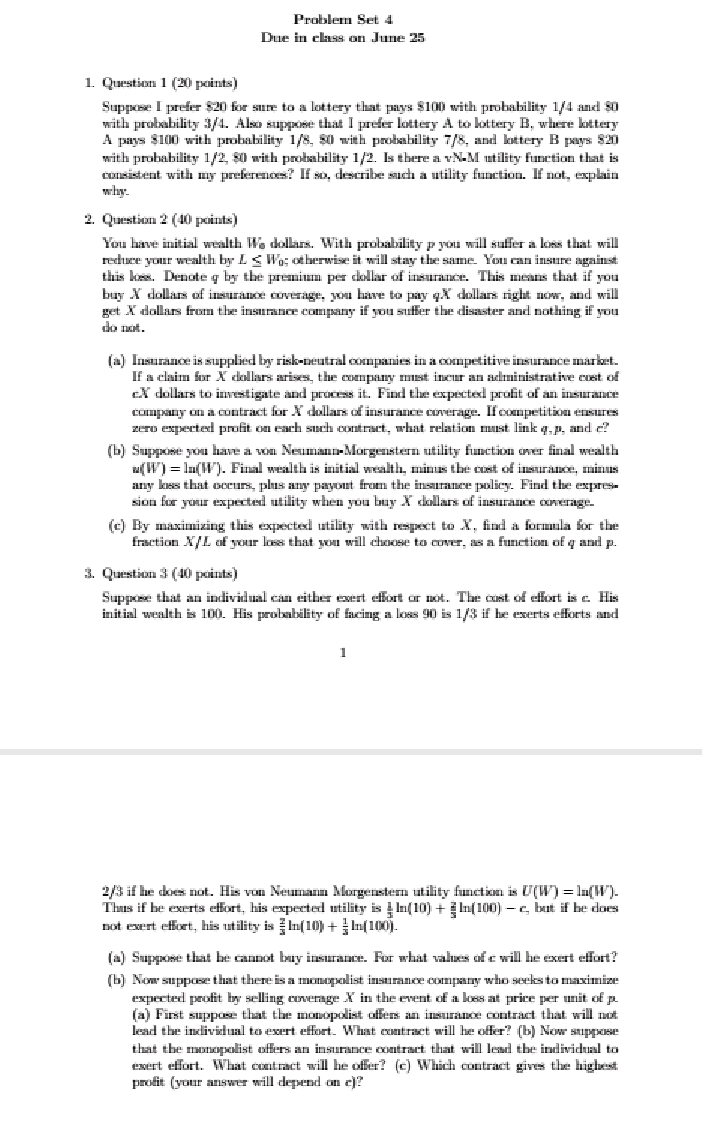
Question: Answers, thorough explanation..... Problem Set 4 Due in class on June 25 1. Question 1 (20 points) Suppose I prefer $20 for sure to a
Answers, thorough explanation.....
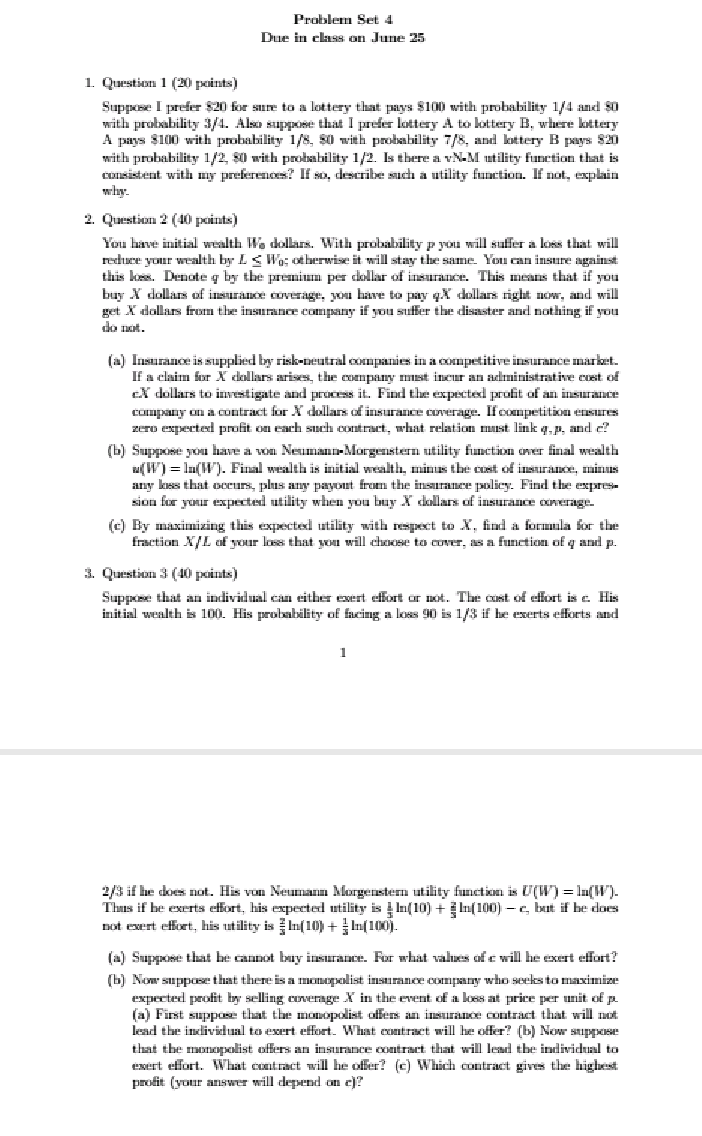
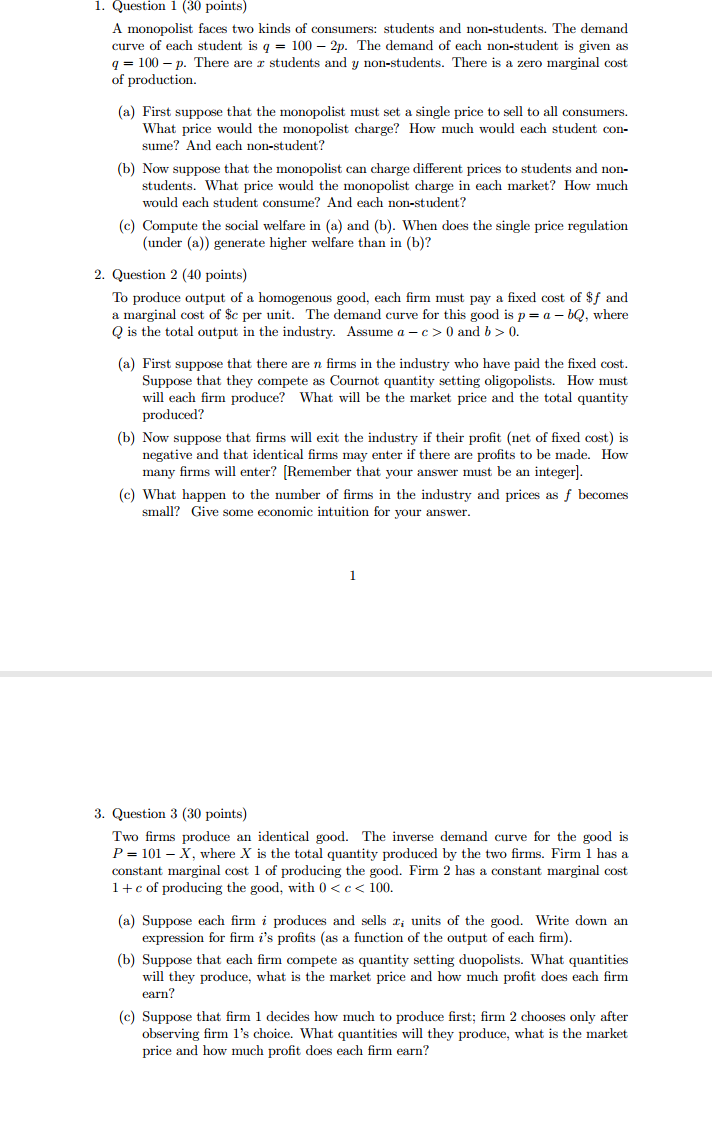
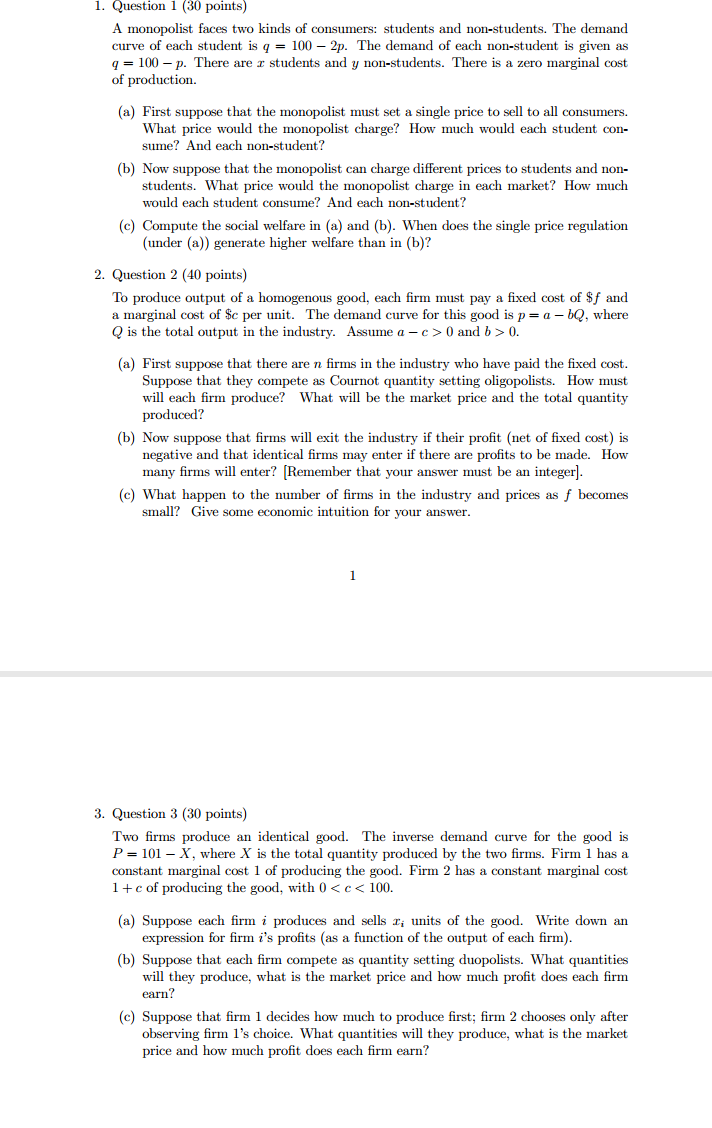
Problem Set 4 Due in class on June 25 1. Question 1 (20 points) Suppose I prefer $20 for sure to a lottery that pays $100 with probability 1/4 and $0 with probability 3/4. Also suppose that I prefer lottery A to lottery B, where kittery A pays $100 with probability 1/8, $0 with probability 7/8, and Jittery B pays $20 with probability 1/2, $0 with probability 1/2. Is there a vN-M utility function that is consistent with my preferences? If so, describe such a utility function. If not, explain why- 2. Question 2 (40 points) You have initial wealth W's dollars. With probability p you will suffer a loss that will reduce your wealth by & & Wo; otherwise it will stay the same. You can insure against this kes. Denote g by the premium per dollar of insurance. This means that if you buy X dollars of insurance coverage, you have to pay q.X dollars right now, and will get X dollars from the insurance company if you suffer the disaster and nothing if you do not. (a) Insurance is supplied by risk-neutral companies in a competitive insurance market. If a claim for X dollars arises, the company must incur an administrative cost of X dollars to investigate and process it. Find the expected profit of an insurance company on a contract for A dollars of insurance coverage. If competition ensures zero expected profit on each such contract, what relation must link q, p, and e? (b) Suppose you have a von Neumann-Morgenstern utility function over final wealth w(W) = la(W/). Final wealth is initial wealth, minus the cost of insurance, minus any kiss that occurs, plus any payout from the insurance policy. Find the express sion for your expected utility when you buy X dollars of insurance coverage. (c) By maximizing this expected utility with respect to X, find a formula for the fraction X/L of your loss that you will choose to cover, as a function of q and p. 3. Question 3 (40 points) Suppose that an individual can either exert effort or not. The cost of effort is c. His initial wealth is 100. His probability of facing a loss 90 is 1/3 if he everts efforts and 2/3 if he does not. His von Neumann Morgenstern utility function is U(W) = In(W). Thus if be exerts effort, his expected utility is [ In(10) + [ In(100) - e, but if he does not exert effort, his utility is : In(10) + ; In(100). (a) Suppose that be cannot buy insurance. For what values of c will he exert effort? (b) Now suppose that there is a monopolist insurance company who seeks to maximize expected profit by selling coverage X in the event of a loss at price per unit of p. (a) Furst suppose that the monopolist offers an insurance contract that will not lead the individual to exert effort. What contract will be offer? (b) Now suppose that the monopolist offers an insurance contract that will lead the individual to exert effort. What contract will he offer? (c) Which contract gives the highest profit (your answer will depend on c)?1. Question 1 (30 points) A monopolist faces two kinds of consumers: students and non-students. The demand curve of each student is q = 100 - 2p. The demand of each non-student is given as q = 100 - p. There are r students and y non-students. There is a zero marginal cost of production. (a) First suppose that the monopolist must set a single price to sell to all consumers. What price would the monopolist charge? How much would each student con- sume? And each non-student? (b) Now suppose that the monopolist can charge different prices to students and non- students. What price would the monopolist charge in each market? How much would each student consume? And each non-student? (c) Compute the social welfare in (a) and (b). When does the single price regulation (under (a)) generate higher welfare than in (b)? 2. Question 2 (40 points) To produce output of a homogenous good, each firm must pay a fixed cost of $f and a marginal cost of $c per unit. The demand curve for this good is p = a - bQ, where Q is the total output in the industry. Assume a - c > 0 and b > 0. (a) First suppose that there are n firms in the industry who have paid the fixed cost. Suppose that they compete as Cournot quantity setting oligopolists. How must will each firm produce? What will be the market price and the total quantity produced? (b) Now suppose that firms will exit the industry if their profit (net of fixed cost) is negative and that identical firms may enter if there are profits to be made. How many firms will enter? [Remember that your answer must be an integer]. (c) What happen to the number of firms in the industry and prices as f becomes small? Give some economic intuition for your answer. 3. Question 3 (30 points) Two firms produce an identical good. The inverse demand curve for the good is P = 101 - X, where X is the total quantity produced by the two firms. Firm 1 has a constant marginal cost 1 of producing the good. Firm 2 has a constant marginal cost 1 + c of producing the good, with 0
Step by Step Solution
There are 3 Steps involved in it

Get step-by-step solutions from verified subject matter experts
 Study Help