



Question: Any help on how to approach this question would be appreciated: 3. An insurance company is offering health insurance. There are three different types of
Any help on how to approach this question would be appreciated:
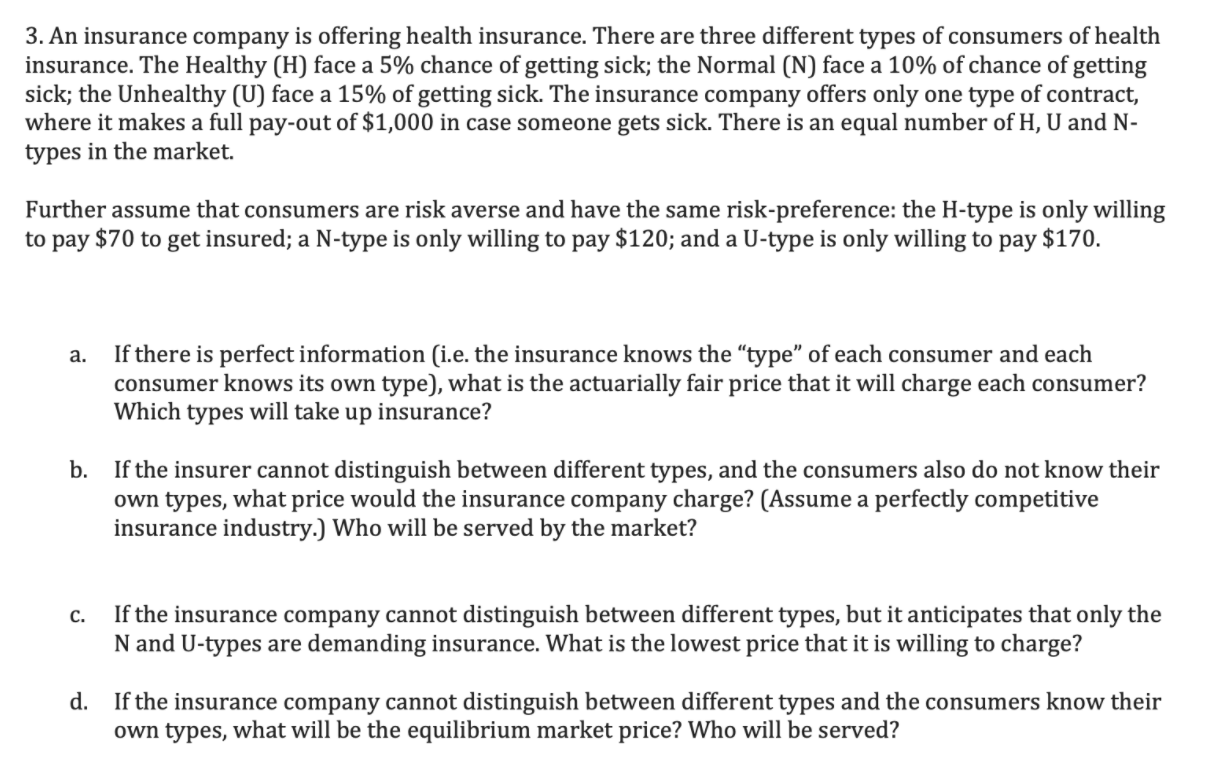
3. An insurance company is offering health insurance. There are three different types of consumers of health insurance. The Healthy (H) face a 5% chance of getting sick; the Normal (N) face a 10% of chance of getting sick; the Unhealthy (U) face a 15% of getting sick. The insurance company offers only one type of contract, where it makes a full pay-out of $1,000 in case someone gets sick. There is an equal number of H, U and N- types in the market. Further assume that consumers are risk averse and have the same riskpreference: the Htype is only willing to pay $70 to get insured; a N-type is only willing to pay $120; and a U-type is only willing to pay $170. a. If there is perfect information [i.e. the insurance knows the \"type\" of each consumer and each consumer knows its own type], what is the actuarially fair price that it will charge each consumer? Which types will take up insurance? b. If the insurer cannot distinguish between different types, and the consumers also do not know their own types, what price would the insurance company charge? (Assume a perfectly competitive insurance industry.) Who will be served by the market? c. If the insurance company cannot distinguish between different types, but it anticipates that only the N and U-types are demanding insurance. What is the lowest price that it is willing to charge? d. If the insurance company cannot distinguish between different types and the consumers know their own types, what will be the equilibrium market price? Who will be served
Step by Step Solution
There are 3 Steps involved in it

Get step-by-step solutions from verified subject matter experts