







Question: any help with this question pleaseee You invent a new kind of ultrasound probe. It can be used in narrow environments (like water pipes, cement
any help with this question pleaseee
- You invent a new kind of ultrasound probe. It can be used in narrow environments (like water pipes, cement cracks, or even blood vessels) to measure how far down there is an obstruction, i.e. something blocking the way. The device can only see 1 unit of length ahead. After making a raw readout, you want to make sure you translate it into an accurate measurement for the user. As an engineer:
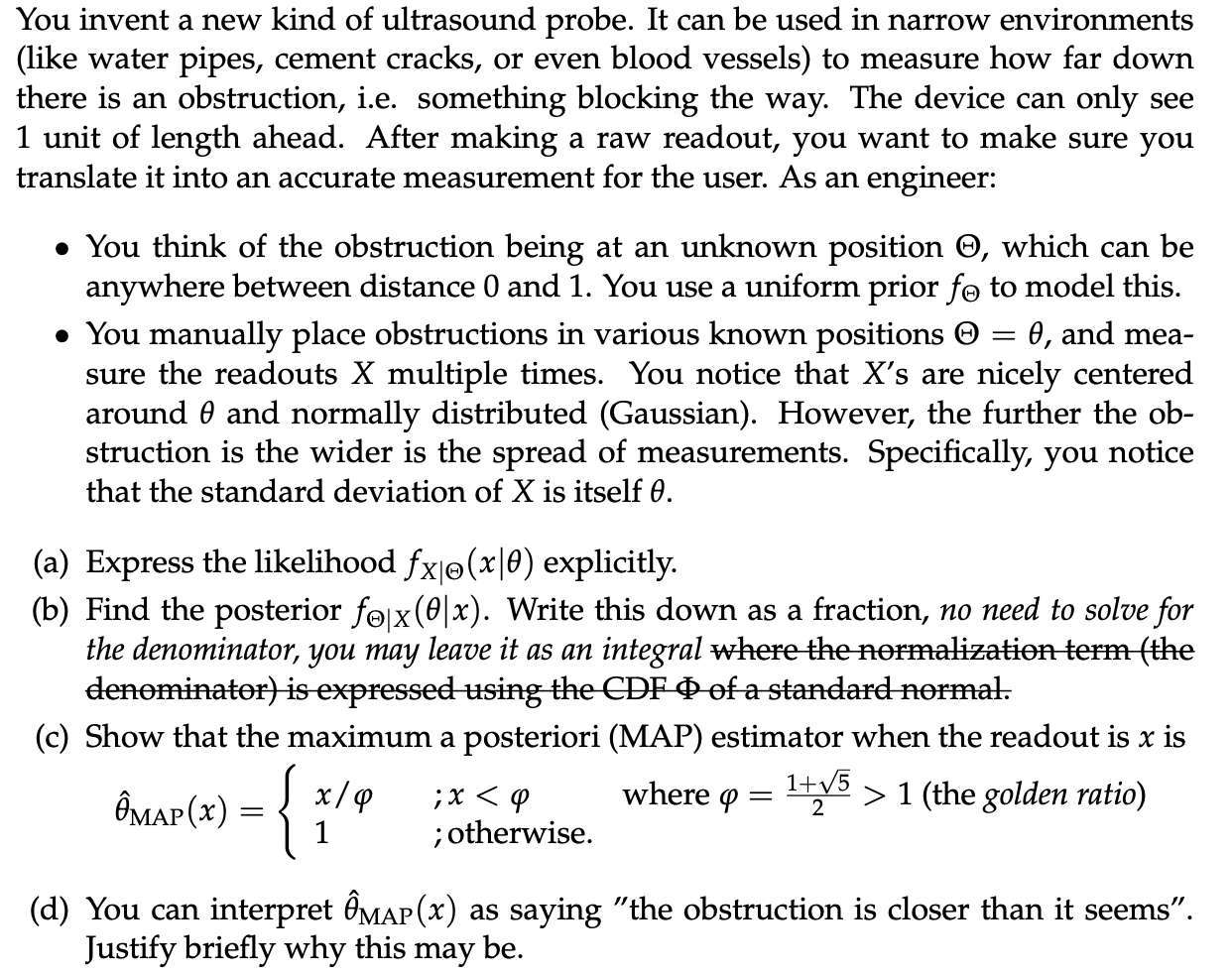
You invent a new kind of ultrasound probe. It can be used in narrow environments (like water pipes, cement cracks, or even blood vessels) to measure how far down there is an obstruction, i.e. something blocking the way. The device can only see 1 unit of length ahead. After making a raw readout, you want to make sure you translate it into an accurate measurement for the user. As an engineer: 0 You think of the obstruction being at an unknown position 6), which can be anywhere between distance 0 and 1. You use a uniform prior f9 to model this. 0 You manually place obstructions in various known positions (9 = 9, and mea- sure the readouts X multiple times. You notice that X's are nicely centered around 9 and normally distributed (Gaussian). However, the further the ob- struction is the wider is the spread of measurements. Specifically, you notice that the standard deviation of X is itself 9. (a) Express the likelihood f Xl@(x|6) explicitly. (b) Find the posterior f@|X(9|x). Write this down as a fraction, no need to solve for the denominator, you may\" leave it as an integral whereihenermalatientem (c) Show that the maximum a posteriori (MAP) estimator when the readout' 1s x is .. = x/cp ;x 1 (the golden ratio) BMAP(x) { 1 ;otherwise. (d) You can interpret dMAP(x) as saying \"the obstruction is closer than it seems\". Justify briey why this may be
Step by Step Solution
There are 3 Steps involved in it

Get step-by-step solutions from verified subject matter experts
 Study Help