



Question: anyone can answer me with matlab step by step? thsnks you! App10. Please derive a cubic spline that fits the data well and retains the
anyone can answer me with matlab step by step? thsnks you! App10. Please derive a cubic spline that fits the data well and retains the periodic behavior. 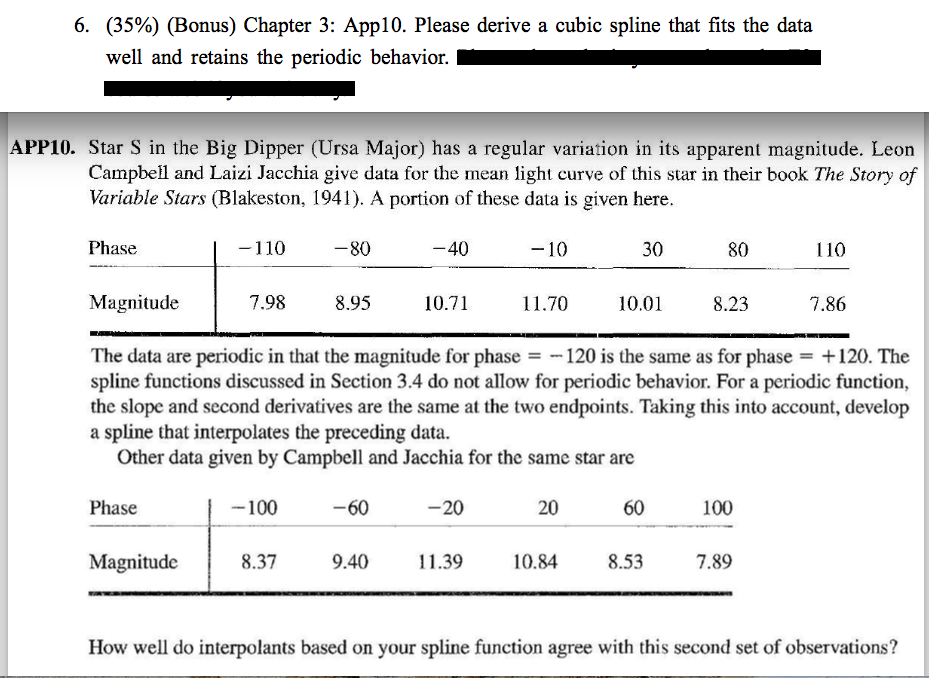
6. (35%) (Bonus) Chapter 3: App10. Please derive a cubic spline that fits the data well and retains the periodic behavior. APP10. Star S in the Big Dipper (Ursa Major) has a regular variation in its apparent magnitude. Leon Campbell and Laizi Jacchia give data for the mean light curve of this star in their book The Story of Variable Stars (Blakeston, 1941). A portion of these data is given here. Phase 110 -80 40 l 10 30 80 Magnitude 7.98 8.95 10.71 11.70 10.01 8.23 7.86 The data are periodic in that the magnitude for phase 120 is the same as for phase 120. The spline functions discussed in Section 3.4 do not allow for periodic behavior. For a periodic function, the slope and second derivatives are the same at the two endpoints. Taking this into account, develop a spline that interpolates the preceding data. Other data given by Campbell and Jacchia for the same star are 100 Phase 100 60 20 20 60 Magnitude 8.37 9.40 11.39 10.84 8.53 7.89 How well do interpolants based on your spline function agree with this second set of observations? 6. (35%) (Bonus) Chapter 3: App10. Please derive a cubic spline that fits the data well and retains the periodic behavior. APP10. Star S in the Big Dipper (Ursa Major) has a regular variation in its apparent magnitude. Leon Campbell and Laizi Jacchia give data for the mean light curve of this star in their book The Story of Variable Stars (Blakeston, 1941). A portion of these data is given here. Phase 110 -80 40 l 10 30 80 Magnitude 7.98 8.95 10.71 11.70 10.01 8.23 7.86 The data are periodic in that the magnitude for phase 120 is the same as for phase 120. The spline functions discussed in Section 3.4 do not allow for periodic behavior. For a periodic function, the slope and second derivatives are the same at the two endpoints. Taking this into account, develop a spline that interpolates the preceding data. Other data given by Campbell and Jacchia for the same star are 100 Phase 100 60 20 20 60 Magnitude 8.37 9.40 11.39 10.84 8.53 7.89 How well do interpolants based on your spline function agree with this second set of observations
Step by Step Solution
There are 3 Steps involved in it

Get step-by-step solutions from verified subject matter experts