







Question: anyone describe these case study 8.7 8.8 8.9 based in what you have read please ? CHAPTER 3 Intellectual Property Rights 157 trademark, copyright, patent,
anyone describe these case study 8.7 8.8 8.9 based in what you have read please ? 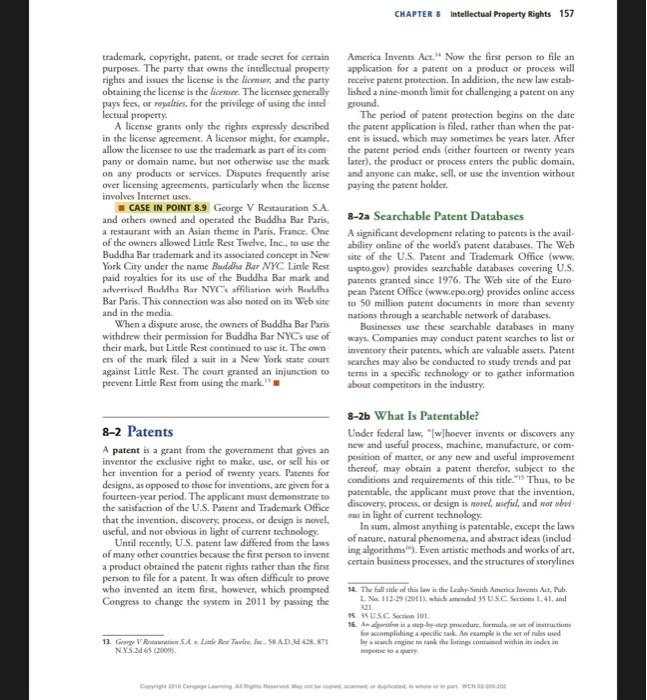
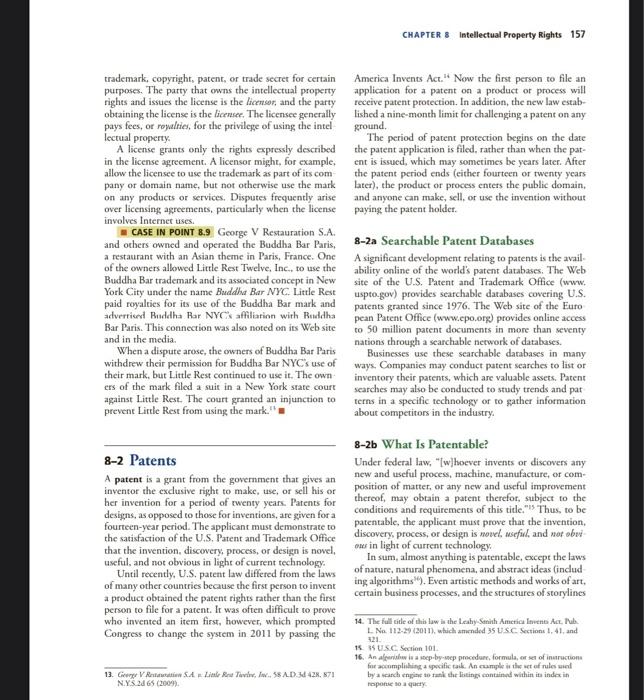
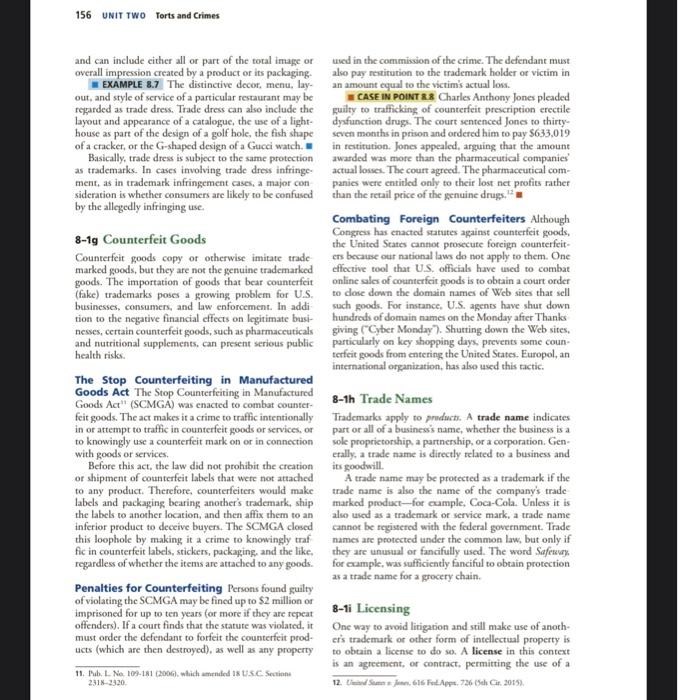
CHAPTER 3 Intellectual Property Rights 157 trademark, copyright, patent, or trade secret for certain America Invents Act." Now the first person to file an purposes. The party that owns the intellectual property application for a patent on a product or process will rights and issues the license is the licensor, and the party receive patent protection. In addition, the new law estab- obtaining the license is the license. The licensee generally lished a nine-month limit for challenging a patent on any pays fees, of royalties, for the privilege of using the intel ground. lectual property The period of patent protection begins on the date A license grants only the rights expressly described the patent application is filed, rather than when the pat- in the license agreement. A licensor might, for cuample, ent is issued, which may sometimes be years later. After allow the license to use the trademark as part of its com the patent period ends (either fourteen or twenty years pany or domain name, but not otherwise use the mark later), the product or process enters the public domain, on any products or services. Disputes frequently arise and anyone can make, sell, or use the invention without over licensing agreements, particularly when the license paying the patent holder involves Internet uses CASE IN POINT 8.9 George V Restauration SA and others owned and operated the Buddha Bar Paris, 8-2 Searchable Patent Databases a restaurant with an Asian me in Paris, France. Onc A significant development relating to patents is the avail of the owners allowed Little Rest Twelve, Inc. to use the ability online of the world's patent databases. The Web Buddha Bar trademark and its associated concept in New site of the U.S. Patent and Trademark Office (www. York City under the name Buddha Bar NYC Little Rest sto gov) provides searchable databases covering U.S. paid royalties for its use of the Buddha Bar mark and patents granted since 1976. The Web site of the Euro advertised Buddha Bar NYC affiliation with Reddha pean Patent Office (www.epo.org) provides online access Bar Paris. This connection was also noted on its Web site to 50 million patent documents in more than seventy and in the media nations through a searchable network of databases. When a dispute arose, the owners of Buddha Bar Paris Businesses use these searchable databases in many withdrew their permission for Buddha Bar NYCs use of ways. Companies may conduct patent searches to list or their mark, but Little Rest continued to use it. The own inventory their patents, which are valuable assets. Patent ers of the mark filed a suit in New York state court searches may also be conducted to study trends and par against Little Rest. The court granted an injunction to terns in a specific technology or to gather information prevent Little Rest from using the mark." about competitors in the industry 8-2 Patents A patent is a grant from the government that gives an inventor the exclusive right to make, use, or sell his or her invention for a period of twenty years. Patents for designs, as opposed to those for inventions, are given for a fourteen-year period. The applicant must demonstrate to the satisfaction of the U.S. Patent and Trademark Office that the invention, discovery, process, or design is novel useful, and not obvious in light of current technology Until recently. U.S. patent law differed from the laws of many other countries because the first person to invent a product obtained the patent rights rather than the first person to file for a patent. It was often difficult to prove who invented an item first, however, which prompted Congress to change the system in 2011 by passing the 8-2b What Is Patentable? Under federal law. "Whoever invents or discovers any new and useful process, machine, manufacture, or com- position of matter, or any new and useful improvement thereof, may obtain a patent therefor, subject to the conditions and requirements of this title." Thus, to be patentable, the applicant must prove that the invention, discovery, process, or design is novel, wel, and not obi in light of current technology In sum, almost anything is patentable, except the laws of nature, natural phenomena and abstract ideas (indud ing algorithms). Even artistic methods and works of art. certain business processes, and the structures of storylines 14. The fall titled this low as the Laby-Smith America Invent Act, Pub. L N 112-29-2011) which amended SUSC Section 1.41. and 21 15. SUSC Section 101 16. Ang isa pyep procedure formulated in came for accomplishing a specific tak. An example is the set of rules used branchengine run the listing contained within its index in 13. Gone Rote Str. Lime Red Toele, S. SAD 320KT NYS.2165 2009) 3003 CHAPTER 8 Intellectual Property Rights 157 America Invents Act. Now the first person to file an application for a patent on a product or process will receive patent protection. In addition, the new law estab lished a nine-month limit for challenging a patent on any ground. The period of patent protection begins on the date the patent application is filed, rather than when the pat- ent is issued, which may sometimes be years later. After the patent period ends (either fourteen or twenty years later), the product or process enters the public domain. and anyone can make, sell or use the invention without paying the patent holder trademark, copyright, patent, or trade secret for certain purposes. The party that owns the intellectual property rights and issues the license is the licensor, and the party obtaining the license is the licensee. The licensee generally pays fees, or royalties, for the privilege of using the intel lectual property A license grants only the rights expressly described in the license agreement. A licensor might, for example, allow the licensee to use the trademark as part of its com pany or domain name, but not otherwise use the mark on any products or services. Disputes frequently arise over licensing agreements, particularly when the license involves Internet uses. CASE IN POINT 8.9 George V Restauration S.A. and others owned and operated the Buddha Bar Paris, a restaurant with an Asian theme in Paris, France. One of the owners allowed Little Rest Twelve, Inc.. to use the Buddha Bar trademark and its associated concept in New York City under the name Buddha Bar NYC. Little Rest paid royalties for its use of the Buddha Bar mark and advertised Buddha Bar NYC affiliation with Buddha Bar Paris. This connection was also noted on its Web site and in the media When a dispute arose, the owners of Buddha Bar Paris withdrew their permission for Buddha Bar NYC's use of their mark, but Little Rest continued to use it. The own ers of the mark filed a suit in a New York state court against Little Rest. The court granted an injunction to prevent Little Rest from using the mark. 8-2 Searchable Patent Databases A significant development relating to patents is the avail ability online of the world's patent databases. The Web site of the U.S. Patent and Trademark Office (www. uspto.gov) provides searchable databases covering U.S. patents granted since 1976. The Web site of the Euro pean Patent Office (www.epo.org) provides online access to 50 million patent documents in more than seventy nations through a searchable network of databases. Businesses use these searchable databases in many ways. Companies may conduct patent searches to list or inventory their parents, which are valuable assets. Patent searches may also be conducted to study trends and pat terns in a specific technology or to gather information about competitors in the industry 8-2 Patents A patent is a grant from the government that gives an inventor the exclusive right to make, use, or sell his or her invention for a period of twenty years. Patents for designs, as opposed to those for inventions, are given for a fourteen-year period. The applicant must demonstrate to the satisfaction of the U.S. Patent and Trademark Office that the invention, discovery, process, or design is novel, useful, and not obvious in light of current technology Until recently. U.S. patent law differed from the laws of many other countries because the first person to invent a product obtained the patent rights rather than the first person to file for a patent. It was often difficult to prove who invented an item first, however, which prompted Congress to change the system in 2011 by passing the 8-2b What Is Patentable? Under federal law," whoever invents or discovers any new and useful process, machine, manufacture, or com- position of matter, or any new and useful improvement thereof, may obtain a patent therefor, subject to the conditions and requirements of this title." Thus, to be patentable, the applicant must prove that the invention, discovery, process, or design is novel, useful and not obw ons in light of current technology In sum, almost anything is patentable, except the laws of nature, natural phenomena, and abstract ideas (includ ing algorithms). Even artistic methods and works of art, certain business processes, and the structures of storylines 14. The full title of this law is the Leahy Sanish America Invent Act Pub L No 112-29 (2011), which amended 35 USC Section 1. 41 and 321 15 SUSC Section 101 16. An alpinish is a soep-by-step procedure, formula, or set of intruction for accomplishing a specific to An cumple is the set of rules we by a scach to take the ting contained within its indesin response ty 13. Gurg Restautin SA LRT, Iw..5AD342.871 NYS2165 (2001) 156 UNIT TWO Torts and Crimes and can include either all or part of the total image or used in the commission of the crime. The defendant must overall impression created by a product or its packaging also pay restitution to the trademark holder or victim in EXAMPLE 8.7 The distinctive decor, menu, lay an amount equal to the victim's actual loss. out, and style of service of a particular restaurant may be CASE IN POINT & Charles Anthony Jones pleaded regarded as trade dress. Trade dress can also include the guilty to trafficking of counterfeit prescription erectile layout and appearance of a catalogue, the use of a light- dysfunction drugs. The court sentenced Jones to thirty house as part of the design of a golf hole, the fish shape seven months in prison and ordered him to pay $633,019 of a cracker , or the G-shaped design of a Gucci watch. in restitution. Jones appealed, arguing that the amount Basically, trade dress is subject to the same protection awarded was more than the pharmaceutical companies as trademarks. In cases involving trade dress infringe actual losses. The court agreed. The pharmaceutical com- ment, as in trademark infringement cases, a major con panies were entitled only to their lost net profits rather sideration is whether consumers are likely to be confused than the retail price of the genuine drugs, by the allegedly infringing use. Combating Foreign counterfeiters Although 8-19 Counterfeit Goods Congress has enacted statutes against counterfeit goods, the United States cannot prosecute foreign counterfeit- Counterfeit goods copy or otherwise imitate trade ets because our national laws do not apply to them. One marked goods, but they are not the genuine trademarked effective tool that U.S. officials have used to combat goods. The importation of goods that bear counterfeit online sales of counterfcit goods is to obtain a court order (fake) trademarks poses a growing problem for U.S. to dose down the domain names of Web sites that sell businesses, consumers, and law enforcement. In addi such goods. For instance, U.S. agents have shut down tion to the negative financial effects on legitimate busi- hundreds of domain names on the Monday after Thanks nesses, certain counterfeit goods, such as pharmaceuticals giving ("Cyber Monday. Shutting down the Web sites, and nutritional supplements, can present serious public particularly on key shopping days, prevents some coun health risks terfeit goods from entering the United States. Europol, an international organization, has also used this tactic. The Stop Counterfeiting in Manufactured Goods Act The Stop Counterfeiting in Manufactured 8-1h Trade Names Goods Act" (SCMGA) was enacted to combat counter feit goods. The act makes it a crime to traffic intentionally Trademarks apply to products . A trade name indicates in or attempt to traffic in counterfeit goods or services, or part or all of a business's name, whether the business is a to knowingly use a counterfeit mark on or in connection sole proprietorship, a partnership, or a corporation. Gen- with goods or services erally, a trade name is directly related to a business and Before this act, the law did not prohibit the creation its goodwill or shipment of counterfeit labels that were not attached A trade name may be protected as a trademark if the to any product. Therefore, counterfeiters would make trade name is also the name of the company's trade labels and packaging bearing another's trademark, ship marked product--for example, Coca-Cola. Unless it is the labels to another location, and then affix them to an also used as a trademark or service mark, a trade name inferior product to deceive buyers. The SCMGA closed cannot be registered with the federal government. Trade this loophole by making it a crime to knowingly traf names are protected under the common law, but only if fic in counterfeit labels, stickers, packaging, and the like, they are unusual or fancifully used. The word Safetvary regardless of whether the items are attached to any goods. For example, was sufficiently fanciful to obtain protection as a trade name for a grocery chain. Penalties for Counterfeiting Persons found guilty of violating the SCMGA may be fined up to $2 million or imprisoned for up to ten years for more if they are repeat 8-1i Licensing offenders). If a court finds that the statute was violated, it One way to avoid litigation and still make use of anoth- must order the defendant to forfeit the counterfeit prod er's trademark or other form of intellectual property is ucts (which are then destroyed), as well as any property to obtain a license to do so. A license in this context is an agreement, or contract, permitting the use of a 11. b. L No 109-181 (2006), which mended 18 USC Section 2318-2320 12. So, 636 Apps 726 Sch Cir. 2015)
Step by Step Solution
There are 3 Steps involved in it
1 Expert Approved Answer
Step: 1 Unlock

Question Has Been Solved by an Expert!
Get step-by-step solutions from verified subject matter experts
Step: 2 Unlock
Step: 3 Unlock
 Study Help