







Question: Anyone help with this problem I know it's long question so I don't know if u want me to separate it to two parts or
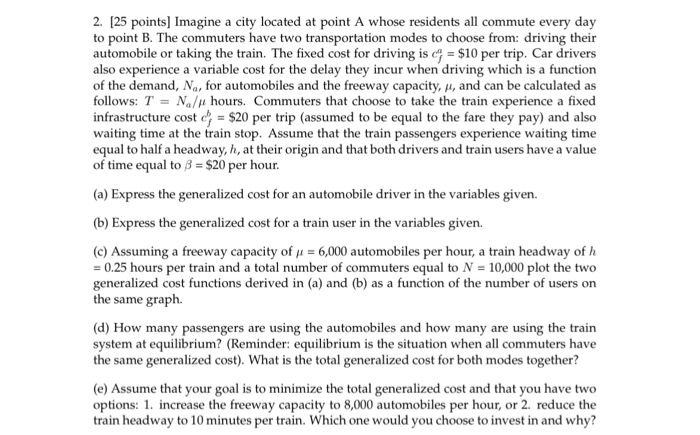
2. 125 points] Imagine a city located at point A whose residents all commute every day to point B. The commuters have two transportation modes to choose from: driving their automobile or taking the train. The fixed cost for driving is $10 per trip. Car drivers also experience a variable cost for the delay they incur when driving which is a function of the demand, Na, for automobiles and the freeway capacity, A, and can be calculated as follows: T Na/u hours. Commuters that choose to take the train experience a fixed infrastructure cost cr $20 per trip (assumed to be equal to the fare they pay) and also waiting time at the train stop. Assume that the train passengers experience waiting time equal to half a headway, h, at their origin and that both drivers and train users have a value of time equal to B* $20 per hour. (a) Express the generalized cost for an automobile driver in the variables given (b) Express the generalized cost for a train user in the variables given. (c) Assuming a freeway capacity of u automobiles per hour, a train headway of h 0.25 hours per train and a total number of commuters equal to N 10,000 plot the two generalized cost functions derived in (a) and (b) as a function of the number of users on the same graph (d) How many passengers are using the automobiles and how many are using the train system at equilibrium? (Reminder: equilibrium is the situation when all commuters have the same generalized cost). What is the total generalized cost for both modes together? (e) Assume that your goal is to minimize the total generalized cost and that you have two options: 1. increase the freeway capacity to 8,000 automobiles per hour, or 2. reduce the train headway to 10 minutes per train. Which one would you choose to invest in and why
Step by Step Solution
There are 3 Steps involved in it

Get step-by-step solutions from verified subject matter experts
 Study Help