







Question: Anyone know how I would solve this? For 10/ 16: Part 0: Create one easy and one medium difculty exam or quiz style problem using
Anyone know how I would solve this?
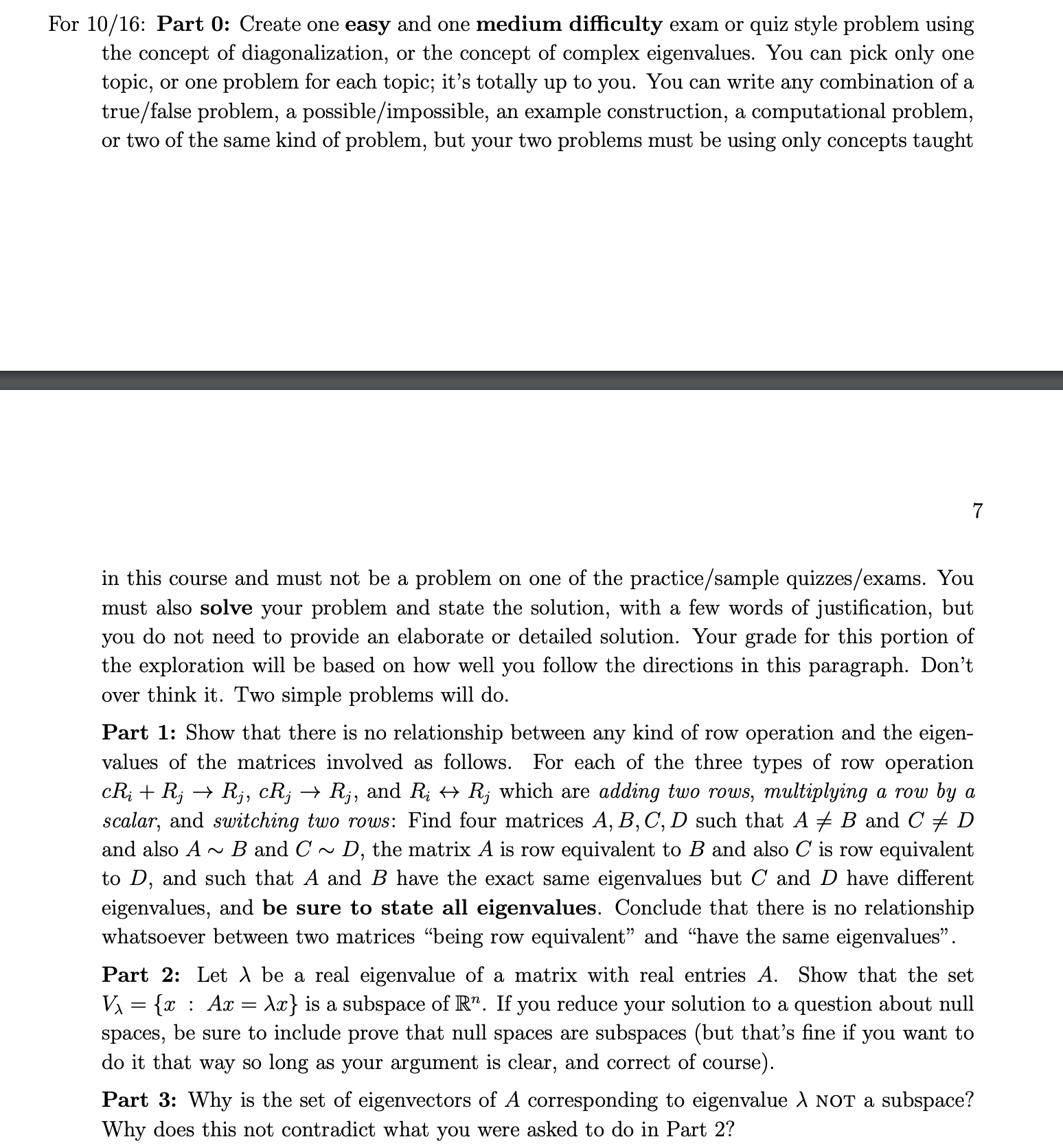
For 10/ 16: Part 0: Create one easy and one medium difculty exam or quiz style problem using the concept of diagonalization, or the concept of complex eigenvalues. You can pick only one topic, or one problem for each topic; it's totally up to you. You can write any combination of a true / false problem, a possible / impossible, an example construction, a computational problem, or two of the same kind of problem, but your two problems must be using only concepts taught in this course and must not be a problem on one of the practice / sample quizzes/ exams. You must also solve your problem and state the solution, with a few words of justication, but you do not need to provide an elaborate or detailed solution. Your grade for this portion of the exploration will be based on how well you follow the directions in this paragraph. Don't over think it. Two simple problems will do. Part 1: Show that there is no relationship between any kind of row operation and the eigen values of the matrices involved as follows. For each of the three types of row operation CR,- + Rj > R5,, CR5; > R,, and R,- (> R, which are adding two rows, multiplying a row by a scalar, and switching two rows: Find four matrices A, B, C, D such that A 7E B and 0 7E D and also A N B and C m D, the matrix A is row equivalent to B and also 0 is row equivalent to D, and such that A and B have the exact same eigenvalues but C and D have different eigenvalues, and be sure to state all eigenvalues. Conclude that there is no relationship whatsoever between two matrices \"being row equivalent\" and \"have the same eigenvalues\". Part 2: Let A be a real eigenvalue of a matrix with real entries A. Show that the set V), = {m : A3: = Aw} is a subspace of R\". If you reduce your solution to a question about null spaces, be sure to include prove that null spaces are subspaces (but that's ne if you want to do it that way so long as your argument is clear, and correct of course). Part 3: Why is the set of eigenvectors of A corresponding to eigenvalue A NOT a subspace? Why does this not contradict what you were asked to do in Part 2
Step by Step Solution
There are 3 Steps involved in it

Get step-by-step solutions from verified subject matter experts
 Study Help