







Question: AP Statistics Chapter 14: From Randomness to Probability - Anticipation Guide Answer the following questions after reading pg 324-337. Questions Answers 1. Explain what the
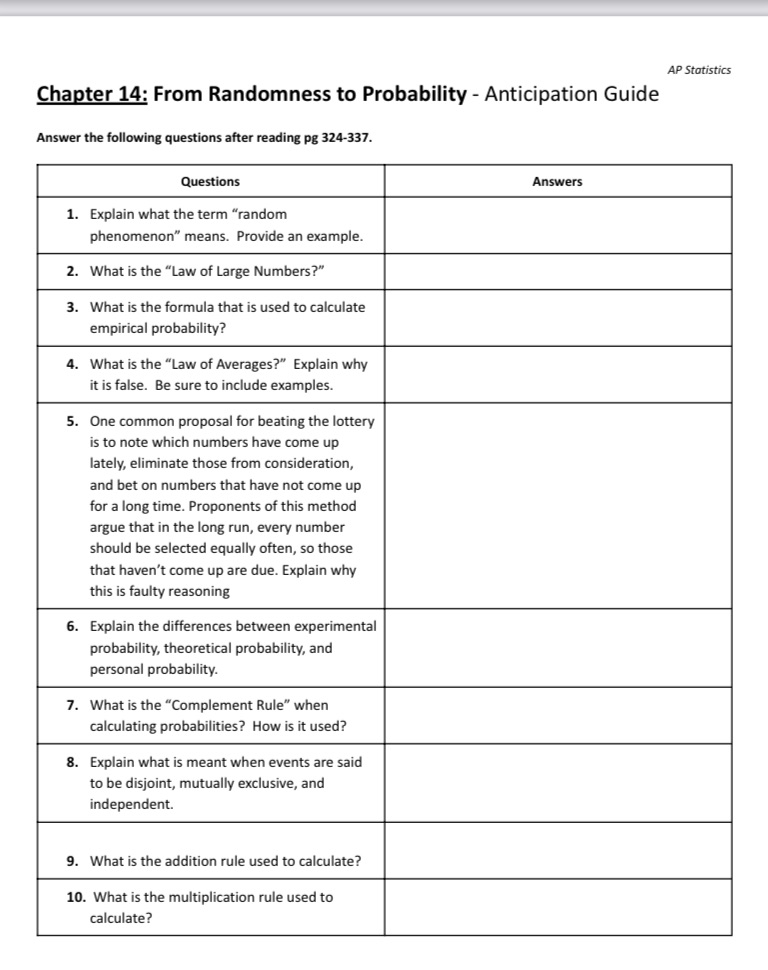
AP Statistics Chapter 14: From Randomness to Probability - Anticipation Guide Answer the following questions after reading pg 324-337. Questions Answers 1. Explain what the term "random phenomenon" means. Provide an example. 2. What is the "Law of Large Numbers?" 3. What is the formula that is used to calculate empirical probability? 4. What is the "Law of Averages?" Explain why it is false. Be sure to include examples. 5. One common proposal for beating the lottery is to note which numbers have come up lately, eliminate those from consideration, and bet on numbers that have not come up for a long time. Proponents of this method argue that in the long run, every number should be selected equally often, so those that haven't come up are due. Explain why this is faulty reasoning 6. Explain the differences between experimental probability, theoretical probability, and personal probability. 7. What is the "Complement Rule" when calculating probabilities? How is it used? 8. Explain what is meant when events are said to be disjoint, mutually exclusive, and independent. 9. What is the addition rule used to calculate? 10. What is the multiplication rule used to calculate
Step by Step Solution
There are 3 Steps involved in it

Get step-by-step solutions from verified subject matter experts
 Study Help