







Question: Appendix 13.1 The Application of Additional Earned Value Rules After reading this appendix you should be able to: LO A13.1-1 Apply pseudo earned value rules
Appendix 13.1 The Application of Additional Earned Value Rules
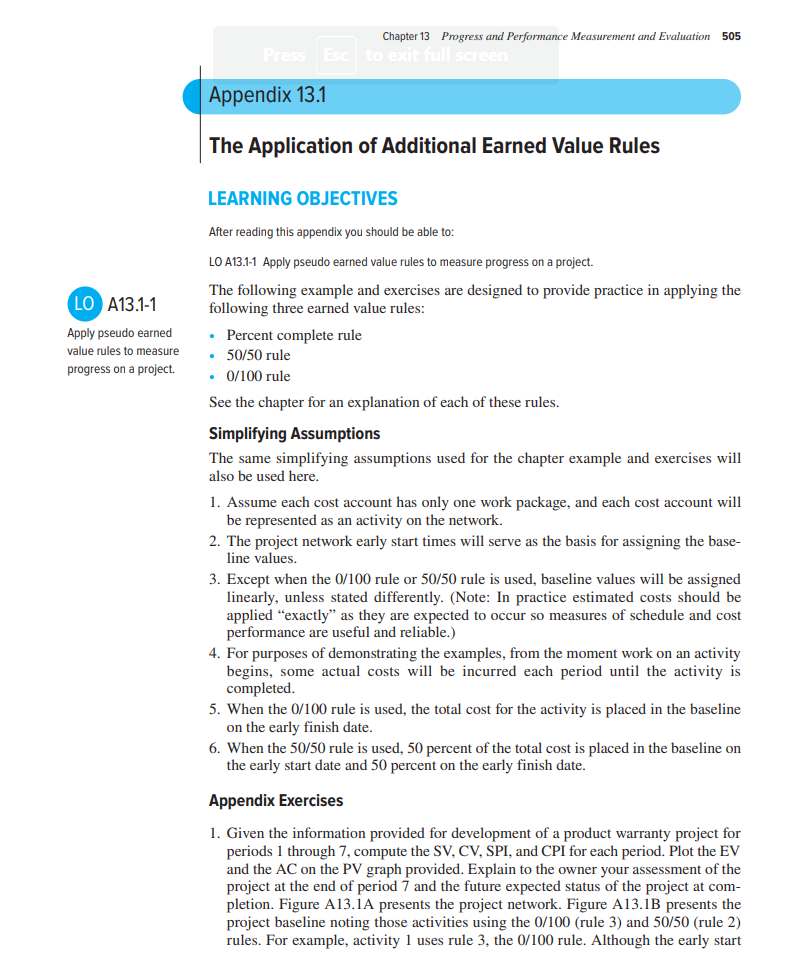
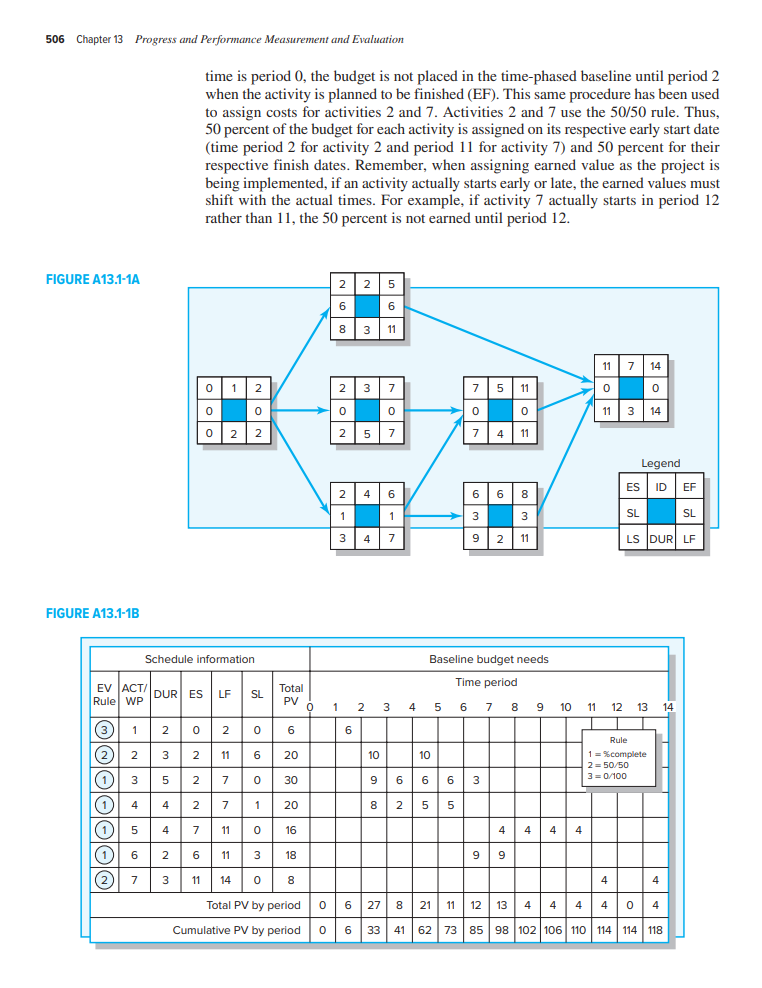
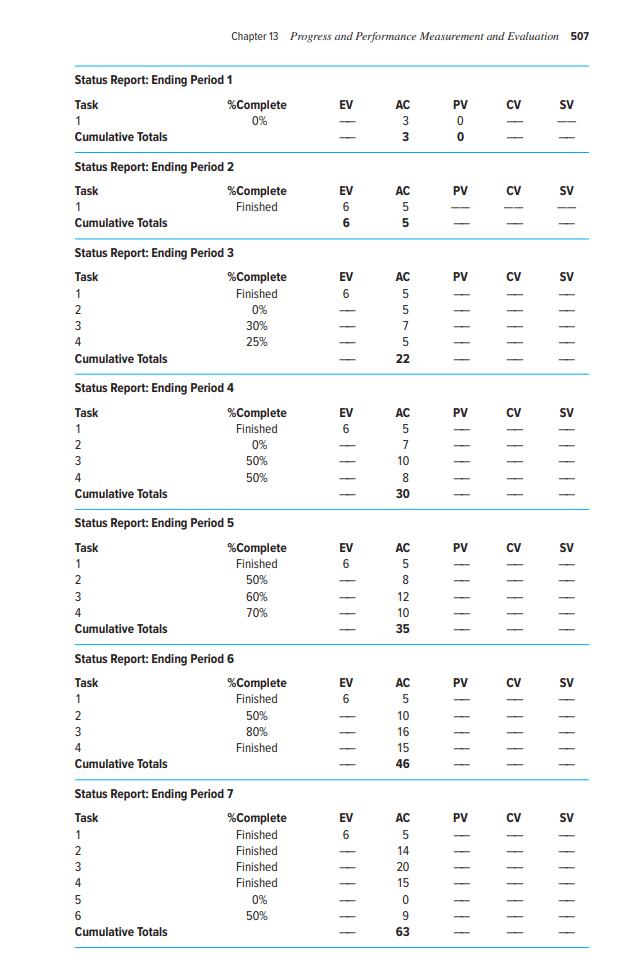
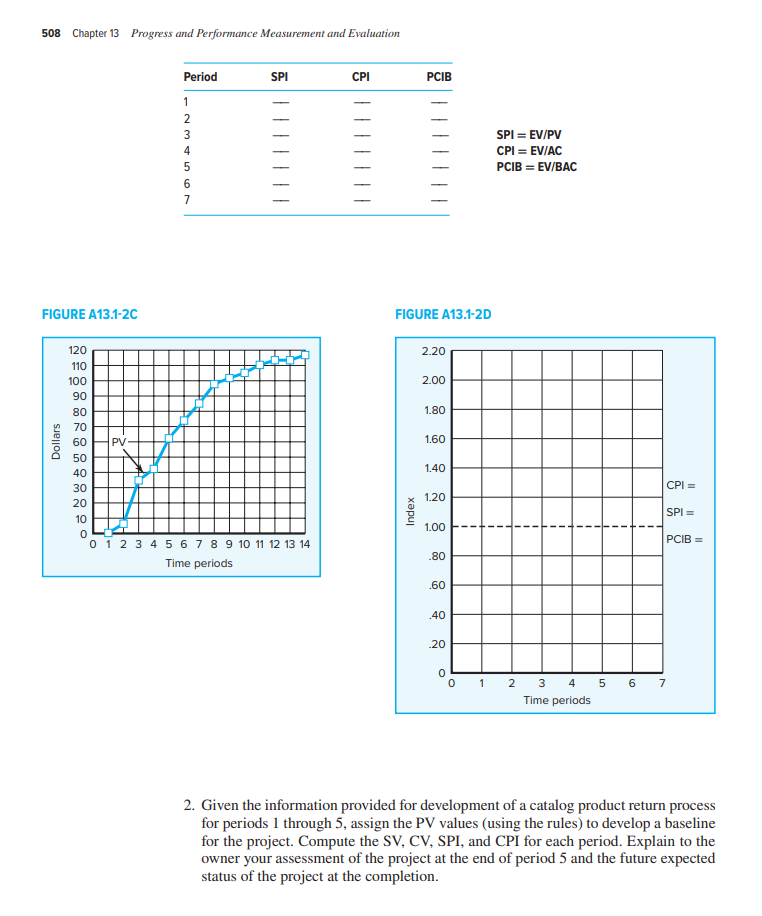
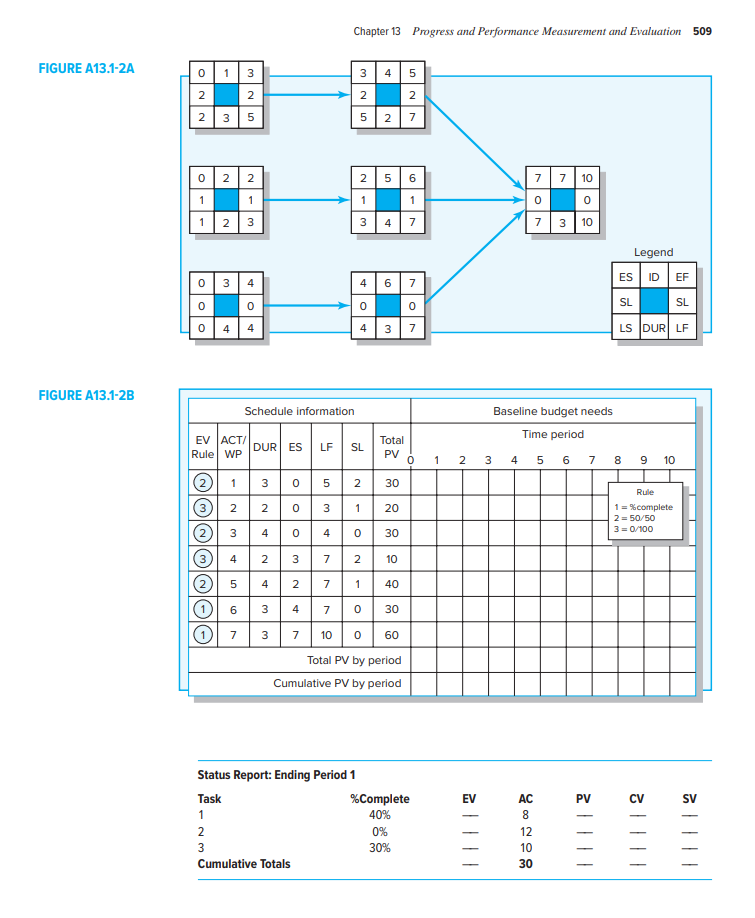
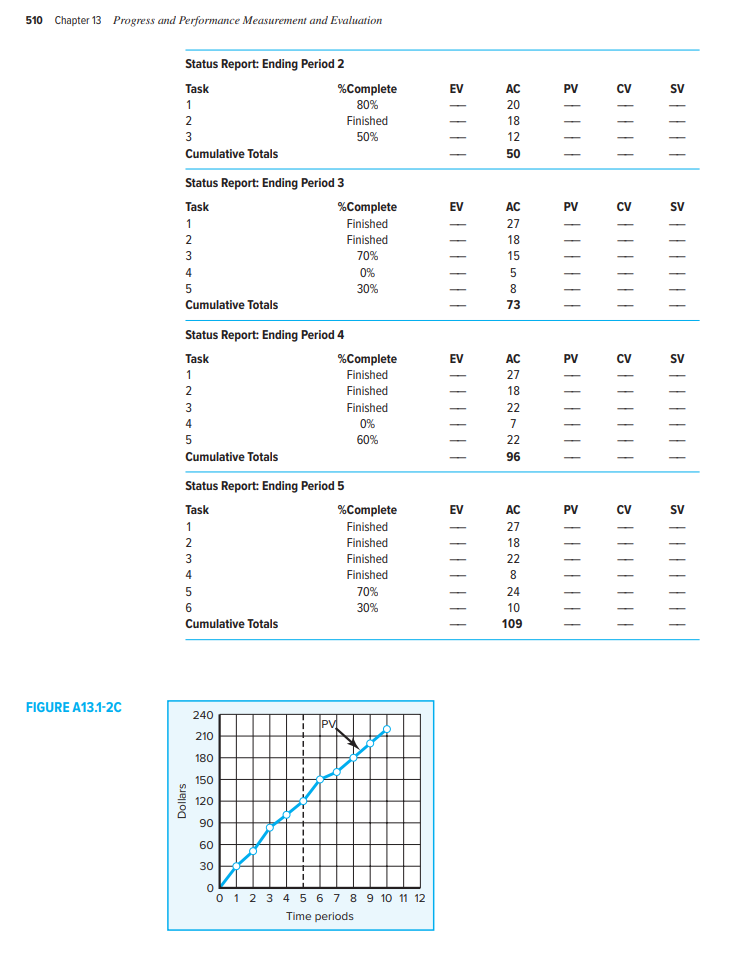
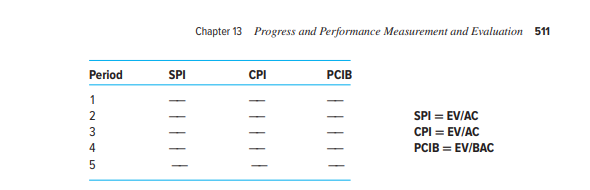
After reading this appendix you should be able to: LO A13.1-1 Apply pseudo earned value rules to measure progress on a project. The following example and exercises are designed to provide practice in applying the following three earned value rules: - Percent complete rule - 50/50 rule - 0/100 rule See the chapter for an explanation of each of these rules. Simplifying Assumptions The same simplifying assumptions used for the chapter example and exercises will also be used here. 1. Assume each cost account has only one work package, and each cost account will be represented as an activity on the network. 2. The project network early start times will serve as the basis for assigning the baseline values. 3. Except when the 0/100 rule or 50/50 rule is used, baseline values will be assigned linearly, unless stated differently. (Note: In practice estimated costs should be applied "exactly" as they are expected to occur so measures of schedule and cost performance are useful and reliable.) 4. For purposes of demonstrating the examples, from the moment work on an activity begins, some actual costs will be incurred each period until the activity is completed. 5. When the 0/100 rule is used, the total cost for the activity is placed in the baseline on the early finish date. 6. When the 50/50 rule is used, 50 percent of the total cost is placed in the baseline on the early start date and 50 percent on the early finish date. Appendix Exercises 1. Given the information provided for development of a product warranty project for periods 1 through 7, compute the SV, CV, SPI, and CPI for each period. Plot the EV and the AC on the PV graph provided. Explain to the owner your assessment of the project at the end of period 7 and the future expected status of the project at completion. Figure A13.1A presents the project network. Figure A13.1B presents the project baseline noting those activities using the 0/100 (rule 3 ) and 50/50 (rule 2) rules. For example, activity 1 uses rule 3 , the 0/100 rule. Although the early start time is period 0 , the budget is not placed in the time-phased baseline until period 2 when the activity is planned to be finished (EF). This same procedure has been used to assign costs for activities 2 and 7 . Activities 2 and 7 use the 50/50 rule. Thus, 50 percent of the budget for each activity is assigned on its respective early start date (time period 2 for activity 2 and period 11 for activity 7 ) and 50 percent for their respective finish dates. Remember, when assigning earned value as the project is being implemented, if an activity actually starts early or late, the earned values must shift with the actual times. For example, if activity 7 actually starts in period 12 rather than 11 , the 50 percent is not earned until period 12. FIGURE A13.1-1A FIGURE A13.1-1B Chapter 13 Progress and Performance Measurement and Evaluation 507 Status Report: Ending Period 1 \begin{tabular}{lccccccc} Task & \%Complete & EV & AC & PV & CV & SV \\ 1 & 0% & - & 3 & 0 & - & - \\ Cumulative Totals & & - & 3 & 0 & - & - \\ \hline \end{tabular} Status Report: Ending Period 2 \begin{tabular}{l} Task \\ 1 \\ Cumulative Totals \\ \hline Status Report: Ending Period 3 \end{tabular} Task 1 2 3 4 Cumulative Totals Status Report: Ending Period 4 Task 1 2 3 4 Cumulative Totals Status Report: Ending Period 5 \begin{tabular}{lcccccc} Task & \%Complete & EV & AC & PV & CV & SV \\ 1 & Finished & 6 & 5 & - & - & - \\ 2 & 50% & - & 8 & - & - & - \\ 3 & 60% & - & 12 & - & - & - \\ 4 & 70% & - & 10 & - & - & - \\ Cumulative Totals & & - & 35 & - & - & - \\ \hline \end{tabular} Status Report: Ending Period 6 508 Chapter 13 Progress and Performance Measurement and Evaluation SPI=EV/PVCPI=EV/ACPCIB=EV/BAC FIGURE A13.1-2C FIGURE A13.1-2D 2. Given the information provided for development of a catalog product return process for periods 1 through 5 , assign the PV values (using the rules) to develop a baseline for the project. Compute the SV, CV, SPI, and CPI for each period. Explain to the owner your assessment of the project at the end of period 5 and the future expected status of the project at the completion. Chapter 13 Progress and Performance Measurement and Evaluation 509 510 Chapter 13 Progress and Performance Measurement and Evaluation Chapter 13 Progress and Performance Measurement and Evaluation 5511 After reading this appendix you should be able to: LO A13.1-1 Apply pseudo earned value rules to measure progress on a project. The following example and exercises are designed to provide practice in applying the following three earned value rules: - Percent complete rule - 50/50 rule - 0/100 rule See the chapter for an explanation of each of these rules. Simplifying Assumptions The same simplifying assumptions used for the chapter example and exercises will also be used here. 1. Assume each cost account has only one work package, and each cost account will be represented as an activity on the network. 2. The project network early start times will serve as the basis for assigning the baseline values. 3. Except when the 0/100 rule or 50/50 rule is used, baseline values will be assigned linearly, unless stated differently. (Note: In practice estimated costs should be applied "exactly" as they are expected to occur so measures of schedule and cost performance are useful and reliable.) 4. For purposes of demonstrating the examples, from the moment work on an activity begins, some actual costs will be incurred each period until the activity is completed. 5. When the 0/100 rule is used, the total cost for the activity is placed in the baseline on the early finish date. 6. When the 50/50 rule is used, 50 percent of the total cost is placed in the baseline on the early start date and 50 percent on the early finish date. Appendix Exercises 1. Given the information provided for development of a product warranty project for periods 1 through 7, compute the SV, CV, SPI, and CPI for each period. Plot the EV and the AC on the PV graph provided. Explain to the owner your assessment of the project at the end of period 7 and the future expected status of the project at completion. Figure A13.1A presents the project network. Figure A13.1B presents the project baseline noting those activities using the 0/100 (rule 3 ) and 50/50 (rule 2) rules. For example, activity 1 uses rule 3 , the 0/100 rule. Although the early start time is period 0 , the budget is not placed in the time-phased baseline until period 2 when the activity is planned to be finished (EF). This same procedure has been used to assign costs for activities 2 and 7 . Activities 2 and 7 use the 50/50 rule. Thus, 50 percent of the budget for each activity is assigned on its respective early start date (time period 2 for activity 2 and period 11 for activity 7 ) and 50 percent for their respective finish dates. Remember, when assigning earned value as the project is being implemented, if an activity actually starts early or late, the earned values must shift with the actual times. For example, if activity 7 actually starts in period 12 rather than 11 , the 50 percent is not earned until period 12. FIGURE A13.1-1A FIGURE A13.1-1B Chapter 13 Progress and Performance Measurement and Evaluation 507 Status Report: Ending Period 1 \begin{tabular}{lccccccc} Task & \%Complete & EV & AC & PV & CV & SV \\ 1 & 0% & - & 3 & 0 & - & - \\ Cumulative Totals & & - & 3 & 0 & - & - \\ \hline \end{tabular} Status Report: Ending Period 2 \begin{tabular}{l} Task \\ 1 \\ Cumulative Totals \\ \hline Status Report: Ending Period 3 \end{tabular} Task 1 2 3 4 Cumulative Totals Status Report: Ending Period 4 Task 1 2 3 4 Cumulative Totals Status Report: Ending Period 5 \begin{tabular}{lcccccc} Task & \%Complete & EV & AC & PV & CV & SV \\ 1 & Finished & 6 & 5 & - & - & - \\ 2 & 50% & - & 8 & - & - & - \\ 3 & 60% & - & 12 & - & - & - \\ 4 & 70% & - & 10 & - & - & - \\ Cumulative Totals & & - & 35 & - & - & - \\ \hline \end{tabular} Status Report: Ending Period 6 508 Chapter 13 Progress and Performance Measurement and Evaluation SPI=EV/PVCPI=EV/ACPCIB=EV/BAC FIGURE A13.1-2C FIGURE A13.1-2D 2. Given the information provided for development of a catalog product return process for periods 1 through 5 , assign the PV values (using the rules) to develop a baseline for the project. Compute the SV, CV, SPI, and CPI for each period. Explain to the owner your assessment of the project at the end of period 5 and the future expected status of the project at the completion. Chapter 13 Progress and Performance Measurement and Evaluation 509 510 Chapter 13 Progress and Performance Measurement and Evaluation Chapter 13 Progress and Performance Measurement and Evaluation 5511
Step by Step Solution
There are 3 Steps involved in it

Get step-by-step solutions from verified subject matter experts
 Study Help