







Question: APPENDIX B PROJECT Mission to Reality: Making it Work Determining program costs and revenues are essential in the planning and evaluation process. This assignment is
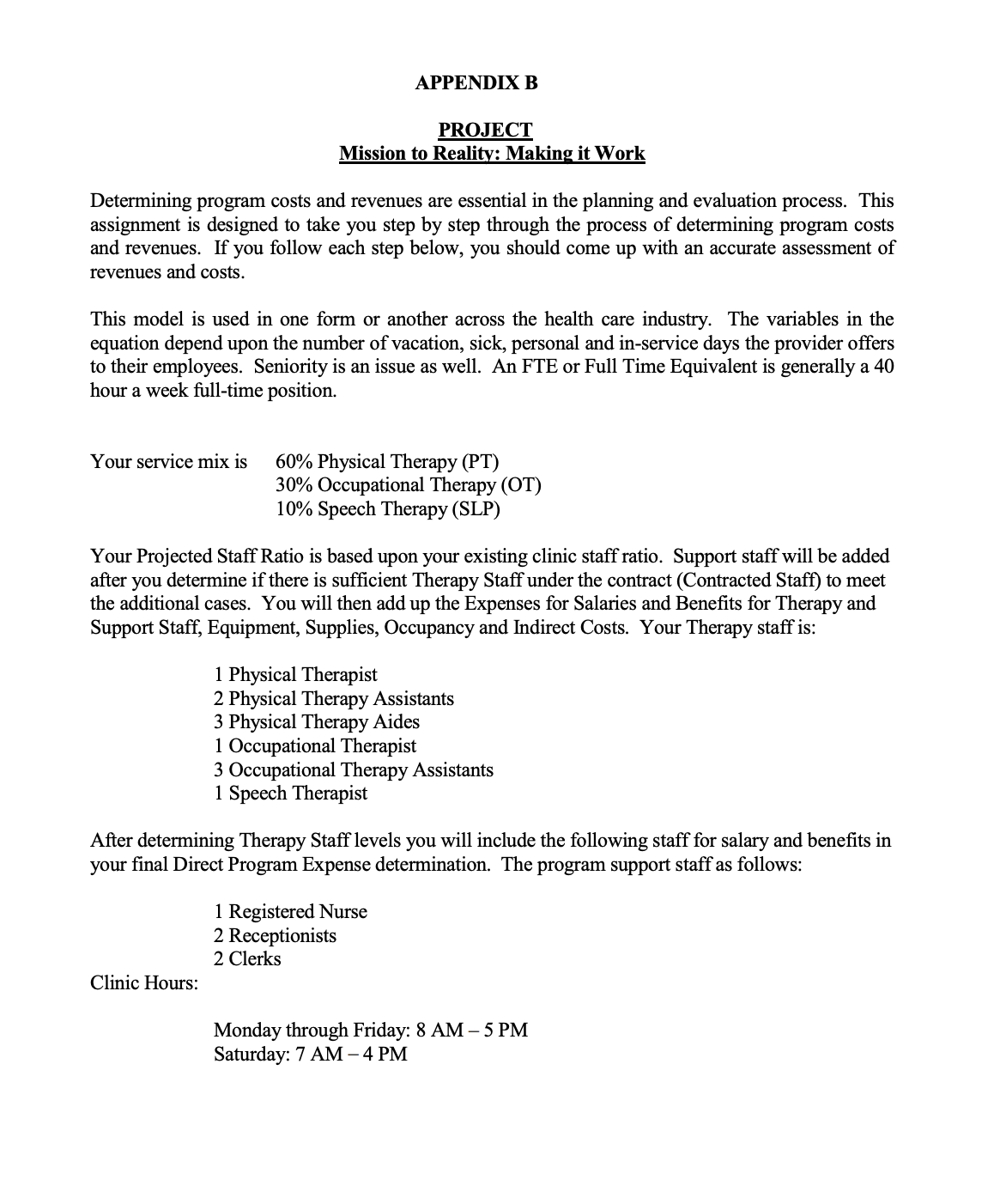
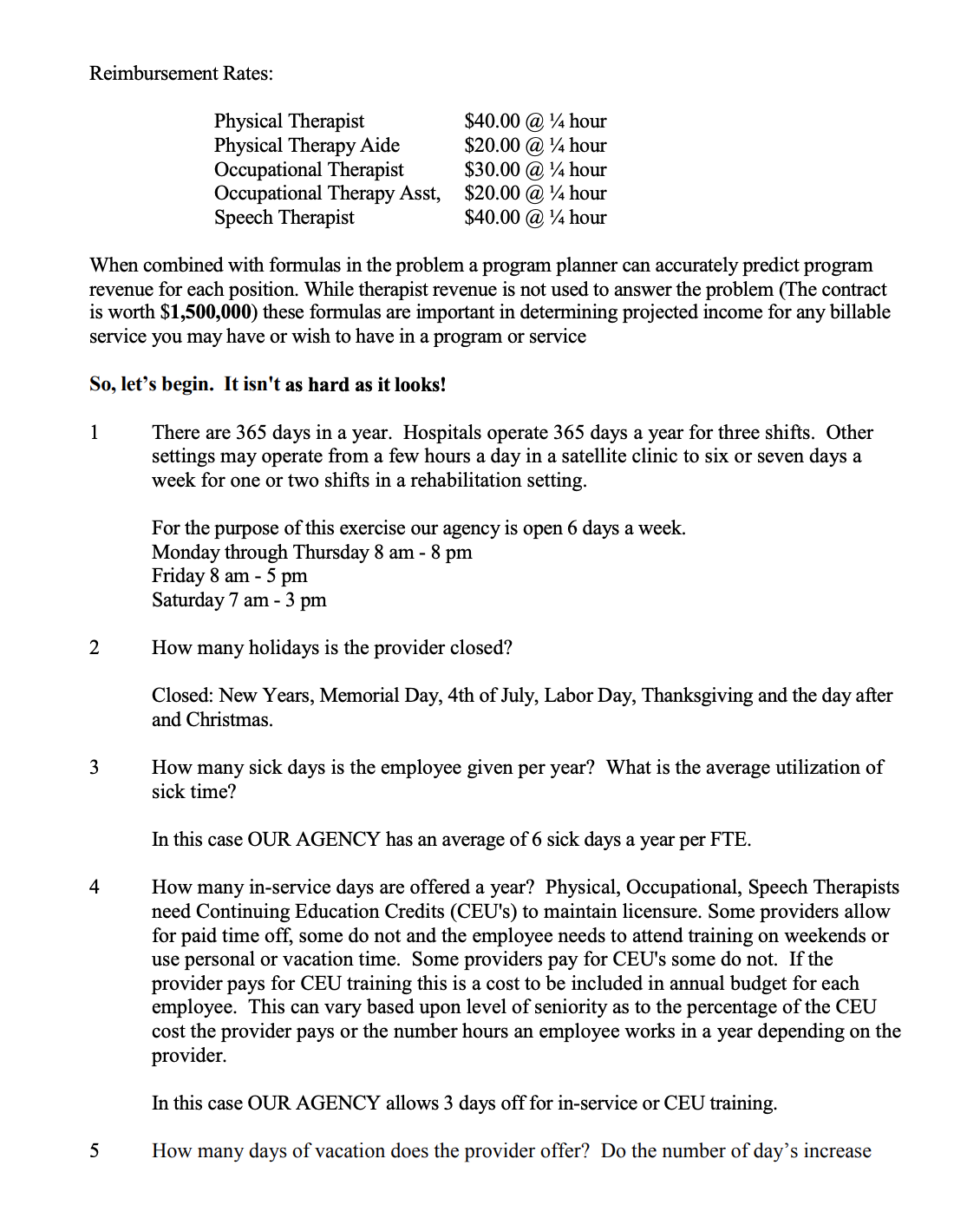
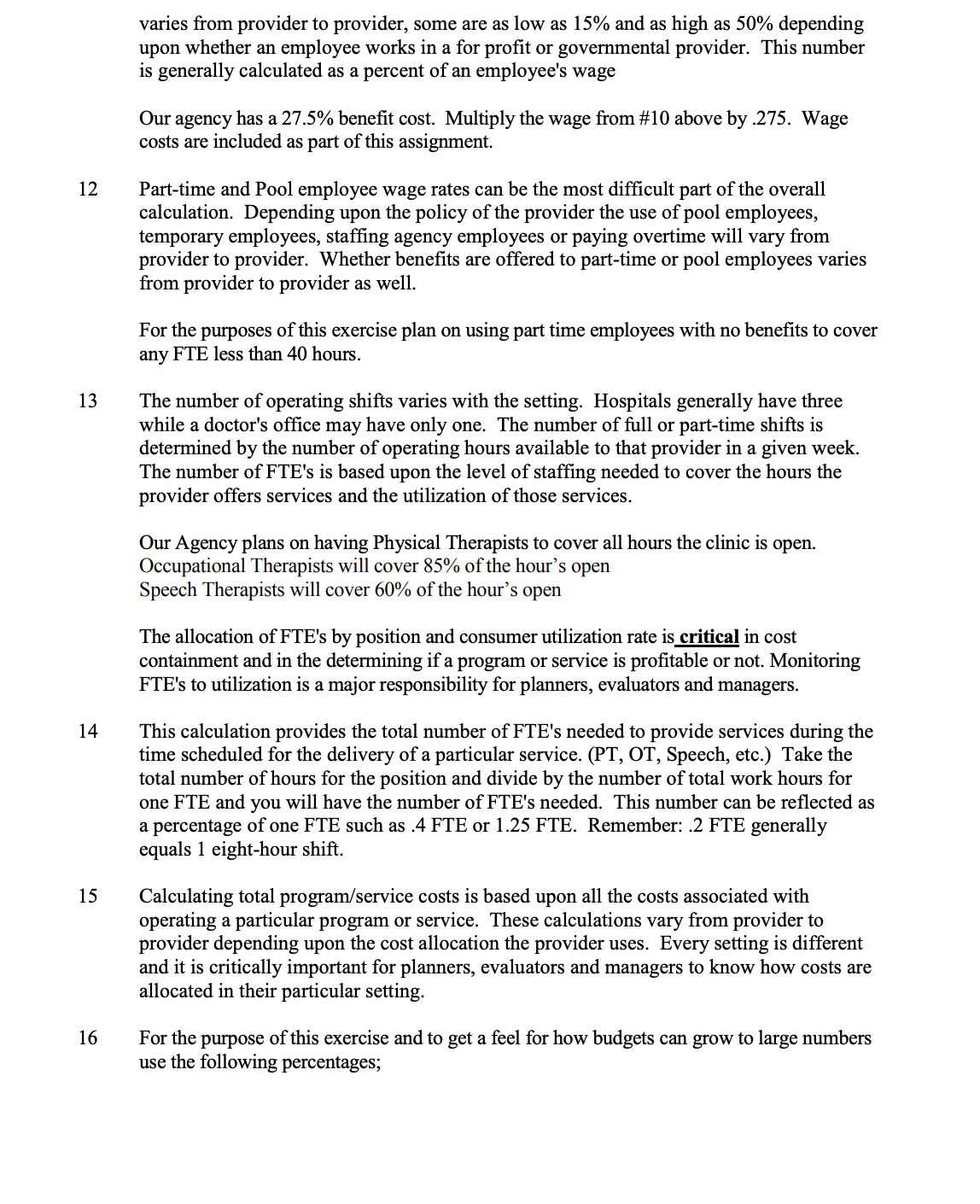
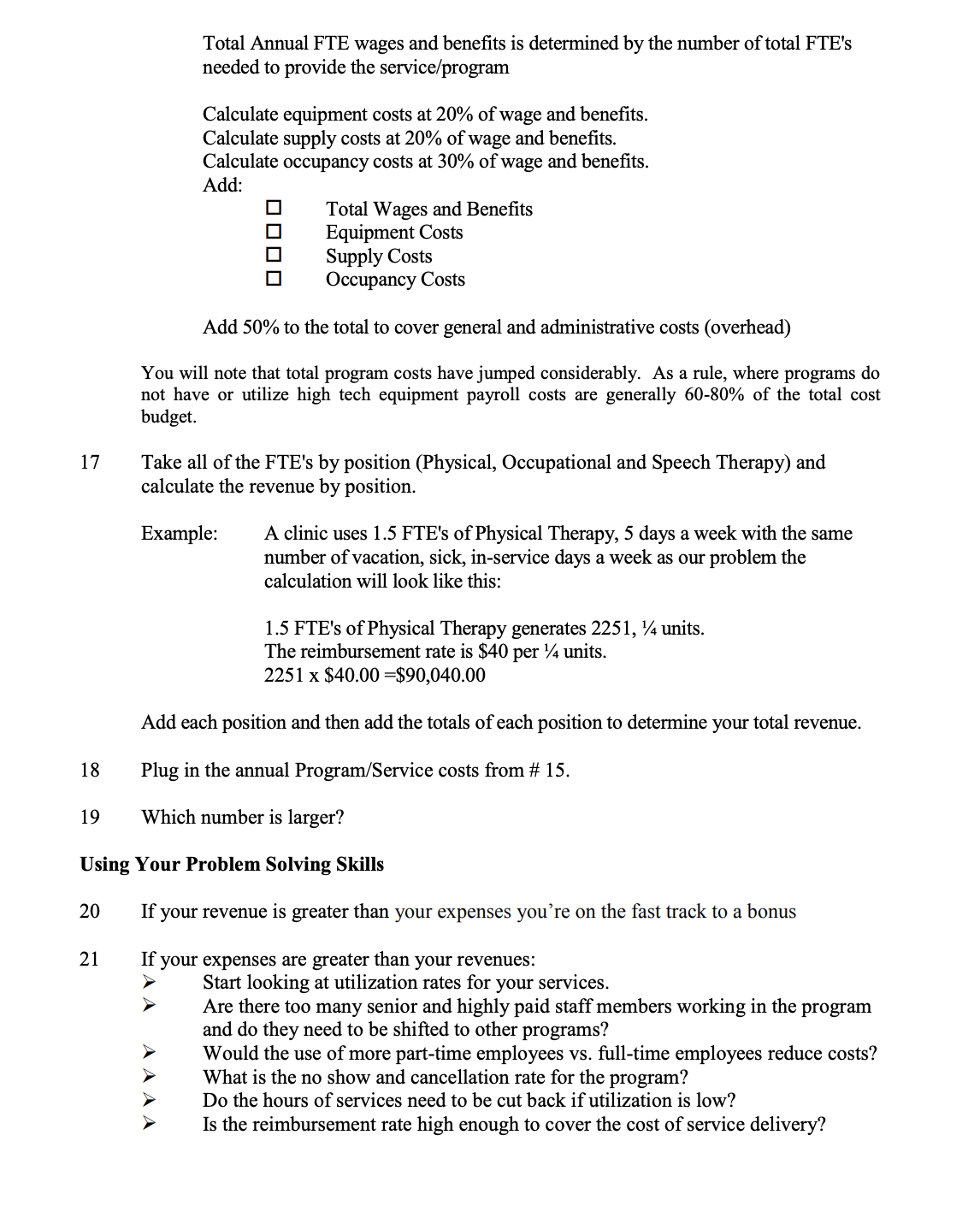
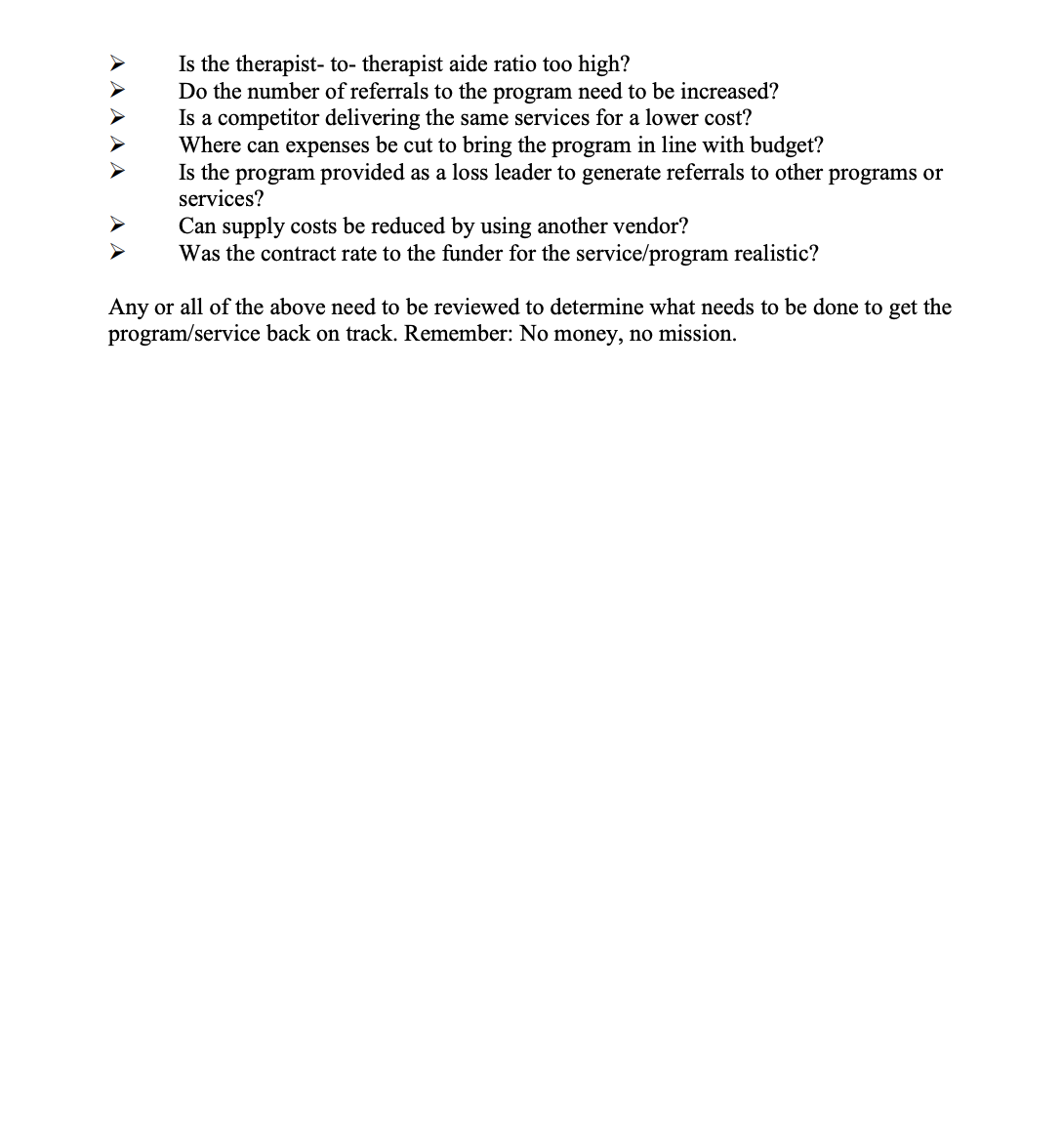
APPENDIX B PROJECT Mission to Reality: Making it Work Determining program costs and revenues are essential in the planning and evaluation process. This assignment is designed to take you step by step through the process of determining program costs and revenues. If you follow each step below, you should come up with an accurate assessment of revenues and costs. This model is used in one form or another across the health care industry. The variables in the equation depend upon the number of vacation, sick, personal and in-service days the provider offers to their employees. Seniority is an issue as well. An FTE or Full Time Equivalent is generally a 40 hour a week full-time position. Your service mix is 60%PhysicalTherapy(PT)30%OccupationalTherapy(OT)10%SpeechTherapy(SLP) Your Projected Staff Ratio is based upon your existing clinic staff ratio. Support staff will be added after you determine if there is sufficient Therapy Staff under the contract (Contracted Staff) to meet the additional cases. You will then add up the Expenses for Salaries and Benefits for Therapy and Support Staff, Equipment, Supplies, Occupancy and Indirect Costs. Your Therapy staff is: 1 Physical Therapist 2 Physical Therapy Assistants 3 Physical Therapy Aides 1 Occupational Therapist 3 Occupational Therapy Assistants 1 Speech Therapist After determining Therapy Staff levels you will include the following staff for salary and benefits in your final Direct Program Expense determination. The program support staff as follows: 1 Registered Nurse 2 Receptionists 2 Clerks Clinic Hours: Monday through Friday: 8AM5PM Saturday: 7 AM - 4 PM Total Annual FTE wages and benefits is determined by the number of total FTE's needed to provide the service/program Calculate equipment costs at 20% of wage and benefits. Calculate supply costs at 20% of wage and benefits. Calculate occupancy costs at 30% of wage and benefits. Add: Total Wages and Benefits Equipment Costs Supply Costs Occupancy Costs Add 50% to the total to cover general and administrative costs (overhead) You will note that total program costs have jumped considerably. As a rule, where programs do not have or utilize high tech equipment payroll costs are generally 6080% of the total cost budget. 17 Take all of the FTE's by position (Physical, Occupational and Speech Therapy) and calculate the revenue by position. Example: A clinic uses 1.5 FTE's of Physical Therapy, 5 days a week with the same number of vacation, sick, in-service days a week as our problem the calculation will look like this: 1.5 FTE's of Physical Therapy generates 2251,1/4 units. The reimbursement rate is $40 per 1/4 units. 2251$40.00=$90,040.00 Add each position and then add the totals of each position to determine your total revenue. 18 Plug in the annual Program/Service costs from \# 15. 19 Which number is larger? Using Your Problem Solving Skills 20 If your revenue is greater than your expenses you're on the fast track to a bonus 21 If your expenses are greater than your revenues: Start looking at utilization rates for your services. Are there too many senior and highly paid staff members working in the program and do they need to be shifted to other programs? Would the use of more part-time employees vs. full-time employees reduce costs? What is the no show and cancellation rate for the program? Do the hours of services need to be cut back if utilization is low? Is the reimbursement rate high enough to cover the cost of service delivery? Is the therapist- to- therapist aide ratio too high? Do the number of referrals to the program need to be increased? Is a competitor delivering the same services for a lower cost? Where can expenses be cut to bring the program in line with budget? Is the program provided as a loss leader to generate referrals to other programs or services? Can supply costs be reduced by using another vendor? Was the contract rate to the funder for the service/program realistic? Any or all of the above need to be reviewed to determine what needs to be done to get the program/service back on track. Remember: No money, no mission. varies from provider to provider, some are as low as 15% and as high as 50% depending upon whether an employee works in a for profit or governmental provider. This number is generally calculated as a percent of an employee's wage Our agency has a 27.5% benefit cost. Multiply the wage from \#10 above by .275 . Wage costs are included as part of this assignment. 12 Part-time and Pool employee wage rates can be the most difficult part of the overall calculation. Depending upon the policy of the provider the use of pool employees, temporary employees, staffing agency employees or paying overtime will vary from provider to provider. Whether benefits are offered to part-time or pool employees varies from provider to provider as well. For the purposes of this exercise plan on using part time employees with no benefits to cover any FTE less than 40 hours. 13 The number of operating shifts varies with the setting. Hospitals generally have three while a doctor's office may have only one. The number of full or part-time shifts is determined by the number of operating hours available to that provider in a given week. The number of FTE's is based upon the level of staffing needed to cover the hours the provider offers services and the utilization of those services. Our Agency plans on having Physical Therapists to cover all hours the clinic is open. Occupational Therapists will cover 85% of the hour's open Speech Therapists will cover 60% of the hour's open The allocation of FTE's by position and consumer utilization rate is critical in cost containment and in the determining if a program or service is profitable or not. Monitoring FTE's to utilization is a major responsibility for planners, evaluators and managers. 14 This calculation provides the total number of FTE's needed to provide services during the time scheduled for the delivery of a particular service. (PT, OT, Speech, etc.) Take the total number of hours for the position and divide by the number of total work hours for one FTE and you will have the number of FTE's needed. This number can be reflected as a percentage of one FTE such as .4 FTE or 1.25 FTE. Remember: .2 FTE generally equals 1 eight-hour shift. 15 Calculating total program/service costs is based upon all the costs associated with operating a particular program or service. These calculations vary from provider to provider depending upon the cost allocation the provider uses. Every setting is different and it is critically important for planners, evaluators and managers to know how costs are allocated in their particular setting. 16 For the purpose of this exercise and to get a feel for how budgets can grow to large numbers use the following percentages; Reimbursement Rates: When combined with formulas in the problem a program planner can accurately predict program revenue for each position. While therapist revenue is not used to answer the problem (The contract is worth $1,500,000 ) these formulas are important in determining projected income for any billable service you may have or wish to have in a program or service So, let's begin. It isn't as hard as it looks! 1 2 3 4 There are 365 days in a year. Hospitals operate 365 days a year for three shifts. Other settings may operate from a few hours a day in a satellite clinic to six or seven days a week for one or two shifts in a rehabilitation setting. For the purpose of this exercise our agency is open 6 days a week. Monday through Thursday 8am8pm Friday 8 am -5 pm Saturday 7 am -3 pm 2 How many holidays is the provider closed? Closed: New Years, Memorial Day, 4th of July, Labor Day, Thanksgiving and the day after and Christmas. 3 How many sick days is the employee given per year? What is the average utilization of sick time? In this case OUR AGENCY has an average of 6 sick days a year per FTE. How many in-service days are offered a year? Physical, Occupational, Speech Therapists need Continuing Education Credits (CEU's) to maintain licensure. Some providers allow for paid time off, some do not and the employee needs to attend training on weekends or use personal or vacation time. Some providers pay for CEU's some do not. If the provider pays for CEU training this is a cost to be included in annual budget for each employee. This can vary based upon level of seniority as to the percentage of the CEU cost the provider pays or the number hours an employee works in a year depending on the provider. In this case OUR AGENCY allows 3 days off for in-service or CEU training. 5 How many days of vacation does the provider offer? Do the number of day's increase
Step by Step Solution
There are 3 Steps involved in it

Get step-by-step solutions from verified subject matter experts
 Study Help