Question: APPENDIX CASE STUDIES AMAZON.COM CASE STUDY com (ticker: AMZN). Shel Kaphan, Amazon's first programmer, assisted by others, and servers, Jeff Bezos set out to change
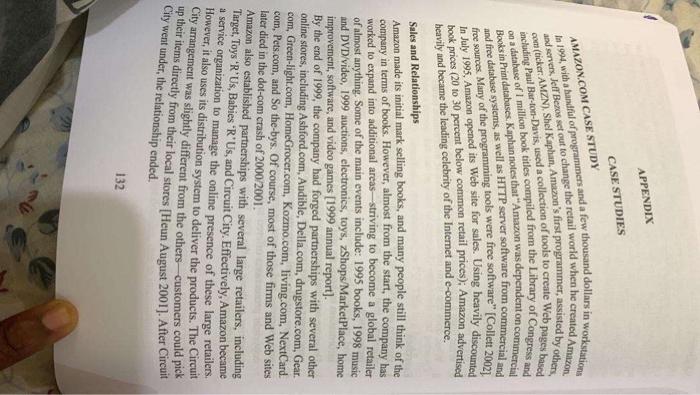
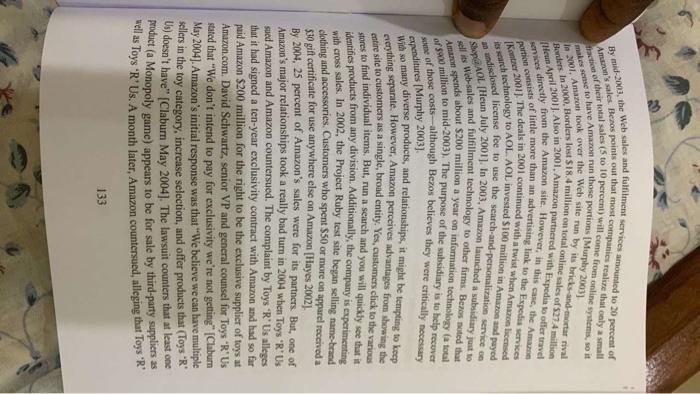
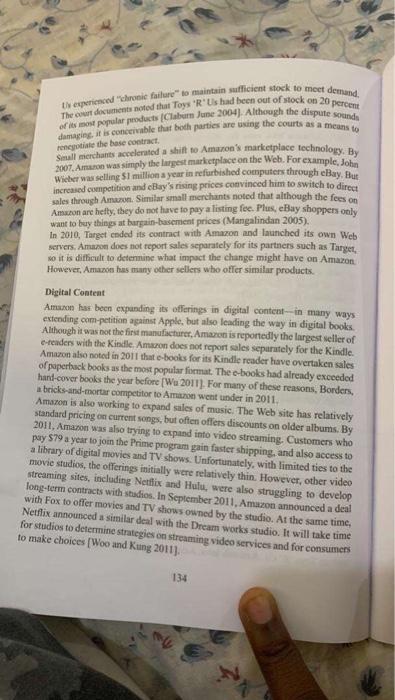
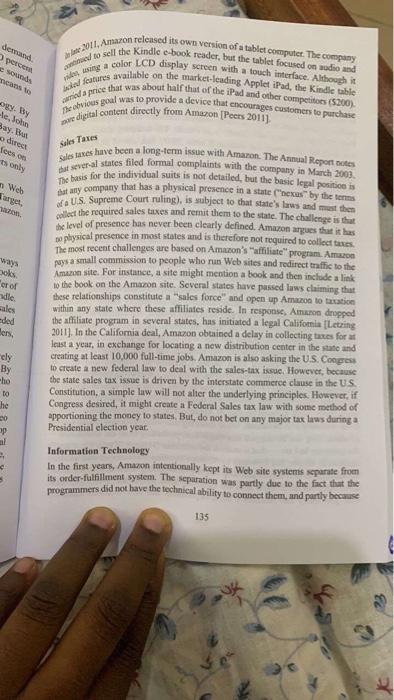
APPENDIX CASE STUDIES AMAZON.COM CASE STUDY com (ticker: AMZN). Shel Kaphan, Amazon's first programmer, assisted by others, and servers, Jeff Bezos set out to change the retail world when he created Amazon. In 1994, with a handful of programmers and a few thousand dollars in workstations including Paul Bar-ton-Davis, used a collection of tools to create Web pages based on a database of 1 million book titles compiled from the Library of Congress and and free database systems, as well as HTTP server software from commercial and Books in Print databases. Kaphan notes that "Amazon was dependent on commercial free sources. Many of the programming tools were free software" [Collett 20021 In July 1995, Amazon opened its Web site for sales. Using heavily discounted book prices (20 to 30 percent below common retail prices); Amazon advertised heavily and became the leading celebrity of the Internet and e-commerce. Sales and Relationships Amazon made its initial mark selling books, and many people still think of the company in terms of books. However, almost from the start, the company has worked to expand into additional areas striving to become a global retailer of almost anything. Some of the main events include: 1995 books, 1998 music and DVD/video, 1999 auctions, electronics, toys, zShops/MarketPlace, home improvement, software, and video games [1999 annual report]. By the end of 1999, the company had forged partnerships with several other online stores, including Ashford.com, Audible, Della.com, drugstore.com, Gear. com, Green-light.com, HomeGrocer.com, Kozmo.com, living.com, NextCard. com, Pets.com, and So the-bys. Of course, most of those firms and Web sites later died in the dot-com crash of 2000/2001. Amazon also established partnerships with several large retailers, including Target, Toys 'R'Us, Babies 'R'Us, and Circuit City. Effectively, Amazon became a service organization to manage the online presence of these large retailers. However, it also uses its distribution system to deliver the products. The Circuit City arrangement was slightly different from the others customers could pick up their items directly from their local stores [Heun August 2001]. After Circuit City went under, the relationship ended. 132 By mid-2003, the Web sales and fulfilment services amounted to 20 percent of Amazon's sales. Bezos points out that most companies realize that only a small traction of their total sales (5 to 10 percent) will come from online systems, so it In 2001, Amazon took over the Web site run by its bricks-and-mortar rival Borders. In 2000, Borders lost $18.4 million on total online sales of $27.4 million makes sense to have Amazon run those portions [Murphy 20031 services directly from the Amazon site. However, in this case, the Amazon (Heun April 2001]. Also in 2001, Amazon partnered with Expedia to offer travel (Kontzer 2001). The deals in 2001 continued with a twist when Amazon licensed portion consists of little more than an advertising link to the Expedia services its search technology to AOL AOL invested $100 million in Amazon and payed Shop@AOL [Heun July 2001]. In 2003, Amazon launched a subsidiary just to an undisclosed license fee to use the search-and-personalization service on Amazon spends about $200 million a year on information technology (a total sell its Web-sales and fulfillment technology to other firms. Bezos noted that of $900 million to mid-2003). The purpose of the subsidiary is to help recover some of those costs-although Bezos believes they were critically necessary expenditures [Murphy 2003]. With so many diverse products, and relationships, it might be tempting to keep everything separate. However, Amazon perceives advantages from showing the entire site to customers as a single, broad entity. Yes, customers click to the various stores to find individual items. But, run a search and you will quickly see that it identifies products from any division. Additionally, the company is experimenting with cross sales. In 2002, the Project Ruby test site began selling name-brand clothing and accessories. Customers who spent $50 or more on apparel received a $30 gift certificate for use anywhere else on Amazon [Hayes 2002). By 2004, 25 percent of Amazon's sales were for its partners. But, one of Amazon's major relationships took a really bad turn in 2004 when Toys 'R' Us sued Amazon and Amazon countersued. The complaint by Toys 'R' Us alleges that it had signed a ten-year exclusivity contract with Amazon and had so far paid Amazon $200 million for the right to be the exclusive supplier of toys at Amazon.com. David Schwartz, senior VP and general counsel for Toys 'R' Us stated that "We don't intend to pay for exclusivity we're not getting" [Claburn May 2004]. Amazon's initial response was that "We believe we can have multiple sellers in the toy category, increase selection, and offer products that (Toys 'R' Us) doesn't have" [Claburn May 2004]. The lawsuit counters that at least one product (a Monopoly game) appears to be for sale by third-party suppliers as well as Toys 'R' Us. A month later, Amazon countersued, alleging that Toys 'R' 133 Us experienced "chronic failure" to maintain sufficient stock to meet demand. The court documents noted that Toys 'R' Us had been out of stock on 20 percent damaging, it is conceivable that both parties are using the courts as a means to of its most popular products (Claburn June 2004). Although the dispute sounds renegotiate the base contract. Small merchants accelerated a shift to Amazon's marketplace technology. By 2007, Amazon was simply the largest marketplace on the Web. For example, John Wieber was selling $1 million a year in refurbished computers through eBay. But increased competition and eBay's rising prices convinced him to switch to direct sales through Amazon. Similar small merchants noted that although the fees on Amazon are hefty, they do not have to pay a listing fee. Plus, eBay shoppers only want to buy things at bargain-basement prices (Mangalindan 2005). In 2010, Target ended its contract with Amazon and launched its own Web servers. Amazon does not report sales separately for its partners such as Target, so it is difficult to determine what impact the change might have on Amazon However, Amazon has many other sellers who offer similar products. Digital Content Amazon has been expanding its offerings in digital content-in many ways extending com-petition against Apple, but also leading the way in digital books. Although it was not the first manufacturer, Amazon is reportedly the largest seller of e-readers with the Kindle. Amazon does not report sales separately for the Kindle. Amazon also noted in 2011 that e-books for its Kindle reader have overtaken sales of paperback books as the most popular format. The e-books had already exceeded hand-cover books the year before [Wu 2011]. For many of these reasons, Borders, a bricks-and-mortar competitor to Amazon went under in 2011. Amazon is also working to expand sales of music. The Web site has relatively standard pricing on current songs, but often offers discounts on older albums. By 2011, Amazon was also trying to expand into video streaming. Customers who pay $79 a year to join the Prime program gain faster shipping, and also access to a library of digital movies and TV shows. Unfortunately, with limited ties to the movie studios, the offerings initially were relatively thin. However, other video streaming sites, including Netflix and Hulu, were also struggling to develop long-term contracts with studios. In September 2011, Amazon announced a deal with Fox to offer movies and TV shows owned by the studio. At the same time, Netflix announced a similar deal with the Dream works studio. It will take time for studios to determine strategies on streaming video services and for consumers to make choices [Woo and Kung 2011]. 134 demand. Opercent sounds means to ogy. By le, John Bay. But o direct fees on ts only n Web Target, azon. ways oks. er of dle. ales ded Mers, cly By -ho to Sales Taxes Sales taxes have been a long-term issue with Amazon. The Annual Report notes dat several states filed formal complaints with the company in March 2003. The basis for the individual suits is not detailed, but the basic legal position is that any company that has a physical presence in a state Cnexus" by the terms da US Supreme Court ruling), is subject to that state's laws and must then collect the required sales taxes and remit them to the state. The challenge is that the level of presence has never been clearly defined. Amazon argues that it has o physical presence in most states and is therefore not required to collect taxes. The most recent challenges are based on Amazon's "affiliate" program Amazon pays a small commission to people who run Web sites and redirect traffic to the Amazon site. For instance, a site might mention a book and then include a link to the book on the Amazon site. Several states have passed laws claiming that these relationships constitute a "sales force" and open up Amazon to taxation within any state where these affiliates reside. In response, Amazon dropped the affiliate program in several states, has initiated a legal California [Letzing 2011). In the California deal, Amazon obtained a delay in collecting taxes for at least a year, in exchange for locating a new distribution center in the state and creating at least 10,000 full-time jobs. Amazon is also asking the U.S. Congress to create a new federal law to deal with the sales-tax issue. However, because the state sales tax issue is driven by the interstate commerce clause in the US. Constitution, a simple law will not alter the underlying principles. However, if Congress desired, it might create a Federal Sales tax law with some method of apportioning the money to states. But, do not bet on any major tax laws during a Presidential election year. I he 20 op al late 2011, Amazon released its own version of a tablet computer. The company continued to sell the Kindle e-book reader, but the tablet focused on audio and using a color LCD display screen with a touch interface. Although it acked features available on the market-leading Applet iPad, the Kindle table amed a price that was about half that of the iPad and other competitors ($200) The obvious goal was to provide a device that encourages customers to purchase nove digital content directly from Amazon [Peers 2011]. Information Technology In the first years, Amazon intentionally kept its Web site systems separate from its order-fulfillment system. The separation was partly due to the fact that the programmers did not have the technical ability to connect them, and partly because 135 the company wanted to improve security by keeping the order systems off the Web By 1997, Amazon's sales had reached $148 million for the year. The big book data-base was being run on Digital Alpha servers. Applications were still custom written in house. By early 2000, the company had over 100 separate database instances running on a variety of servers-handling terabytes of data In 2000, Amazon decided to overhaul its entire system. The company spent $200 million on new applications, including analysis software from Epiphany, logistics from Manugistics, and a new DBMS from Oracle. The company also signed deals with SAS for data mining and analysis [Collett 2002]. But, one of its biggest deal was with Excel on for business-to-business integration systems. The system enables suppliers to communicate in real time, even if they do not have sophisticated IT departments. It provides a direct connection to Amazon's ERP system either through programming connections or through a Web browser [Konicki 2000). About the same time (May 2000), Amazon inked a deal with HP to supply new servers and IT services (Goodridge and Nelson 2000]. The new systems ran the open-source Linux operating system. Already by the third quarter of 2001, Amazon was able to reduce its IT costs by 24 percent from the same quarter in 2000 [Collett 2002). By 2004, the supply chain system at Amazon was a critical factor in its success Jeffrey Wilke, Senior VP of worldwide operations, observed that "When we think about how we're going to grow our company, we focus on price, selection, and availability. All three de-pend critically on the supply chain" [Bacheldor 2004]. Almost the entire system was built from scratch, customized to Amazon's needs. When a customer places an order, the system immediately connects to the distribution centers, determines the best way to ship the product, and provides the details to the customer in under two minutes. The entire process is automatic. Dr. Russell Allgor moved from Bayer Chemical to Amazon and built an 800,000-equation computer model of the company's sprawling operation. When implemented, the goal of the model was to help accomplish almost everything from scheduling Christmas overtime to rerouting trucks in a snowstorm. Allgor's preliminary work focused on one of Amazon's most vexing problems: How to keep inventory at a minimum, while ensuring that when someone orders several products, they can be shipped in a single box, preferably from the warehouse- the company had six-that is nearest the customer [Hansell, 2001]. Dr. Allgor's analysis is simple, but heretical to Amazon veterans. Amazon should increase its holdings of best sellers and stop holding slow-selling titles. It would still sell these titles but order them after the customer does. Lyn Blake, a vice president who previously ran Amazon's book department and now oversees company 136 10 1 a relations with manufacturers, disagrees with this perspective. "I worry about the customer's perspective if we suddenly have a lot of items that are not available for quick delivery." New Services Amazon requires huge data centers and high-speed Internet connections to run its systems. Through vast economies of scale, Amazon is able to achieve incredibly low prices for data storage and bandwidth. Around 2005, the company decided that it could leverage those low costs into a new business selling Internet-based services. The company offers an online data storage service called $3. For a monthly fee of about 15 cents per gigabyte stored plus 15 cents per gigabyte of data transferred, any person or company can transfer and store data on Amazon servers [Markoff 2006]. Through a similar service (EC2), any company can use the company's Web servers to deliver digital content to customers. The company essentially serves as a Web host, but instead of paying fixed costs, you pay 10 cents per virtual server per hour plus bandwidth costs. Amazon's network can handle bursts up to 1 gigabit per se-cond. The system creates virtual servers, running the Linux kernel, and you can run any software you want [Gralla 2006]. By 2011, the company had several locations providing S3 and EC2 Web services. It also offered online relational database services using either MySQL or the Oracle DBMS. Anyone can pay to store data in the DBMS, with charges being levied per hour, per data stored, and per data transferred. The point is that Amazon handles all of the maintenance and other companies avoid fixed costs. Even government agencies are adopting the benefits of storing data in these cloud services including those run by Amazon. For example, the U.S. Treasury Department moved is public Web sites to the Amazon cloud. [Pratt 2011]. Perhaps the most unusual service is Mturk. The name derives from an 18-century joke where a "mechanical" chess-playing machine surprised European leaders and royalty by beating many expert players. The trick was that a human was hidden under the board and moved the pieces with magnets. Amazon's trick is to use human power to solve problems. Companies post projects on the Mturk site and offer to pay a price for piecemeal work. Any individual can sign up and perform a task and get paid based on the amount of work completed. Amazon takes a 10 percent commission above the fee. For example, the company Casting Words places audio files on the site and pays people 42 cents to transcribe one minute of audio files into text [Markoff 2006]. The Amazon EC2 and 53 services suffered some problems in the summer of 2011. A configuration error during an upgrade in the East Coast facility triggered a cascade that delayed all services in the facility. Internet services including Foursquare and Reddit that used the facility were impacted by the problems 137 for almost a week [Tibken 2011]. Amazon engineers learned a lot from the problems and the same issue is unlikely to occur again [http://aws.amazon.com message/65648/]. But, the outage points out the risks involved in any centralized system. Ironically, the main problems were caused by algorithms designed to copy data to multiple servers to reduce risks. On the other hand, with multiple facilities Amazon provides the ability to spread content and risk across multiple locations Adam Selipsky, vice president of product management and developer relations at Amazon Web Services observed that Amazon is fundamentally a technology company; we've spent more than one and a half billion dollars investing in technology and content. We began by retailing books, but it was never in our business plan to stay with that" [Gralla 2006]. Case Questions 1. Who are Amazon's competitors? 2. Why would customers shop at Amazon if they can find better prices elsewhere? 3. Why did Amazon create most of its own technology from scratch? 4. If Amazon buys products from other firms and simply ships them to customers, why does it need so many of its own distribution centers? 5. Will other retailers buy or lease the Web software and services from Amazon? Can Amazon make enough money from selling these services? 6. Write a report to management that describes the primary cause of the problems, a detailed plan to solve them, and show how the plan solves the problems and describe any other benefits it will provide. TEN The beak pou SIC pro wh









 Study Help