Question: Application and Skill Building Case Study One Opening the Hollywood Knitting Factory You don't raise $5 million and run a successful, growing business for more
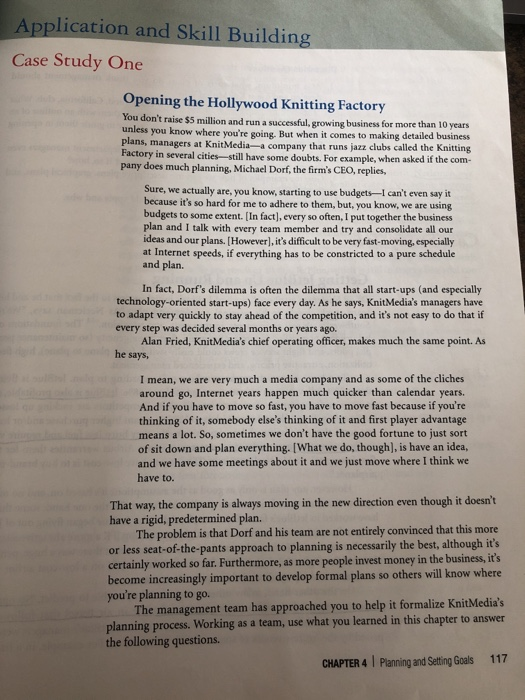
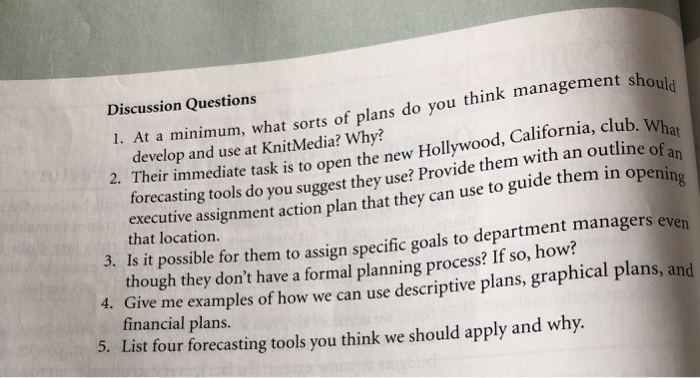
Application and Skill Building Case Study One Opening the Hollywood Knitting Factory You don't raise $5 million and run a successful, growing business for more than 10 years unless you know where you're going. But when it comes to making detailed business plans, managers at KnitMedia-a company that runs jazz clubs called the Knitting Factory in several cities--still have some doubts. For example, when asked if the com- pany does much planning, Michael Dorf, the firm's CEO, replies, Sure, we actually are, you know, starting to use budgets- I can't even say it because it's so hard for me to adhere to them, but, you know, we are using budgets to some extent. [In fact), every so often. I put together the business plan and I talk with every team member and try and consolidate all our ideas and our plans. However, it's difficult to be very fast-moving, especially at Internet speeds, if everything has to be constricted to a pure schedule and plan. In fact, Dorf's dilemma is often the dilemma that all start-ups (and especially technology-oriented start-ups) face every day. As he says, KnitMedia's managers have to adapt very quickly to stay ahead of the competition, and it's not easy to do that if every step was decided several months or years ago. Alan Fried, KnitMedia's chief operating officer, makes much the same point. As he says. I mean, we are very much a media company and as some of the cliches around go, Internet years happen much quicker than calendar years. And if you have to move so fast, you have to move fast because if you're thinking of it, somebody else's thinking of it and first player advantage means a lot. So, sometimes we don't have the good fortune to just sort of sit down and plan everything. What we do, though), is have an idea, and we have some meetings about it and we just move where I think we have to. That way, the company is always moving in the new direction even though it doesn't have a rigid, predetermined plan. The problem is that Dorf and his team are not entirely convinced that this more or less seat-of-the-pants approach to planning is necessarily the best, although it's certainly worked so far. Furthermore, as more people invest money in the business, it's become increasingly important to develop formal plans so others will know where you're planning to go. The management team has approached you to help it formalize KnitMedia's planning process. Working as a team, use what you learned in this chapter to answer the following questions. CHAPTER 4 Planning and Setting Goals 117 Discussion Questions 1. At a minimum, what sorts of plans do you think management should 2. Their immediate task is to open the new Hollywood, California, club. What forecasting tools do you suggest they use? Provide them with an outline of an executive assignment action plan that they can use to guide them in opening that location. develop and use at KnitMedia? Why? 3. Is it possible for them to assign specific goals to department managers even though they don't have a formal planning process? If so, how?. 4. Give me examples of how we can use descriptive plans, graphical plans, and financial plans. 5. List four forecasting tools you think we should apply and why









 Study Help