







Question: Application - Differentials: Problem 1 (1 point) The figure shows how a function f() and its linear approximation (i.e., its tangent line) change value when
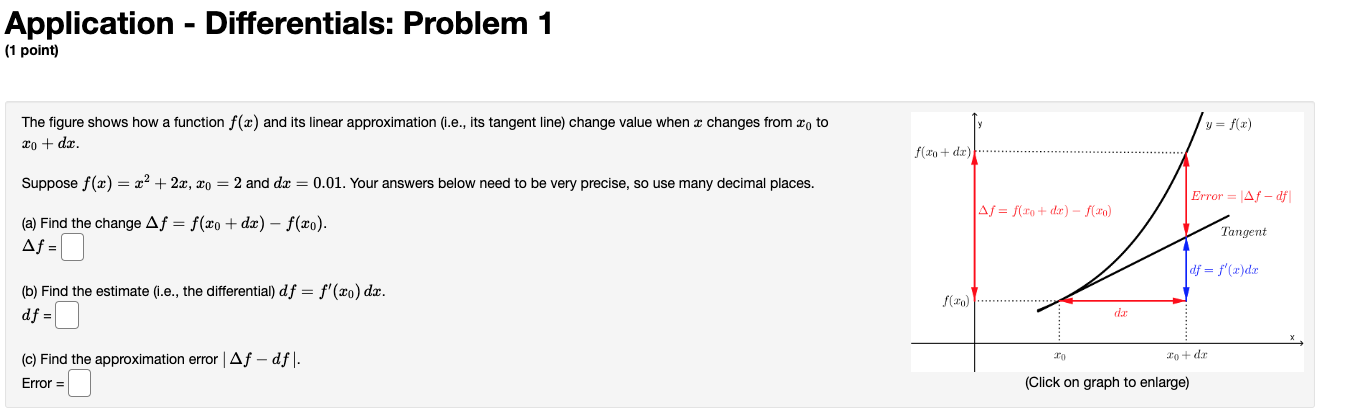
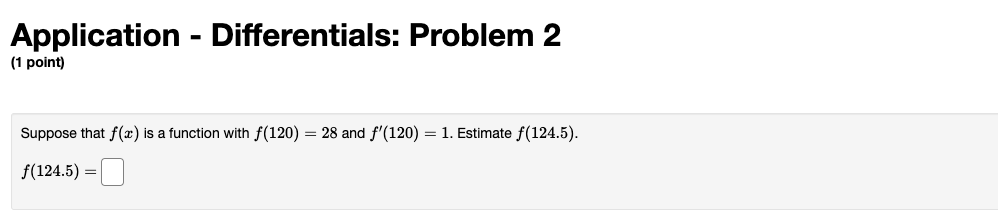
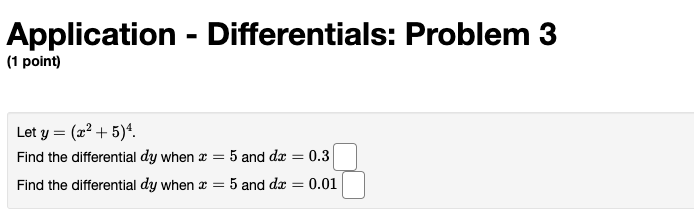
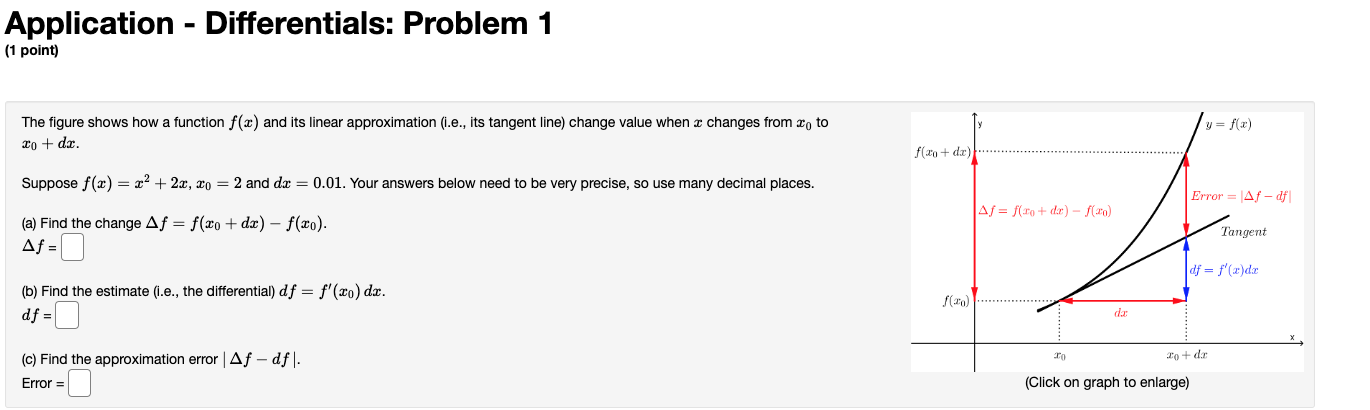
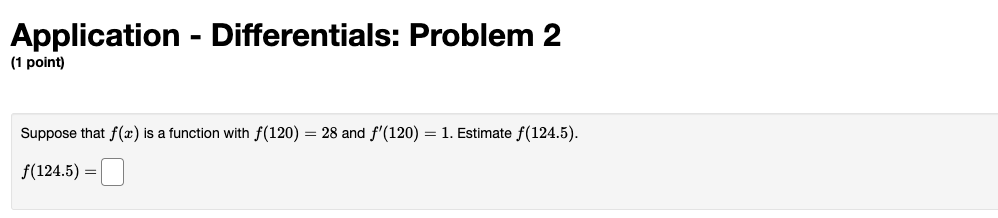
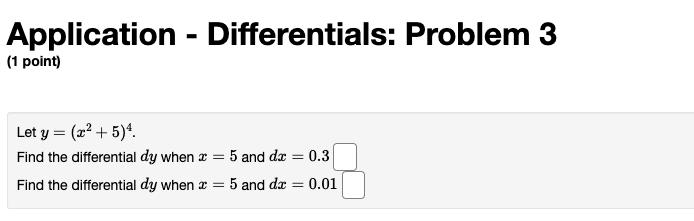
Application - Differentials: Problem 1 (1 point) The figure shows how a function f() and its linear approximation (i.e., its tangent line) change value when I changes from To to y = f(x) To + dr. f(xo + dr)......... Suppose f(x) = x2 + 2x, x0 = 2 and dar = 0.01. Your answers below need to be very precise, so use many decimal places. Error = 14f - dfl (a) Find the change Af = f(xo + dx) - f(x0). Af = f(ro+ de) - f(zo) Tangent Af = df = f(x)de (b) Find the estimate (i.e., the differential) df = f'(xo) dx. f(zo) df = da (c) Find the approximation error | Af - dif |. To + da Error = (Click on graph to enlarge)Application - Differentials: Problem 2 (1 point) Suppose that f() is a function with f(120) = 28 and f'(120) = 1. Estimate f(124.5). f (124.5) =Application - Differentials: Problem 3 {1 point} Let y = {in2 + 5)'. Find the differential dy when a: = 5 and do: = 0.3 Find the differential dy when a: = 5 and do: = 0.01
Step by Step Solution
There are 3 Steps involved in it

Get step-by-step solutions from verified subject matter experts
 Study Help