







Question: Application to Civil Engineering practice: The profile ( cross section ) on the following page is part of a slurry wall excavation made during the
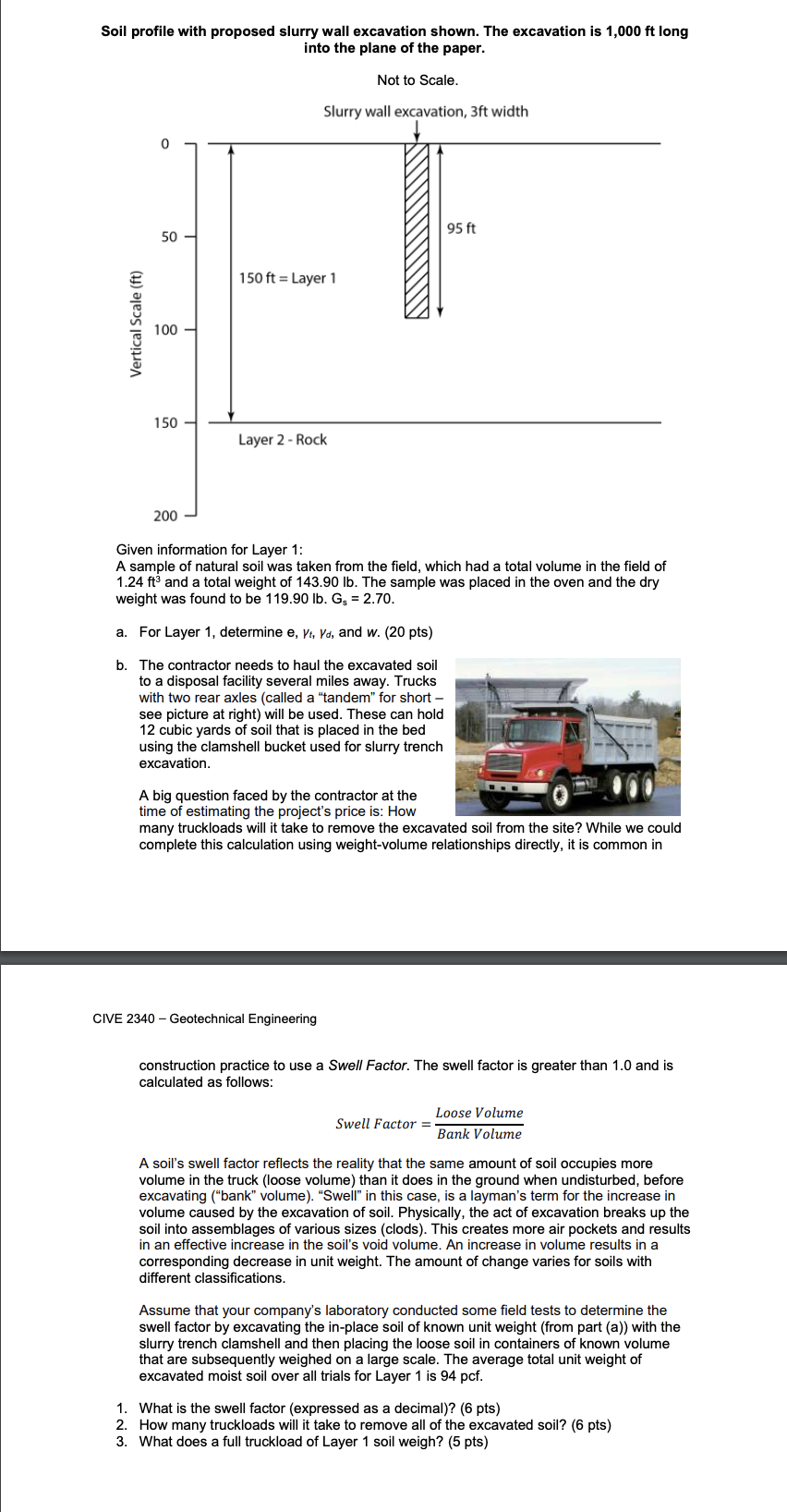
Application to Civil Engineering practice: The profile cross section on the following page is
part of a slurry wall excavation made during the construction of the nd Avenue Subway line in New York City. The stratigraphy soil layering and some laboratory data for each layer are given. All soils are inorganic.Soil profile with proposed slurry wall excavation shown. The excavation is long into the plane of the paper. darr
Given information for Layer :
A sample of natural soil was taken from the field, which had a total volume in the field of
and a total weight of The sample was placed in the oven and the dry
weight was found to be
a For Layer determine e and pts
b The contractor needs to haul the excavated soil
to a disposal facility several miles away. Trucks
with two rear axles called a "tandem" for short
see picture at right will be used. These can hold
cubic yards of soil that is placed in the bed
using the clamshell bucket used for slurry trench
excavation.
A big question faced by the contractor at the
time of estimating the project's price is: How
many truckloads will it take to remove the excavated soll trom the ste vvnile we coula
complete this calculation using weightvolume relationships directly, it is common in
CIVE Geotechnical Engineering
construction practice to use a Swell Factor. The swell factor is greater than and is
calculated as follows:
Swell Factor
A soil's swell factor reflects the reality that the same amount of soil occupies more
volume in the truck loose volume than it does in the ground when undisturbed, before
excavating bank volume "Swell" in this case, is a layman's term for the increase in
volume caused by the excavation of soil. Physically, the act of excavation breaks up the
soil into assemblages of various sizes clods This creates more air pockets and results
in an effective increase in the soil's void volume. An increase in volume results in a
corresponding decrease in unit weight. The amount of change varies for soils with
different classifications.
Assume that your company's laboratory conducted some field tests to determine the
swell factor by excavating the inplace soil of known unit weight from part a with the
slurry trench clamshell and then placing the loose soil in containers of known volume
that are subsequently weighed on a large scale. The average total unit weight of
excavated moist soil over all trials for Layer is pcf
What is the swell factor expressed as a decimal pts
How many truckloads will it take to remove all of the excavated soil? pts
What does a full truckload of Layer soil weigh?
Step by Step Solution
There are 3 Steps involved in it
1 Expert Approved Answer
Step: 1 Unlock

Question Has Been Solved by an Expert!
Get step-by-step solutions from verified subject matter experts
Step: 2 Unlock
Step: 3 Unlock
 Study Help