







Question: Applied Numerical Method: Solve problems by hand 10.3 Consider the fo llowing fi rst-order ODE: r!l!.. = y + t3 dt fr om t =
Applied Numerical Method: Solve problems by hand
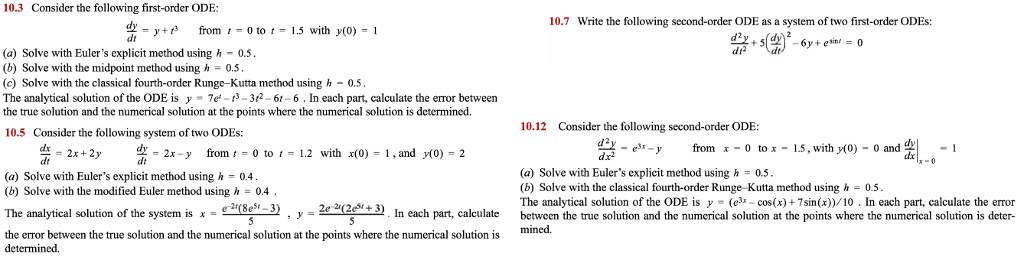
10.3 Consider the fo llowing fi rst-order ODE: r!l!.. = y + t3 dt fr om t = 0 to t = 1.5 with y(O) = 1 (a) Solve with Euler's explicit method using h = 0.5. (b) Solve with the midpoint method using h = 0.5. (c) Solve with the classical fo urth-order Runge-Kutta method using h = 0.5. The analytical solution of the ODE is y = 7 e 1 -t3 - 3 t2 -6t -6 . In each part, calculate the error between the true solution and the numerical solution at the points where the numerical solution is determined.
10.5 Consider the fo llowing system of two ODEs: dx = 2x + 2y
10.7 Write the fo llowing second-order ODE as a system of two fi rst-order ODEs: d2y + 5 (
Consider the fo llowing second-order ODE: d2 = e3x_y dx2 fr om x = O to x = 1.5, with y(O) = 0 and r!J:. I 1 dx x=O (a) Solve with Euler's explicit method using h = 0.5. (b) Solve with the classical fo urth-order Runge-Kutta method using h = 0.5. The analytical solution of the ODE is y = (e3x-cos(x) + 7sin(x))/10 . In each part, calculate the error between the true solution and the numerical solution at the points where the numerical solution is deter mined.
10.3 Consider the following first-order ODE: 10.7 write the following second-order ODE as a system of two first-order oDEs dy y +P from t 0 to t 5 with y(0) 1 6yr e'in (a) Solve with Euler's explicit method using h 0.5 (b) Solve with the midpoint method using h 0.5 (c) Solve with the classical fourth-order Runge-Kutta method using h 0.5. The analytical solution of the ODE is y 7e 312-6 6 In each part, calculate the error between the true solution and the numerical solution at the points where the numerical solution is determined. 10.12 Consider the following second-order oDE: 10.5 Consider the following system of two ODEs: es y from x 0 to x 1.5, with y(0) 0 and 2x y from t 0 to t 2 with x(0) and yo 2 2x 2 y dx2 (a Solve with Euler's explicit method using h 0.5 (a) Solve with Euler's explicit method using h 0.4 (b) Solve with the classical fourth-order Runge-Kutta method using h 0.5 (b) Solve with the modified Euler method using h 0.4 The analytical solution of the ODE is y (es COS +7sin(x))/10. In each part, calculate the error e-2 (8e The analytical solution of the system is x In each part, calculate between the true solution and the numerical solution at the points where the numerical solution is deter- mined. the error between the true solution and the numerical solution at the points where the numerical solution is determined. 10.3 Consider the following first-order ODE: 10.7 write the following second-order ODE as a system of two first-order oDEs dy y +P from t 0 to t 5 with y(0) 1 6yr e'in (a) Solve with Euler's explicit method using h 0.5 (b) Solve with the midpoint method using h 0.5 (c) Solve with the classical fourth-order Runge-Kutta method using h 0.5. The analytical solution of the ODE is y 7e 312-6 6 In each part, calculate the error between the true solution and the numerical solution at the points where the numerical solution is determined. 10.12 Consider the following second-order oDE: 10.5 Consider the following system of two ODEs: es y from x 0 to x 1.5, with y(0) 0 and 2x y from t 0 to t 2 with x(0) and yo 2 2x 2 y dx2 (a Solve with Euler's explicit method using h 0.5 (a) Solve with Euler's explicit method using h 0.4 (b) Solve with the classical fourth-order Runge-Kutta method using h 0.5 (b) Solve with the modified Euler method using h 0.4 The analytical solution of the ODE is y (es COS +7sin(x))/10. In each part, calculate the error e-2 (8e The analytical solution of the system is x In each part, calculate between the true solution and the numerical solution at the points where the numerical solution is deter- mined. the error between the true solution and the numerical solution at the points where the numerical solution is determined
Step by Step Solution
There are 3 Steps involved in it

Get step-by-step solutions from verified subject matter experts
 Study Help